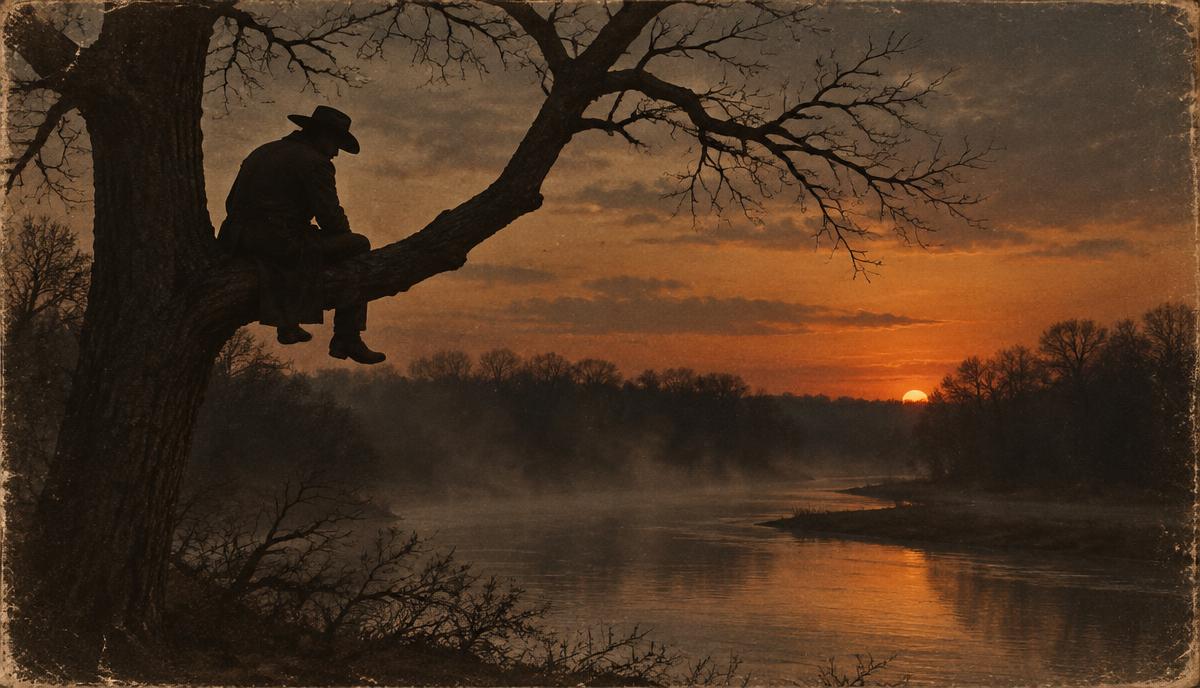
The Cowboy in the Tree
A river treeline, Texas · At dusk, on an ordinary evening · 7 min read
Told by A.J. and his wife, from their own patio
There is a particular hour on a river property that people who live near water learn to recognize. The heat lets go. The cicadas hand off to the frogs. The sky over the treeline keeps its color for a few minutes longer than the ground does, so the trees stop being trees and become a single black shape with the river behind it. That is the hour this happened in.
We were on the patio, the way we are most evenings — chairs turned out toward the yard, the treeline maybe a hundred feet off, the river below it where you can hear it more than see it. Nothing about the evening was set up for a story. There was no wind to speak of. No one else was outside. The kind of quiet where you can hear a truck cross a bridge a half mile away.
My wife went still first. Not startled — just stopped, the way you do when your eye catches something out of order and your body wants to check it before your mouth does. Then she said, plainly, the way you'd mention a deer: there's a man in that tree.
He was sitting on a heavy limb, high enough that he'd have had to climb with intent to get there. Legs down, one boot hanging lower than the other. Shoulders rolled forward, elbows on his knees. And the hat — that was the detail she said first and kept coming back to, because a hat brim is a shape you don't mistake at dusk. Not a ball cap. Not a hood. A cowboy hat, with the crease in it, the brim cutting a clean line against what was left of the sky.
He was looking down at the river. Not at the house. Not at us, sitting lit up in our chairs with our drinks on the table. Down, at the water, with the patience of a man who has been assigned a stretch of bank and is working it.
I looked where she was pointing. I want to be careful here, because this is where honest accounts usually get improved and I would rather this one stay ordinary. I saw a shape on the limb. I saw the hat. I did not see a face, and I could not tell you the color of anything he wore, because at that hour everything at the treeline is one color. What I can tell you is that the shape had weight to it. It sat the way a person sits, with the small asymmetries a person has, and not the way a snag or a broken branch hangs.
We did what everyone does. We said what are you looking at to each other about four times. We stood up. One of us went in for a flashlight, which is the single worst thing you can do, because the moment you throw a beam at a treeline at dusk you trade the whole soft picture for a bright circle and a lot of black around it. By the time the light was on the tree there was nothing on the limb but the limb.
In the morning we walked down there, because you do. The limb was real, and it was the right limb — the shape of it matched, thick and nearly level, running out over the drop toward the bank. It was also a good deal higher than either of us had judged from the patio. There was no ladder mark in the dirt, no boot scuff on the trunk, no place where a person climbing would have grabbed and pulled bark loose. The ground under it was undisturbed. Whoever had been sitting there had not gotten there the ordinary way, and had not come down the ordinary way either.
The rational explanations came in the order they always do, and I have kept every one of them. It could have been a trick of a broken branch and low light — pareidolia, the same instinct that finds faces in bark and lets you see a rabbit in a cloud. It could have been someone real, a trespasser with a strange idea of a fishing spot, who climbed while we weren't watching and slipped off through the brush while I was hunting up a flashlight in a kitchen drawer. It could have been a shadow of something in front of something else. All of that fits, and I am not going to pretend it doesn't.
But here is what doesn't quite settle. My wife described the posture before she described the hat, and she described the direction of his attention before either. She didn't say there's something in the tree. She said there's a man, and he's looking at the river. People who are inventing a figure out of branches invent a figure looking back at them. Whatever she saw had somewhere else to be.
The river has been there a great deal longer than the house has. Cattle used to be moved across water like that at the low crossings, and men used to sit above the bank to watch stock come through, to count, to wait for someone who was late. That is not evidence. It is only the sort of thing you find yourself thinking about at dusk, once you have seen a hat brim where no hat brim should be, and once you have walked down the next morning and found the limb exactly where you left it and nothing else at all.
We still sit out there. The chairs still face the treeline, because that is the good view and we are not going to give it up. Most evenings the trees are only trees. But both of us look at that limb first now, before the river, before the sky — every single time, without discussing it, the way you check a door you know you locked.
“He wasn't watching us. That was the part that stayed with me — whatever he was waiting on, it was down in the water.”