The Old Anthology
Classic Ghost Stories
Before films, ghost stories were furniture: something you kept in the house and brought out when the nights turned. The classic form is short, spoken, and built to survive retelling — which is why the best of them travel from county to county changing only the names.
The short answer
A classic ghost story is a short spoken-tradition tale — usually under 1,500 words — with a simple premise, a single supernatural turn and a final line that lands like a door closing. The three below are original but built to that pattern, and each takes four to five minutes to read aloud.
Key points
- Keep it short: the classic form runs five minutes aloud, no more.
- One supernatural element only. Two dilutes both.
- Name real, plain things — a coat, a bell, a bicycle — so the impossible thing has something to stand next to.
- Deliver the last line flatly. Never explain it afterwards.
- Read by one light source, and stop talking when you finish.
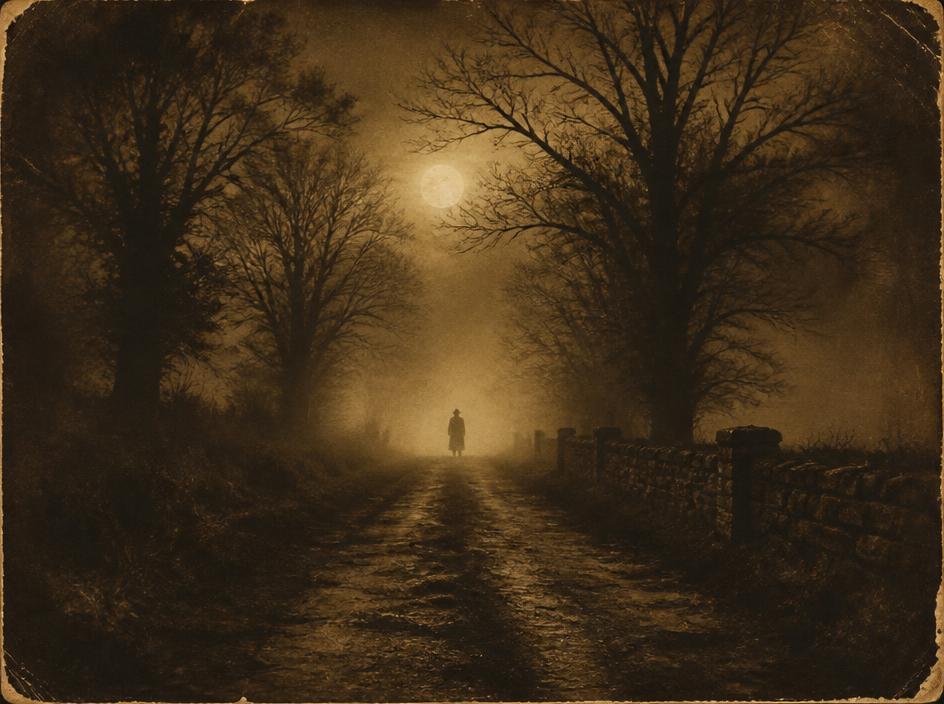
Yorkshire, told since 1900 · 4 min read
The Coat on the Milestone
A driver keeps passing the same folded coat on the same stone, mile after mile.
The road over Fell Head runs eleven miles between villages with nothing on it but weather and milestones, and every driver who has taken it late has a version of this story. This is the version I was told by a man who drove a delivery van on that route for nineteen years, and who told it without any pleasure at all.
At the third milestone he saw a coat. A good wool coat, dark, folded once and laid across the top of the stone, the way a man folds a coat when he means to come straight back for it. He noted it, as drivers note things, and drove on.
At the fifth milestone there was a coat. The same coat, folded the same way. He slowed, and looked, and told himself that hill farmers leave things at markers, and that two coats on eleven miles of road is a coincidence and nothing else.
At the seventh there was a coat. At the ninth there was a coat, and this time the fog had come in and he could see it only at the last moment, close enough to make out a button hanging by a thread. He did not stop. He said afterward that stopping had felt, in the moment, like agreeing to something.
At the eleventh milestone, at the edge of the village, there was no coat. There was a man standing with his back to the road and his arms held slightly out from his sides, the way a man stands when he is cold and waiting to be dressed.
The driver went the long way round for nineteen years after that — forty minutes extra, in all weathers, at his own expense. When people asked why, he said the Fell Head road was hard on tyres.
Told at the reservoir since 1936 · 5 min read
The Bell Under Cauldwell Water
The village was flooded for a reservoir. The church bell was left behind, and it still keeps time.
When they dammed the Cauldwell valley in 1936 they moved the graves, the schoolhouse benches and the war memorial, and they left the church. There was no money to take it down and no reason to, they said, since it would be under sixty feet of water by August. They took the pews. They did not take the bell.
The reservoir keeper's cottage stands on the north bank, and the keepers have kept a logbook since the first year. The entries are dull: rainfall, levels, weed. But in most years, in the low water of a dry September, there is one line in a different hand, and it always says some version of the same thing — *bell heard, 6 p.m., three strokes.*
Three strokes, not six. The Cauldwell bell rang the hour, and it also rang three strokes at evening for the walk home: a signal for anyone out on the fell that the light was going and it was time to turn back. It is that signal, and only that signal, that the water gives back.
In 1978 a diving club went down to photograph the tower. They found it standing, the roof gone, the bell still in the frame with silt to the lip of it and no clapper — the clapper had been sold with the scrap in 1936, which is a matter of record, with a receipt.
The club surfaced at ten past six. Every one of the six divers reported hearing the three strokes while they were in the water, and all six agreed the sound had come from above them, from the direction of the bank, as though somebody standing on the shore in the last of the light were calling them in.
The keeper's log for that day reads: *Divers up, all well. Bell heard, 6 p.m., three strokes. Nothing further.* It is the only entry that year in that hand.
Kent, 1954 · 5 min read
The Late Post
A returned letter arrives forty years after it was sent, and it is answered.
The sorting office at Marden turned up a mailbag in 1954 behind a partition wall, a canvas bag of eighty-one letters posted in the autumn of 1914 and never delivered. It was a small story in the papers at the time. The Post Office did the decent thing and delivered them, forty years late, to whatever address still existed.
Most went to strangers. A few went to the children of the dead, which was hard but manageable. One went to Mrs. Ada Prentice of Sheepshank Lane, who was eighty-nine and who had been nineteen when the letter was written, and who received it from the postman on a Tuesday morning and sat down on her front step with it unopened for the better part of an hour.
It was from a boy named Walter, and it said what such letters say: that he was well, that the food was poor, that he had thought of her when the birds went over, and that she was not to worry because he would be back before the leaves were down. He had been dead since the November of that same year.
Ada Prentice wrote a reply. Her niece told me this and thought it a sweet, sad, harmless thing — an old woman answering a boy across forty years, four pages of it, everything that had happened since. She addressed it in the old way, to his unit, and she posted it in the pillar box at the end of Sheepshank Lane because that is where she had posted all the others.
It was not returned. That is the whole of the strangeness, and it is enough. A letter to a dead soldier's dead unit, addressed to an army that no longer existed, put into the general post — and it did not come back marked, and it did not come back at all, and the Post Office, when asked, could find no record of it ever having been collected.
Ada died the following spring. Among her things was a single sheet in a hand her niece did not recognise, folded twice, and it said only: *Received. All quiet here. Don't wait up.*
Frequently Asked Questions
- What counts as a classic ghost story?
- A short tale in the spoken tradition: one supernatural turn, plain everyday detail around it, and a closing line that is not explained. Length matters — classics run four to five minutes aloud because they were built to be told, not read.
- How do you tell a ghost story well on Halloween?
- Learn the shape rather than the words, use one light source, keep your voice level, and slow down for the last three sentences. Deliver the final line flatly and then stop talking — the silence afterwards is part of the story.
- How long should a ghost story be?
- Around 700 to 1,200 words, or four to five minutes aloud. Anything longer loses a listening audience; anything shorter usually skips the ordinary detail that makes the ending land.
- Where can I find more stories like these?
- Our library holds original tales in the same tradition — local hauntings, urban legends and supernatural creatures — and the Victorian and haunted house collections on this site are written to the same standard.
- What are the best classic ghost stories for Halloween?
- The strongest classics are short, spoken and end with a single unforgettable image. 'The Coat on the Milestone,' 'The Bell Under Cauldwell Water' and 'The Late Post' above are written to that pattern, and each can be read aloud in under five minutes.
- What is the oldest ghost story tradition?
- Every culture has tales of the returning dead, but the English-language classic ghost story took its modern shape in the 19th-century magazine and Christmas annual, when writers like Dickens, Le Fanu and M. R. James turned oral fireside tales into short, printable fiction.