The Almanac
Halloween Traditions & Their Origins
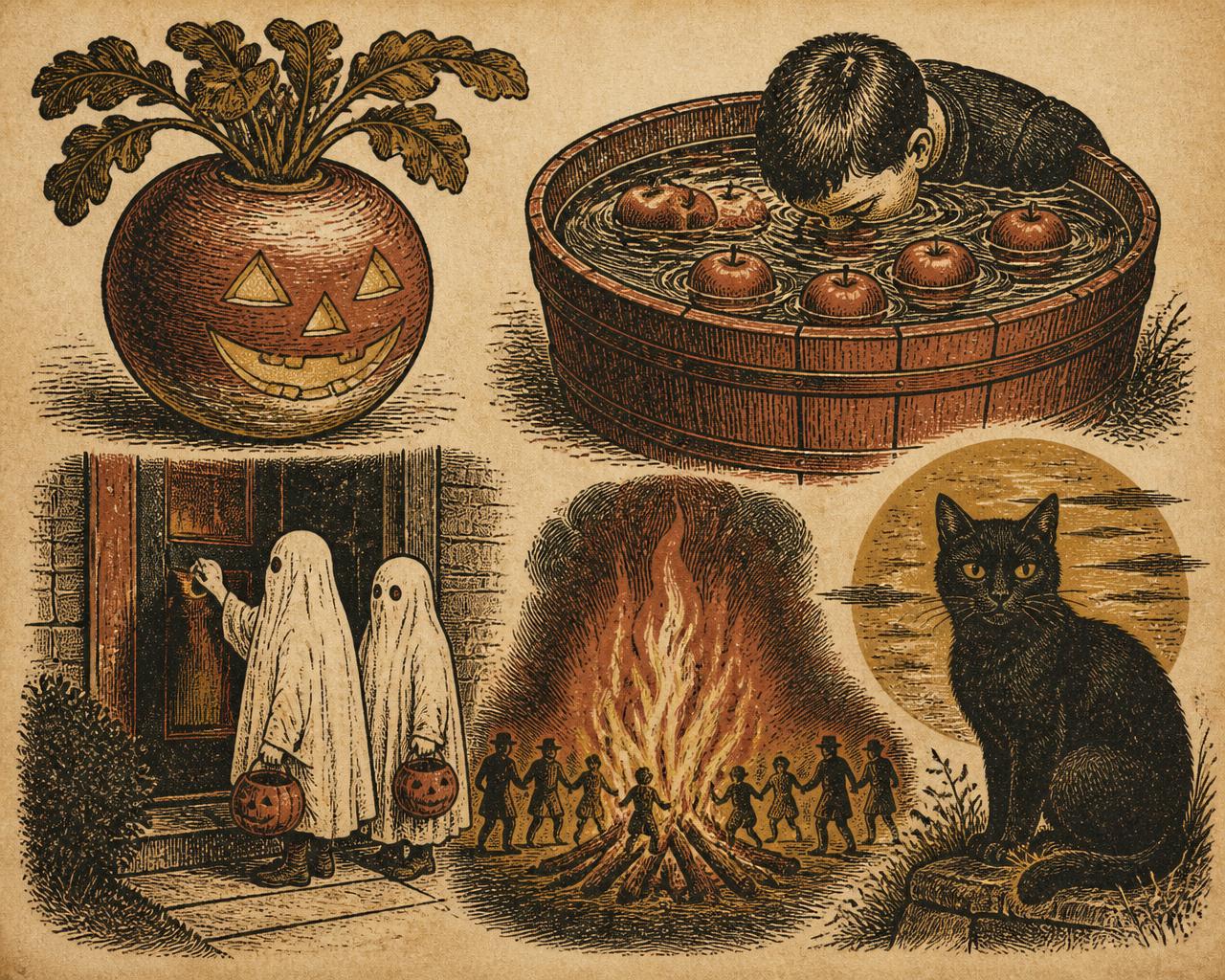
Almost everything done on the thirty-first of October is older than the country it is now most popular in. The bonfires are Iron Age, the lanterns were carved from turnips, the door-to-door begging was for soul cakes, and the apple games were fortune-telling before they were party filler. Here is where each tradition comes from and how to keep it properly.
The short answer
Halloween traditions descend from the Gaelic festival of Samhain (31 October to 1 November), which marked the end of harvest and a night when the boundary with the otherworld thinned. Christian All Hallows' Eve absorbed it, medieval souling became trick-or-treating, carved turnip lanterns became jack-o'-lanterns in America, and Irish and Scottish emigrants carried the whole bundle across the Atlantic in the nineteenth century, where it grew into the modern American holiday.
Key points
- Samhain, marked at sunset on 31 October, is the direct ancestor of Halloween.
- Costumes began as guising and mumming — disguise to avoid or impersonate wandering spirits.
- Trick-or-treating grew out of souling and guising: a rhyme, song or trick performed in exchange for food.
- The first jack-o'-lanterns were carved turnips and beets; pumpkins were an American substitution.
- Apple bobbing and nut roasting were divination games about marriage, not children's amusements.
- American Halloween as we know it took shape between the 1840s Irish emigration and the 1950s candy boom.
Where Halloween Came From
Three layers stack on top of each other: a Gaelic seasonal festival, a Christian feast placed on the same days, and a nineteenth-century American reinvention.
Samhain, the Gaelic Original
A harvest-end festival in Ireland, Scotland and the Isle of Man, reckoned from sunset on 31 October to sunset on 1 November.
At a glance
- A bonfire or hearth fire
- The last of the harvest
- A dish set aside for the dead
Mark the turn of the year at sunset, not midnight — the Gaelic day began at dusk.
Light one communal fire; households traditionally relit their own hearths from it.
Bring the herds in and finish the harvest; anything left in the field after Samhain was considered spoiled or spoken for.
Lay a place at the table or leave food outside for the dead and the aos sí who were thought to travel that night.
Tell the year's stories around the fire — the oral tradition is the part most easily kept today.
All Hallows' Eve and Souling
By the eighth century the Church had fixed All Saints' Day on 1 November and All Souls' on 2 November, making 31 October All Hallows' Eve.
At a glance
- Soul cakes (spiced, currant-topped small buns)
- A rhyme or prayer to offer at the door
Bake soul cakes — small spiced buns marked with a cross, given out on All Hallows' Eve and All Souls' Day.
Understand the exchange: the poor and children went 'souling' door to door, offering prayers for the household's dead in return for a cake.
Note the ringing of church bells for the departed, which survives in some English parishes.
Recognize the shape of trick-or-treating here — a performance at the door, then food.
How It Became American
Mass Irish and Scottish emigration in the 1840s carried Halloween into North America, where it was reworked into a neighborhood holiday.
At a glance
- A neighborhood
- Pumpkins
- Store-bought candy
Trace the arrival to the Great Famine emigration of the 1840s and after, when guising and lantern-carving crossed the Atlantic.
Note the substitution: American field pumpkins were larger and easier to carve than turnips, and became the standard by the late 1800s.
Watch the 1920s–1930s vandalism problem push communities toward organized parties and supervised trick-or-treating.
Follow the 1950s: suburban growth plus mass-produced wrapped candy turned trick-or-treating into the near-universal custom it is now.
The Individual Customs, and How to Keep Them
Each of these has a traceable origin and a simple, faithful modern version.
Turnip Lanterns and Jack-o'-Lanterns
Carved-vegetable lanterns were carried as protection and as a joke, tied to the Irish tale of Stingy Jack.
At a glance
- A large turnip, swede or rutabaga (or a pumpkin)
- A sturdy spoon and a small knife
- A tealight or LED candle
- String for a carry handle
Cut the top from a turnip and hollow it out with a spoon — it is far harder work than a pumpkin, which is exactly why pumpkins won.
Carve a simple grotesque face; turnip lanterns were meant to be ugly enough to turn away wandering spirits.
Pierce two holes near the rim and thread string through for a handle.
Light it after dark and set it on a step or windowsill, or carry it on a walk around the block.
Guising, Mumming and Trick-or-Treating
Disguise plus a performance is the older form; 'trick or treat' as a phrase is a twentieth-century North American arrival.
At a glance
- A homemade disguise
- A rhyme, song, joke or short trick
- A basket or pail
Disguise the face — the original point was not to be recognized by whatever was abroad that night.
Prepare a performance: guisers were expected to earn the treat with a song, a rhyme or a joke.
Go door to door in the neighborhood after dark, in a group, with a lit lantern.
Give as well as receive: keep a bowl by the door and answer every knock, which is the household half of the tradition.
Apple Bobbing, Nut Roasting and Fortune Games
Samhain was the great night for divination, and most Halloween party games are fortune-telling with the fortune forgotten.
At a glance
- A wide tub of water and unbruised apples
- Hazelnuts or chestnuts
- An apple, a knife and a candle for peel-throwing
Bob for apples: the first to catch one with the teeth was said to be the first to marry.
Peel an apple in one unbroken strip, throw it over the left shoulder and read the letter it forms as a future sweetheart's initial.
Set two named hazelnuts by the fire: if they roast quietly the match is good, if one jumps away it is not.
Play snap-apple — an apple hung on a string, hands behind the back — for the same fortune as bobbing, with less water on the floor.
Barmbrack, Colcannon and Feast-Night Food
Halloween food was harvest food, often with a token baked in to tell a fortune.
At a glance
- Barmbrack (a fruited tea loaf) or colcannon
- A ring, a coin, a thimble and a rag, wrapped in parchment
Bake barmbrack and hide wrapped tokens inside: the ring means marriage, the coin wealth, the thimble spinsterhood, the rag misfortune.
Serve colcannon — potato with kale or cabbage — with a small hidden coin, an Irish Halloween staple.
Set aside a portion for the dead, or simply an empty place at the table.
Warn guests before they bite; wrapped tokens are for adults and older children only.
Keeping the Traditions Today
A faithful modern Halloween needs fire, disguise, food and a story — the decorations are optional.
At a glance
- Candles or a fire pit
- Handmade costumes
- One dish with a token or fortune
- A book of local ghost stories
Light something real, even if it is only candles in the windows.
Make rather than buy at least one costume element, which is how costumes worked before 1950.
Read or tell one story aloud after dark — the oldest and cheapest tradition on the list.
Answer the door yourself, generously, and end the evening by putting the fire out together.
Frequently Asked Questions
- What are the origins of Halloween traditions?
- They descend chiefly from the Gaelic festival of Samhain, marked from sunset on 31 October, which combined harvest-end rites, bonfires, disguise and divination. The Christian feasts of All Saints' and All Souls' were placed on 1 and 2 November, making 31 October All Hallows' Eve, and medieval souling added door-to-door begging for cakes in exchange for prayers.
- Is Halloween an American tradition?
- No — its roots are Irish, Scottish and Manx. But the modern form is American: pumpkins replaced turnips, the phrase 'trick or treat' appeared in North America in the 1920s–30s, and suburban trick-or-treating with wrapped candy became standard in the 1950s. That American version is now exported back worldwide.
- Why do we carve pumpkins for Halloween?
- Because lanterns carved from turnips, swedes and beets were carried in Ireland and Scotland to ward off wandering spirits, and tied to the folk tale of Stingy Jack. Emigrants to North America found pumpkins larger, softer and far easier to hollow out, so pumpkins replaced turnips by the end of the nineteenth century.
- Why do people wear costumes on Halloween?
- Guising and mumming were meant to disguise the wearer from spirits abroad on Samhain night, or to impersonate them. The disguise came with a duty: guisers performed a song, rhyme or joke at each door in exchange for food, which is the direct ancestor of trick-or-treating.
- Where did trick-or-treating come from?
- From two older customs: souling, in which the poor and children went door to door offering prayers for a household's dead in return for soul cakes, and Scottish and Irish guising, where a costumed performance earned a treat. The American phrase 'trick or treat' is recorded from the late 1920s and spread widely in the 1930s and 1940s.
- What is bobbing for apples really about?
- Marriage divination. On Samhain and Halloween the apple games were fortunes: the first to catch an apple in the teeth would be the first to wed, and a peel thrown over the shoulder was read as the initial of a future sweetheart.
- What date is Halloween and why that date?
- 31 October. Samhain was reckoned from sunset on 31 October to sunset on 1 November, and the Church's All Saints' Day on 1 November made the preceding evening All Hallows' Eve — contracted over time to Hallowe'en.