The Costume Trunk
Vintage Halloween Costumes
Before rubber masks and polyester jumpsuits, Halloween costumes were made at the kitchen table out of crepe paper, cardboard, shoe polish and whatever hung in the closet. That is exactly why the old looks still work: they are cheap, they photograph beautifully in low light, and nobody else at the party will be wearing one.
The short answer
The most authentic vintage Halloween costumes are the homemade ones: a crepe-paper witch, a bedsheet ghost with cut eyeholes, a cardboard animal mask, a 1920s flapper, a 1940s pin-up or land-girl, or a 1950s greaser or poodle-skirt look. Build each from thrifted clothing plus one strong handmade element, and keep the palette to cream, black, rust and copper so it reads period rather than costume-shop.
Key points
- Pick a decade first — 1920s, 1930s, 1940s or 1950s — then build the whole outfit inside that decade's silhouette.
- One handmade element (mask, hat, collar) carries the costume; the rest can be thrifted street clothes.
- Crepe paper, cardboard, muslin and shoe polish are the four historically correct materials, and all four are inexpensive.
- Mute the colors. Antique orange, cream, rust and black photograph as vintage; neon reads as modern.
- Age new fabric with strong tea, and dull plastic with a wash of watered-down brown paint.
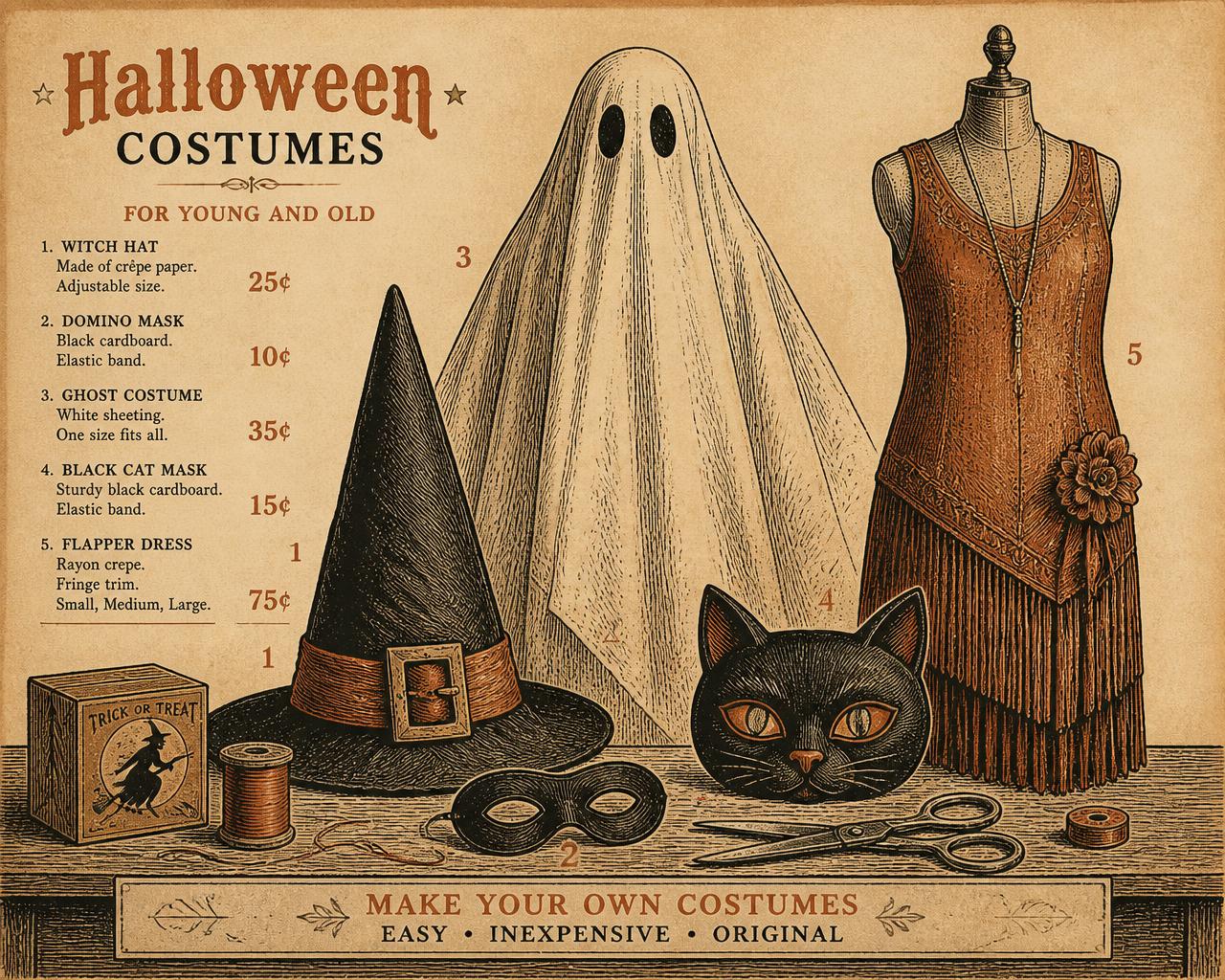
Costumes by Decade
Four looks, one per decade, each described the way a 1930s pattern envelope would have described it: what to gather and what to do.
1920s Flapper or Domino-Mask Reveler
The masquerade era. A dropped-waist dress, a beaded headband and a simple black domino mask are all it takes.
What you need
- Straight, dropped-waist dress in cream, black or rust
- Beaded or ribbon headband, plus one feather
- Long faux-pearl rope
- Black cardstock and thin elastic for a domino mask
- T-strap shoes or plain flats
How to do it
- Choose a shift dress with no waist definition — the 1920s silhouette is a straight column, not an hourglass.
- Add fringe by stitching or hot-gluing two rows of fringe trim across the hip and hem.
- Cut a domino mask from black cardstock: a shallow figure-eight covering the eyes and nose bridge, then punch holes and thread elastic.
- Wrap the headband low across the forehead, just above the brows, and tuck one feather at the side.
- Finish with a long pearl rope knotted once at chest height and a deep matte lip.
1930s Crepe-Paper Witch
The classic dime-store witch, made the original way — out of crepe paper over a plain black base.
What you need
- Black crepe paper streamers or folds
- Black poster board for the hat cone
- Plain black dress or skirt and blouse
- Hot glue, tape and a stapler
- Twine and a few dry twigs for the broom
How to do it
- Roll the poster board into a cone that sits on the crown of your head, trim the base flat and staple it.
- Cut a circle brim with a head-sized hole, tab the inner edge, and glue the tabs inside the cone.
- Cover hat and brim in overlapping strips of black crepe paper for the soft, matte 1930s texture.
- Glue layered crepe ruffles along the hem and cuffs of the black dress so it moves raggedly.
- Bind twigs to a broom handle with twine, and keep makeup simple: dark brow, hollowed cheek, nothing green.
1940s Bedsheet Ghost or Land Girl
Wartime Halloween was thrifty. Two directions: the pure bedsheet ghost, or a practical 1940s working look.
What you need
- Old cream or ecru cotton sheet
- Strong black tea for aging
- High-waisted trousers or an A-line skirt
- Headscarf tied in a front knot
- Red lipstick and a cardigan
How to do it
- For the ghost, soak the sheet in strong cooled tea for an hour and line-dry it so the white goes bone-colored.
- Drape it over your head, mark the eyeholes with chalk while a helper checks the height, then cut ovals — not circles.
- Trim the hem to just above the floor so you can walk, and singe or fray the edge for age.
- For the land-girl look, pair high-waisted trousers with a tucked blouse, cardigan and a front-knotted headscarf.
- Add victory-roll hair and a strong red lip; the silhouette does the period work, so keep accessories plain.
1950s Greaser, Poodle Skirt or Cardboard Animal Mask
The most thriftable decade — nearly every piece still exists in secondhand shops.
What you need
- White tee and dark denim, or a felt circle skirt
- Leather or denim jacket
- Neck scarf and cat-eye sunglasses
- Corrugated cardboard, craft paint and elastic
- Saddle shoes or plain sneakers
How to do it
- For the greaser: cuff the jeans twice, tuck the tee, and comb hair back with pomade.
- For the poodle skirt: cut a felt circle skirt, appliqué a simple poodle or cat shape, and add a wide belt.
- For the mask, cut a cat or owl face from corrugated cardboard slightly wider than your face.
- Paint it in flat black, rust and cream, let it dry, then rub a little brown paint into the edges to age it.
- Punch holes at the temples and thread elastic; wear the mask pushed up on the forehead between photographs.
Making New Things Look Old
The difference between a retro costume and a period one is surface. Three quick treatments do most of the work.
Aging Fabric, Cardboard and Plastic
Twenty minutes of treatment turns craft-store material into something that looks pulled from a trunk.
What you need
- Six black tea bags and a basin
- Watered-down brown acrylic paint
- Fine sandpaper
- Old rag or sponge
How to do it
- Steep six tea bags in hot water, cool it, then soak white fabric for 30–60 minutes and dry it in sunlight.
- For cardboard and plastic, brush on watered-down brown paint and wipe most of it off with a rag, leaving it in the crevices.
- Sand raised edges lightly so the base color shows through where a real costume would have worn.
- Skip glitter and gloss entirely — matte surfaces are what read as pre-1960.
Frequently Asked Questions
- What is a good vintage Halloween costume you can make at home?
- A crepe-paper witch, a tea-aged bedsheet ghost or a 1920s flapper with a black domino mask. Each needs one handmade element and otherwise uses clothing you already own, and all three are historically accurate to Halloween between 1920 and 1950.
- What did Halloween costumes look like in the 1920s and 1930s?
- They were homemade from crepe paper, cardboard and muslin, and leaned on masquerade imagery: witches, cats, devils, skeletons, clowns and domino-masked revelers. Colors were muted — black, cream, rust and antique orange — because dyes and printing of the era produced softer tones.
- How do you make a retro Halloween costume without sewing?
- Use hot glue, staples and safety pins. Crepe-paper ruffles glue directly onto a plain dress, cardboard masks need only elastic and a hole punch, and a bedsheet ghost requires nothing but scissors.
- Where can you find vintage-looking costume pieces cheaply?
- Thrift stores for silhouettes (shift dresses, high-waisted trousers, circle skirts, cardigans, leather jackets), craft shops for crepe paper and felt, and your own kitchen for tea-dyeing. Most complete looks come in well under the price of a packaged costume.
- What colors make a costume look vintage?
- Antique orange, rust, copper, cream, ochre and true black. Avoid neon green and purple, which are modern Halloween colors and instantly date a photograph to the present.