The Cat Almanac
Halloween Cats: Black Cats, Orange Cats & Their History
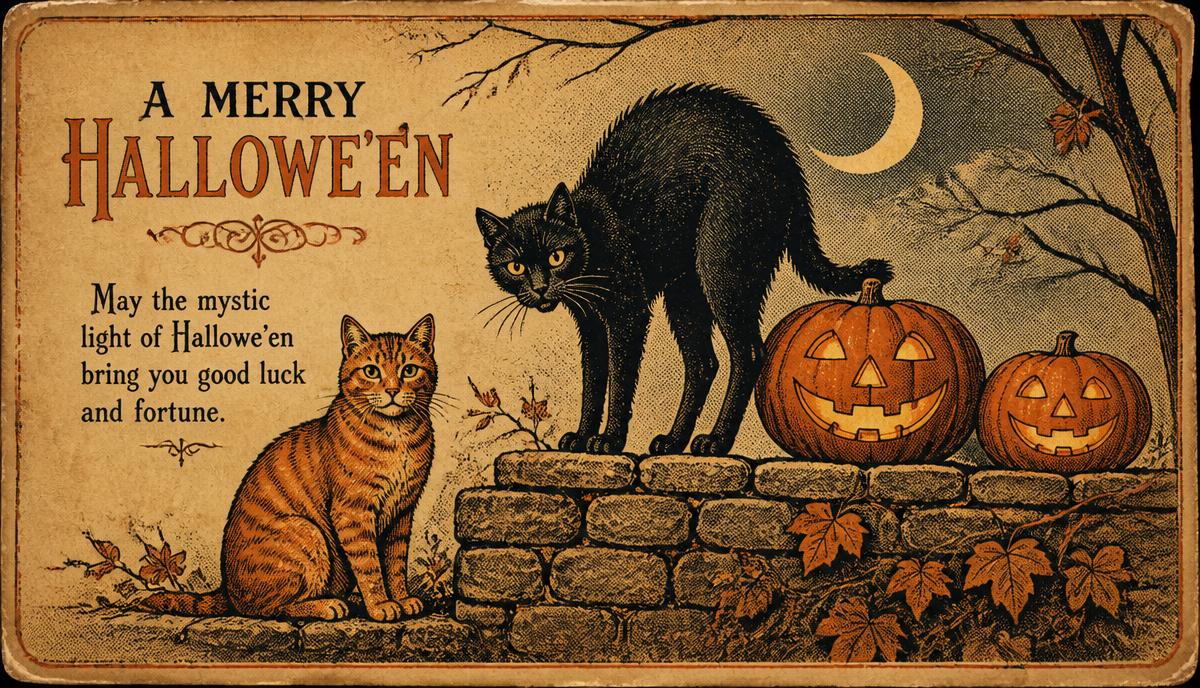
No animal is bound to Halloween the way the cat is. The arched black cat on a stone wall is as fixed an emblem as the jack-o'-lantern, and it got there by a long, strange road: harvest festivals, witch trials, Victorian printing presses and a century of candy advertising. Here is where the cat came from, what the colors are supposed to mean, and how to look after the real animal on the loudest night of the year.
The short answer
Cats became Halloween symbols because medieval and early-modern Europe tied them to witchcraft — a cat was believed to be a witch's familiar or the witch herself in another shape — and because cats were sacred night animals in the Celtic Samhain tradition that Halloween grew out of. Victorian and early-1900s Halloween postcards then printed the black cat beside the pumpkin thousands of times and fixed the pairing permanently. Orange cats carry luck and hearth-fire symbolism rather than dread, which is why vintage cards often place a tabby next to the black cat.
Key points
- The cat–witch link is medieval European, not Celtic: it hardens after the 1200s and peaks during the witch trials.
- Samhain lore already treated cats as night creatures that crossed between worlds, which made the later association easy.
- Black cats are unlucky in Britain's later folklore and in the US, but lucky in Scotland, Japan and much of sailing tradition.
- Orange and ginger cats read as hearth, harvest and good fortune — the friendly counterweight on vintage Halloween cards.
- The 'black cats are adopted less / harmed at Halloween' claims are largely myth; shelters adopt out black cats at normal rates.
- Real Halloween risk to cats is doors, traffic, chocolate, candy wrappers, lilies and open flames — not folklore.
How Cats Became Halloween Animals
The cat arrives at Halloween by three separate routes that eventually merge: an old harvest festival, a long religious panic, and a printing boom. Each one left a mark you can still see on a Halloween card.
Samhain and the Boundary-Crossing Animal
Halloween descends from Samhain, the Gaelic festival marking the end of harvest and the start of winter, when the boundary between the living and the dead was believed to thin. Cats were already the classic threshold animal — awake at night, silent, indoors and outdoors at will.
At a glance
- Gaelic Samhain tradition (Ireland, Scotland, Isle of Man)
- Folk belief in a thinning boundary on the last night of harvest
- The cat as a nocturnal, half-domestic animal
Samhain is kept on the night of October 31 into November 1, when livestock came in and the dark half of the year began.
Because the dead were thought to travel that night, animals that moved easily in the dark were watched closely and read as omens.
Irish and Scottish tales give cats uncanny standing — the Cat Sìth, a large black cat with a white breast spot, was said to take the souls of the unburied dead and had to be distracted with music and riddles at a wake.
None of this makes the cat evil yet; it makes the cat a creature that goes where people cannot, which is exactly the role Halloween needs.
The Witch's Familiar
The dread comes later, from medieval and early-modern Europe, where the cat is recast from omen to accomplice. This is the single biggest reason a black cat sits on the Halloween card.
At a glance
- Thirteenth-century church rhetoric against heretical sects
- English and Scottish witch-trial records, 1500s–1600s
- Colonial New England trial testimony
From the 1200s onward, church polemic increasingly associated cats — black ones especially — with heresy and the devil, and cats were killed in numbers during periods of religious panic.
English witch trials introduced the 'familiar': a small animal, most often a cat, said to serve a witch and to be fed by her in exchange for harm done to neighbours.
Testimony frequently claimed a witch could take a cat's shape to travel unseen, which is why so many later illustrations show the witch and the cat as a matched pair.
Colonial New England inherited the whole framework, and it survived the trials as harmless superstition — a black cat crossing your path retained the flavour of bad luck long after anyone believed the theology behind it.
The Postcard That Fixed the Image
Halloween's visual language was largely standardised between roughly 1900 and 1920 by cheap colour-printed greeting postcards, and the black cat was one of its four or five stock characters.
At a glance
- Golden-age Halloween postcards, c. 1905–1920
- Chromolithography and halftone colour printing
- American Halloween party culture of the same period
Publishers needed instantly readable Halloween emblems, and settled on the jack-o'-lantern, the witch, the owl, the bat and the cat.
The cat was drawn in a fixed pose — back arched, tail up, fur spiked, eyes yellow — because it printed clearly as a silhouette at small size.
Cards paired the black cat with a smiling pumpkin to soften it, and often added a ginger or tabby cat as the friendly figure in the scene.
Millions of these cards circulated in a single generation, which is how a medieval witchcraft accusation turned into decorative seasonal shorthand.
Black Cats, Orange Cats and What the Colours Mean
Coat colour carries most of the folklore, and it contradicts itself constantly from one country to the next. The short version: black is ominous in some places and lucky in others, and orange is almost always warm.
Black Cats: Unlucky, Lucky, or Neither
Black cat superstition is regional, not universal. The same animal that means a bad day in Boston means a good marriage in Yorkshire and a safe voyage on a sailing ship.
At a glance
- British and American 'crossing your path' superstition
- Scottish, Welsh and Japanese good-fortune traditions
- Maritime and theatre folklore
In much of England and in the US, a black cat crossing your path is read as bad luck — the direct residue of the witch-familiar era.
In Scotland, a strange black cat arriving at the house is a sign of coming prosperity, and in parts of England a black cat is a lucky wedding gift for the bride.
In Japan, black cats are lucky and were thought to ward off misfortune and help single women find suitors; the beckoning maneki-neko appears in a black variant sold specifically as protective.
Sailors kept black ships' cats for luck and practical mousing, and theatre tradition treats a cat backstage as fortunate — the same colour, the opposite meaning.
Modern research does not support the popular claim that black cats are adopted far less often; large shelter datasets show black cats adopted at rates comparable to other coats, partly because more of them come through the door.
Orange Cats: Harvest, Hearth and Luck
Ginger cats sit on the friendly side of Halloween imagery: pumpkin-coloured, fire-coloured, associated with warmth and household good fortune rather than menace.
At a glance
- Harvest and hearth-fire colour symbolism
- Vintage card conventions pairing tabby and black cat
- The orange tabby's genetic quirk
Orange reads as autumn in the same visual breath as the pumpkin, so a ginger cat belongs to the season without carrying the witchcraft charge.
Folk tradition treats ginger cats as bringers of money and household luck, and in several European sayings a red cat by the fire is a sign of a prosperous house.
Illustrators exploit the contrast deliberately: the black cat supplies the threat, the orange cat supplies the welcome, and putting both in one frame makes the card feel festive instead of grim.
A genuine curiosity behind the 'orange cats are all the same' jokes: the ginger gene sits on the X chromosome, so roughly three in four orange cats are male, and nearly all calicos and tortoiseshells are female.
Tortoiseshells, Calicos and the Crazy Ones
Beyond black and orange, patched cats carry their own luck traditions — and the specific behaviour people call 'Halloween crazy' has an ordinary explanation.
At a glance
- Tortoiseshell 'money cat' tradition
- Japanese mike-neko maritime luck
- Feline evening activity patterns
Tortoiseshells are called money cats in parts of the US and are said to bring luck; folk belief also credited them with foretelling weather.
Calico cats — mike-neko in Japan — were carried on ships as protection against storms and misfortune, and Maryland made the calico its state cat because it matches the Baltimore oriole.
The wild-eyed dash around the house at dusk is normal crepuscular behaviour: cats are built to hunt at dawn and twilight, and a burst of running, pupil dilation and sideways hopping is play, not possession.
Halloween genuinely does make cats stranger for a night — doorbells, costumes and strangers trigger the same arousal, which is why the arched-back postcard pose is drawn from life.
Keeping Cats Safe on Halloween
The folklore is harmless; the night itself is not. Almost every Halloween cat emergency comes from one of four things: an open door, a bowl of candy, a naked flame, or a costume.
Set Up a Quiet Room Before Dusk
Trick-or-treating means a door opening every few minutes for hours, which is the single largest risk of a cat going missing.
At a glance
- A closable interior room away from the front door
- Litter tray, water, bed and a familiar blanket
- Collar with ID and up-to-date microchip registration
Move the cat into the room before the first knock, not after — once a cat is already agitated it will fight being carried.
Add the litter tray, water and something that smells like home, and leave a low light or a radio at conversational volume to mask the door noise.
Check that the microchip contact details are current, because a cat that slips out on Halloween may be found streets away.
Keep a cat with outdoor access indoors from late afternoon on October 31 and again on any local fireworks night.
Clear the Real Hazards
Candy, decorations and flames account for most Halloween veterinary calls involving cats.
At a glance
- Sealed candy container out of reach
- Battery tea lights instead of open flame
- Vet or emergency clinic number saved in your phone
Keep chocolate and anything sweetened with xylitol fully out of reach; both are toxic to cats, and xylitol is dangerous in very small amounts.
Bin wrappers, lollipop sticks and foil immediately — swallowed wrappers and ribbon cause intestinal blockage far more often than poisoning does.
Use LED tea lights in carved pumpkins and lanterns; a cat's tail passing over a candle is a burn and a fire risk at once.
Move lilies out of the house entirely for the season, as every part of a true lily is severely toxic to cats.
Skip glow sticks within reach, keep fake cobweb off floors and low surfaces, and secure electrical cords from light strings.
Costumes and Photographs
If you want the vintage-postcard photo, aim for a five-minute session with an escape route, not an evening in a costume.
At a glance
- A collar-style or bandana costume rather than a full body suit
- Treats the cat already likes
- Warm, indirect light and a dark backdrop
Introduce the costume days early, on the floor, with treats, so it is a known object before it goes on.
Rule out anything that covers the ears or eyes, tightens around the neck or chest, or restricts the front legs — a cat that cannot move normally will panic.
Watch for flattened ears, a low tail, freezing in place or crouching, and take it off at the first sign; those are distress, not sulking.
For the photo, place the cat beside an unlit carved pumpkin, shoot at eye level with a lamp off to one side, and stop after a few minutes whether or not you got the shot.
Frequently Asked Questions
- Why are black cats associated with Halloween?
- Because medieval and early-modern Europe linked cats to witchcraft. From the 1200s onward, church rhetoric tied black cats to the devil, and witch trials in Britain and colonial New England described cats as 'familiars' that served witches or as shapes witches took to travel unseen. Halloween itself descends from Samhain, when the boundary between living and dead was believed to thin and night animals were read as omens. American Halloween postcards printed between about 1905 and 1920 then paired the arched black cat with the jack-o'-lantern so often that the image became permanent seasonal shorthand.
- Are black cats really bad luck?
- Only in some traditions. A black cat crossing your path is considered unlucky in much of England and the United States, but in Scotland a black cat arriving at your door signals prosperity, in parts of England a black cat is a lucky wedding gift, and in Japan black cats are protective and lucky. Sailors kept black ships' cats for good fortune. There is no evidence any of it affects outcomes — the meaning is regional folklore, not a property of the animal.
- What do orange cats symbolise at Halloween?
- Warmth, harvest and luck. Orange reads as autumn and hearth-fire rather than witchcraft, and folk tradition credits ginger cats with bringing money and household good fortune. Vintage Halloween cards often place a ginger tabby beside a black cat on purpose: the black cat carries the menace, the orange cat makes the scene festive.
- Are most orange cats male?
- Yes. The gene for orange coat colour is carried on the X chromosome, so roughly 75–80% of orange cats are male. The same genetics work in reverse for patched coats: nearly all calico and tortoiseshell cats are female, because the pattern normally requires two X chromosomes.
- Do shelters stop adopting out black cats before Halloween?
- Some historically paused black cat adoptions in late October out of caution, but most no longer do. The fear rests on the belief that black cats are ritually harmed at Halloween, and there is no reliable evidence of a seasonal pattern. Large shelter datasets also contradict the related claim that black cats are adopted much less often — their adoption rates are broadly comparable to other coat colours.
- What is the Cat Sìth?
- A creature of Scottish and Irish Highland folklore: a large black cat with a white spot on its chest, said to prowl the Highlands and to be able to steal the soul of a dead person before burial. Wakes included the Fèill Fadalach, or Late Wake, where mourners kept watch with music, riddles and games to distract the Cat Sìth from the body.
- Why do cats act crazy on Halloween night?
- Cats are crepuscular, meaning they are naturally most active at dawn and dusk, so evening bursts of sprinting, wide pupils and sideways hopping are ordinary play. Halloween adds a repeatedly ringing doorbell, strangers at the door, costumes and unfamiliar sounds, which raise arousal and stress on top of that natural activity peak. The arched back and bottle-brush tail in the vintage postcards is a real defensive display drawn from life.
- How do I keep my cat safe on Halloween?
- Shut the cat in a quiet interior room with litter, water and a familiar blanket before trick-or-treaters arrive, keep outdoor cats indoors from late afternoon, and confirm the microchip details are current. Keep chocolate and xylitol-sweetened candy out of reach, bin wrappers and ribbon immediately, use LED tea lights instead of candles in carved pumpkins, and remove lilies from the house since every part of a true lily is severely toxic to cats.
- Can cats wear Halloween costumes?
- Some tolerate a collar-style costume or bandana for a few minutes; many do not tolerate anything. Avoid anything that covers the ears or eyes, tightens at the neck or chest, or restricts the front legs. Introduce it days in advance with treats, and remove it immediately if the cat freezes, crouches, flattens its ears or drops its tail.