The Gaslight Shelf
Victorian Ghost Stories
The Victorians invented the ghost story as we know it — a short, mannered, deeply unsettling thing told beside a fire at Christmas or Halloween. Their hauntings were rarely loud. They arrived as a draught under a door, a face at a window that should have shown only sky, a letter written in a hand no living person still used.
The short answer
A Victorian ghost story is a short tale from roughly 1840–1900 in which a restrained, respectable narrator encounters something quietly impossible. The horror comes from atmosphere, delay, and social propriety rather than gore. The three original tales below are written in that tradition and take about five minutes each to read aloud.
Key points
- Victorian ghost stories favour suggestion over spectacle — the reader assembles the horror themselves.
- The narrator is usually a sceptic: a solicitor, a scholar, a governess, someone whose word we are meant to trust.
- Settings are domestic — a rented house, a country parish, a railway carriage — so the intrusion feels personal.
- They were traditionally read aloud in company, which is why the sentences are long, rhythmic, and easy to perform.
- The endings withhold explanation; the unresolved detail is the point.
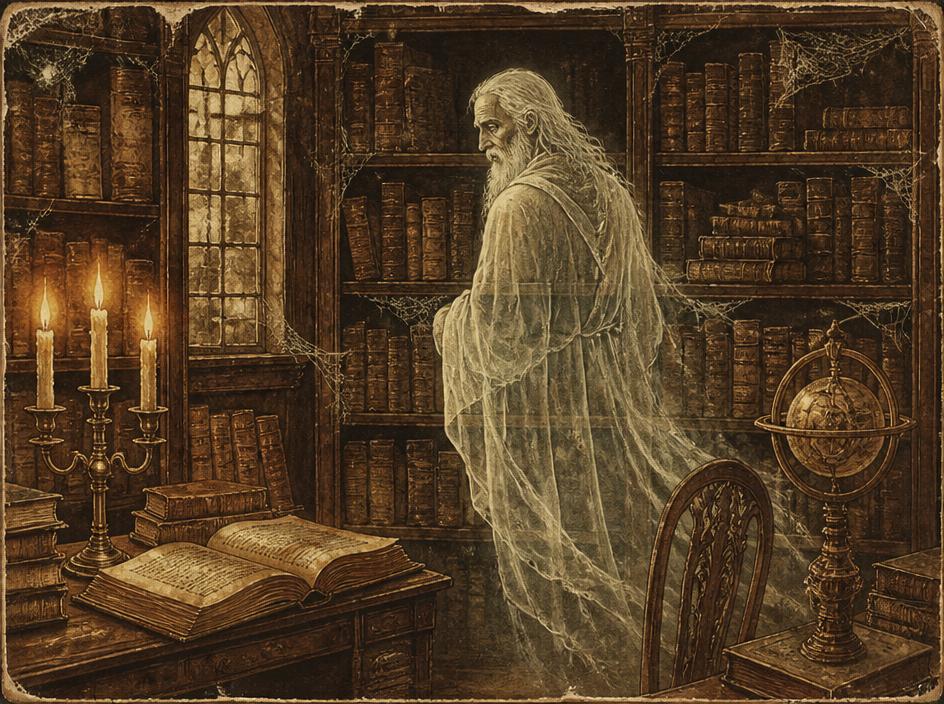
London, 1873 · 5 min read
The Lamplighter of Carrow Street
A young clerk notices that one lamp on his street is lit before the lamplighter ever reaches it.
I took lodgings in Carrow Street in the autumn of 1873, a narrow terrace of soot-darkened brick where the fog gathered early and left late. My rooms were cheap because they faced the street, and the gas lamp outside my window burned all night with a small persistent hiss, like a kettle that had forgotten its purpose.
The lamplighter came at dusk. I could set my watch by him: a stooped man with a brass-tipped pole, moving up the odd numbers and down the even, his breath showing white before him. What troubled me — and it did not trouble me at once, but slowly, the way cold gets into a house — was that the lamp outside my window was always already lit when he arrived. He would pause beneath it, lift his pole, hesitate, and pass on.
I asked my landlady about it. She was a practical woman with red hands and no patience for lodgers' fancies, and she said only that the lamp had been that way since before her time, and that I was not to speak of it after dark. When I pressed her, she left the room and did not bring my supper up that evening.
On the third Thursday of November I resolved to watch. I put out my candle and sat by the window from four o'clock, and I did not look away. The sky went from pewter to slate to nothing at all. And at the precise moment the last light left the street, the lamp came alight — not with the sudden bloom of a match, but slowly, the way a face emerges when someone leans toward you across a table.
Beneath it stood a man in a lamplighter's coat, thirty years out of fashion, with his pole already lowered. He looked up at my window. I would like to write that his face was terrible. It was not. It was patient, and tired, and entirely ordinary, and it wore the expression of a man who has been asked to do one small thing forever and has agreed to it.
I moved from Carrow Street before Christmas. I am told the lamp is electric now. I am told, too, that it comes on early — before the timer, before the dark — and that the tenants have stopped complaining, because the complaints were never answered.
Bath, 1881 · 5 min read
A Letter From the Tenant Below
A widow begins receiving polite, beautifully written notes from the empty flat beneath hers.
The first note came under my door on a Tuesday, folded twice, the paper heavy and slightly damp. It read: *Madam — I am obliged to ask that you walk less heavily after ten in the evening. The ceiling here is thinner than the landlord admits. Your servant, H. Pell.*
I had lived at Number Fourteen for six months and I knew, as anyone in the building knew, that the ground-floor flat had stood empty since the Pell family left it. The letter was courteous. The hand was very fine. I wrote a reply, because I was a widow of forty-one with few correspondents and I confess the attention pleased me, and I slipped it beneath the ground-floor door.
It was answered. Over that winter we conducted, Mr. Pell and I, a correspondence of some fifty letters. He was well read. He asked after my health during a bad February and recommended a poultice that worked. He never once suggested that we meet, and I — for reasons I could not then have explained — never once suggested it either.
In March I mentioned him to the porter, who went rather grey and asked to see the letters. He read three of them standing in my hallway with his cap in his hand, and then he told me that Henry Pell had died in the ground-floor flat in 1869, and that he had died alone, and that the neighbours upstairs at the time had complained a good deal about the noise of her footsteps.
I did not write again. For eleven nights nothing came. On the twelfth there was a single sheet under my door, and it said: *Madam — I find the silence above me very hard. I had grown used to the sound of someone living. Please walk as heavily as you like. Your servant, H. Pell.*
I have walked heavily ever since. It costs me nothing, and I have come to think that there are worse duties in this world than being a noise that comforts someone.
Norfolk, 1892 · 6 min read
The Governess at Hollow Mere
A new governess is told the children may play anywhere except the east lawn — and the children agree.
Hollow Mere was a low grey house set in flat country, with a lawn on the east side that ran down to standing water. On my first evening the housekeeper, Mrs. Aldis, gave me the rules of the place as though reciting a shopping list: dinner at seven, the blue room is damp, and the children do not go on the east lawn.
I have taught in six households and I know that such rules usually protect a fishpond or a temper. But the children — Cecily, who was nine, and Thomas, who was six — did not treat it as a rule at all. They treated it as a fact, like gravity. When I once walked them along the east border to point out a heron, Thomas took my hand and moved me back onto the gravel with the gentle firmness of a much older man.
"She counts," he said, when I asked why. "If you're on the grass when she finishes, she takes you in to be dried."
I did not ask him to explain, which I have regretted for thirty years, because the following week I saw for myself. It was near four o'clock on a still afternoon and the lawn was empty of everything but light. Then the grass moved in a line, from the water toward the house, as though something were walking through it, and the line stopped at the terrace and waited, and I heard — distinctly, in the ordinary voice of a woman counting linen — the numbers seventeen, eighteen, nineteen.
I took the children inside. Mrs. Aldis met us in the hall and asked no questions whatsoever, which frightened me more than the counting had. That night I found the nursery door propped open by Cecily, who explained that it had to be, because otherwise the counting could be heard, and Thomas could not sleep through the counting.
I stayed until Christmas, out of duty and a kind of stubbornness, and then I gave notice. Mrs. Aldis accepted it without surprise. At the door she said the only unguarded thing I ever heard her say: that the last governess had been a great walker, and had loved the east lawn, and had been very fond of the children — and that the children were still very fond of her, which was the difficulty.
Frequently Asked Questions
- What makes a ghost story Victorian?
- Victorian ghost stories were written roughly between 1840 and 1900, usually as short fiction for magazines. They rely on restraint: a credible narrator, a domestic setting, slow accumulation of wrong details, and an ending that explains very little. Blood and monsters are rare; propriety, guilt and grief do the work instead.
- Why did the Victorians read ghost stories at Christmas?
- Cheap magazine printing, long dark evenings and a culture of reading aloud in company made the winter ghost story an annual ritual. Christmas annuals commissioned them by the dozen, which is why so many famous examples were written to be performed in a parlour rather than read alone.
- Are these stories suitable to read aloud to older children?
- Yes. The tales on this page contain no gore or graphic violence — they are unsettling rather than frightening, and they run about five minutes each aloud. For younger children we'd suggest the games room instead.
- What should I read next if I like this era?
- Look for the classic authors of the form — M. R. James, Elizabeth Gaskell, Sheridan Le Fanu, Charlotte Riddell and Amelia Edwards — and then come back to our library of original tales, which are written in the same key.
- Who were the most famous Victorian ghost story writers?
- M. R. James is the best known for scholarly, winter-read tales; Elizabeth Gaskell wrote domestic hauntings; Sheridan Le Fanu brought Gothic atmosphere; and Charlotte Riddell produced dozens of magazine stories about financial ruin and haunted property.
- Why are Victorian ghost stories still popular today?
- They are short, atmospheric and easy to read aloud. Their fears — loneliness, debt, bad landlords, unwanted houseguests — still feel current, and their restraint leaves room for the reader's imagination.