The Collector's Cabinet
Vintage Halloween Collectibles: Beistle, Blow Molds & Antique Finds
Halloween has left behind more than a century of paper, pulp, tin and plastic — and almost all of it is still findable. This is a practical field guide to the four collecting families that matter most, how to tell an original from a reproduction, and what condition really does to price.
The short answer
The most collected vintage Halloween items are Beistle die-cut cardboard decorations (1920s-1960s), German composition and pulp jack-o'-lanterns (1900s-1930s), tin litho noisemakers (1920s-1950s), hard-plastic candy containers (1950s) and lighted plastic blow molds (1960s-1990s). Value comes from maker, age, condition and completeness — original color, intact tabs and working parts matter far more than rarity alone.
Key points
- Beistle of Shippensburg, Pennsylvania is the single most important name in vintage Halloween paper.
- German pulp and composition lanterns pre-date American mass production and sit at the top of the market.
- Tin litho noisemakers are the best entry point — plentiful, cheap and unmistakably vintage.
- Blow molds bridge vintage and retro collecting and are still easy to find in the wild.
- Condition, original color and completeness drive price more than scarcity.
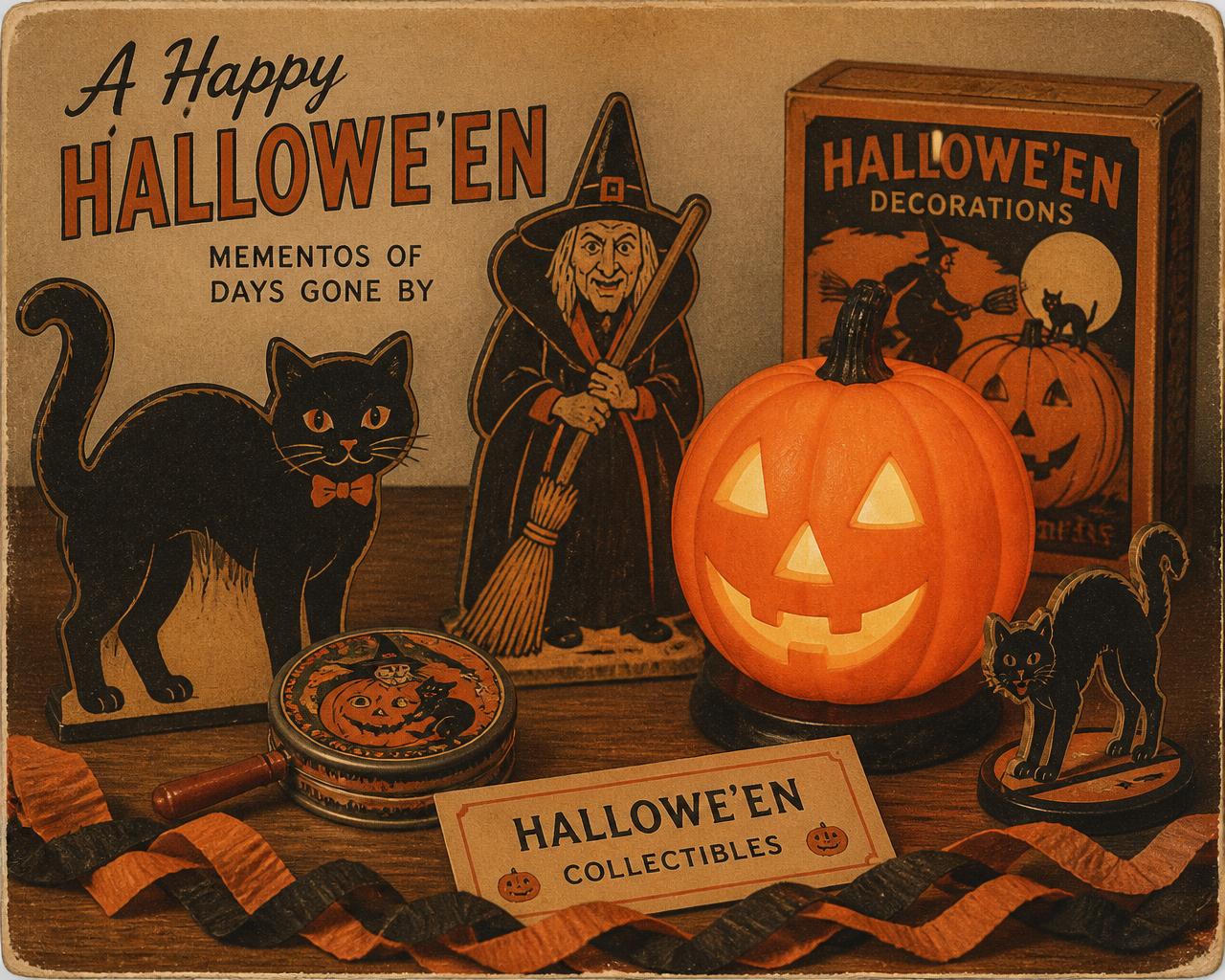
Beistle Die-Cuts and Vintage Paper
Printed paper is where most collections begin, because it was made by the million and thrown away almost as fast.
Identifying Beistle Die-Cuts
Embossed cardboard cats, witches, skeletons and owls — the defining look of American Halloween decorating.
What to look for
- A small diamond-shaped 'Bee-line' or H.E. Luhrs mark, usually low on the back or edge
- Heavy embossing you can feel with a fingertip
- Honeycomb tissue centers on fold-out pieces
- Original punched hanging holes rather than added ones
How to do it
- Check the reverse first — most originals carry a printed maker's mark, and many reproductions do not.
- Feel the emboss depth; period presses cut deeper than modern reprints.
- Look at the ink: originals fade toward warm orange and dull black, never bright modern orange.
- Date roughly by subject — 1920s pieces are grotesque and folk-like, 1950s pieces are round, smiling and child-friendly.
- Beistle still reissues classic designs, which is good news for decorating and a reason to verify before paying original prices.
Postcards, Crepe Paper and Party Ephemera
Embossed greeting postcards, crepe streamers, nut cups, invitations and paper table covers.
The categories
- Embossed Halloween postcards, roughly 1905-1920
- Dennison crepe paper and Bogie Books (party planning booklets)
- Nut cups, place cards, invitations and paper hats
- Fortune-telling and party game sheets
How to do it
- Postcards are graded on corners, gloss and postal wear; unmailed examples cost more but mailed ones carry dates.
- Dennison Bogie Books are the single best reference for what a period party actually looked like.
- Crepe paper survives poorly — unopened folds in original wrappers are the prize.
- Store all paper flat, out of sunlight, in acid-free sleeves.
- Never trim, tape or laminate anything; a repaired paper piece loses most of its value.
German Lanterns, Pulp and Tin
Before American factories took over, Halloween decorations arrived from Germany — and the noise came in printed tin.
German Composition and Pulp Jack-o'-Lanterns
Molded pulp or composition heads with paper-insert eyes, made for export in the early twentieth century.
How to identify
- Molded pressed pulp or plaster-like composition body
- Original tissue or acetate face inserts, often missing
- A wire bail handle and interior candle clip
- Hand-painted highlights over a dipped base color
How to do it
- Look inside for candle scorch and a soldered or twisted wire clip — a strong sign of period use.
- Original paper inserts multiply value; replacements are common and should be disclosed.
- Devils, cats, veggie-men and skulls command more than plain pumpkins.
- American pulp lanterns from the 1940s-50s are lighter, cruder and much more affordable entry pieces.
- Never wash pulp — dry-brush dust off and keep it out of humidity.
Tin Litho Noisemakers
Ratchets, clangers, tambourines and horns printed with cats, witches and dancing skeletons.
Best-known makers
- T. Cohn
- U.S. Metal Toy Manufacturing Company
- Kirchhof (Newark, New Jersey)
- Chein
How to do it
- Turn it over and read the maker's mark stamped in the metal or printed on the litho.
- Grade on the printing: bright, unscratched lithography is everything.
- Rust, dents and a missing wooden handle each cut the price sharply.
- Test the mechanism gently — a ratchet that still clacks is worth more than one that binds.
- Buy these first if you are new; a good noisemaker is inexpensive and instantly reads as vintage.
Hard Plastic and Blow Molds
Post-war plastic is the fastest-rising corner of the market and the easiest to find at estate sales.
1950s Hard-Plastic Candy Containers
Rosbro, Rosen and E. Rosen figures — witches on rockets, cats on pumpkins, skeletons pushing carts.
What to check
- Crisp molded detail and original painted highlights
- Intact wheels, sticks, lollipop loops and small accessories
- No stress cracks around thin arms and hat brims
How to do it
- Look for the tiny original candy loop or stick — its presence is often half the value.
- Hold the piece to light; hairline cracks in old styrene show up instantly.
- Original paint should be soft and slightly worn, not glossy and even.
- Beware modern reproductions of the popular witch-on-motorcycle figures.
- Display out of direct sun — 1950s plastic yellows and becomes brittle.
Lighted Blow Molds
Hollow plastic pumpkins, cats, ghosts and scarecrows lit by a bulb inside, 1960s through the 1990s.
Makers to know
- Empire Plastics
- General Foam Plastics
- Union Products
- Poloron
How to do it
- Read the raised maker's mark on the base to date the piece.
- Bright, unfaded color is the main value driver; chalky surfaces clean up with mild soap and water.
- Replace old light cords with a modern C7 or LED kit rather than trusting a thirty-year-old socket.
- Large figures and unusual subjects (owls, devils, witch heads) outperform plain pumpkins.
- Store upright with paper inside so the plastic does not crease or collapse.
Buying, Pricing and Care
The habits that separate a good collection from an expensive pile of damaged goods.
Where the Finds Actually Are
Estate sales and small-town antique malls still beat the online market on price.
Hunting grounds
- Estate sales, especially the last day
- Rural antique malls and group shops
- Flea markets in late summer, before Halloween stock is marked up
- Online auctions for specific gaps in a collection
How to do it
- Shop in spring and summer — Halloween material is cheapest when nobody is thinking about it.
- Ask sellers directly whether there is holiday material still boxed in the attic.
- Search misspellings and generic terms online: 'Halloween lot', 'old paper cat', 'tin ratchet'.
- Set a price ceiling per category before you go and stick to it.
- Photograph maker's marks as you learn them; a phone reference library pays for itself.
Care and Display
Vintage Halloween is paper, pulp and early plastic — all three hate light and damp.
Supplies
- Acid-free sleeves and flat boxes
- Soft brushes and a microfiber cloth
- LED replacement light kits
- Silica packs for storage bins
How to do it
- Keep everything out of direct sunlight — fading is the most common and least reversible damage.
- Store paper flat rather than rolled or folded, and never use tape on it.
- Switch lighted pieces to LED bulbs to eliminate heat inside the plastic.
- Keep storage cool and dry; attics and basements are where collections quietly die.
- Document what you own with photos and prices paid — it doubles as insurance record.
Frequently Asked Questions
- What are the most valuable vintage Halloween collectibles?
- Early German composition and pulp figures — jack-o'-lantern lanterns, devils, veggie-men and cat heads from roughly 1900 to 1930 — sit at the top, especially with original paper face inserts. Rare Beistle die-cuts in unfaded condition, early embossed postcards by sought-after publishers, and unusual 1950s hard-plastic candy containers with their original candy loops also command strong prices. Condition and originality matter more than age alone.
- How do I know if a Beistle decoration is original?
- Check the back for a small diamond 'Bee-line' or H.E. Luhrs mark, feel the depth of the embossing, and look at the ink colors. Originals have deep embossing and warm, slightly faded orange and dull black, while reproductions print brighter and emboss shallowly. Beistle still reissues its classic designs, so an unmarked, crisp, vividly colored piece is more likely a modern reprint than an unmarked original.
- What is a Halloween blow mold?
- A hollow plastic figure formed by blowing molten plastic into a mold, with a bulb inside so the whole piece glows. Empire, General Foam, Union Products and Poloron produced them from the 1960s through the 1990s. Halloween classics include the smiling pumpkin, the black cat, the ghost, the scarecrow and the witch head. Bright unfaded plastic and a readable maker's mark on the base are what collectors pay for.
- Where can I buy vintage Halloween collectibles?
- Estate sales, small-town antique malls, group shops and flea markets are the best-value sources, particularly outside October. Online auctions and marketplaces fill specific gaps but cost more. Specialist holiday-antique shows and dedicated collector groups are where the top-tier German pulp and rare Beistle pieces change hands. Shopping in spring and summer consistently beats shopping in season.
- Are vintage Halloween decorations safe to display?
- Paper, pulp and tin are safe to display as long as you keep them out of sunlight and damp. Lighted pieces need attention: original cords and sockets from the 1960s-80s are often brittle, so replace them with a modern C7 or LED kit and never leave a damaged cord plugged in. Older painted surfaces may contain lead, so wash your hands after handling and keep flaking pieces away from small children.
- How should I clean vintage Halloween items?
- As little as possible. Dry-brush dust from pulp and composition, and never wet them. Wipe tin litho with a barely damp cloth and dry immediately — water sits in seams and starts rust. Plastic tolerates mild soap and water. Paper should only be brushed with a soft dry brush. Aggressive cleaning removes original paint and printed surface, which is precisely what the value lives in.
- What years count as 'vintage' Halloween?
- Collectors generally treat 1900 to about 1965 as vintage — the German import era through American paper, pulp and early plastic. Material from roughly 1965 to 1990 is usually called retro or collectible rather than vintage, and that is where blow molds and later plastic sit. The 1990s is now entering the same conversation, which is why 90s decor has become its own collecting category.
- Is vintage Halloween a good investment?
- Treat it as decorating with resale value rather than as an investment. Interest in Halloween antiques has grown steadily and top-condition early pieces have appreciated, but the market rewards patience, condition knowledge and specialization — not volume buying. Buy pieces you actively want to display, pay fairly for condition, and any appreciation is a bonus rather than the plan.