The Field Watch
Scarecrows: History, Meaning & Halloween
A scarecrow is a working tool that turned into a symbol. For most of its history it was a piece of farm equipment: something roughly human-shaped, staked in a field, meant to keep birds off a crop long enough for it to ripen. Everything eerie about it came later, and came from us — because a figure built to look like a person, standing alone in the dark at the far edge of a field, does not stop looking like a person once the sun goes down.
The short answer
Scarecrows began as practical bird-scarers in ancient Egypt, Greece and Japan, spread through medieval European farming as human 'bird-scarers' and later straw effigies, and arrived in North America alongside colonial and Indigenous corn-guarding practices. They became Halloween icons in the 20th century because they belong to the harvest season, they are human-shaped without being human, and they stand in exactly the kind of dark, empty field where folklore likes to put things.
Key points
- The oldest recorded scarecrows are Egyptian: wooden frames in Nile wheat fields to keep quail off the grain.
- Greek fields used carved figures of Priapus; Japanese rice fields used the kakashi, originally foul-smelling rags burned to repel birds.
- Medieval England employed live 'bird-scarers' — children with clappers — and turned to straw effigies after the plague reduced the workforce.
- In North America, Indigenous farmers and later European settlers both guarded corn, which is why scarecrows and cornfields are permanently linked in American imagery.
- The Halloween association is 20th century: harvest timing, an uncanny human shape, and the season's shift toward yard displays.
- Real birds habituate within days — movement, sound and repositioning matter far more than the face.
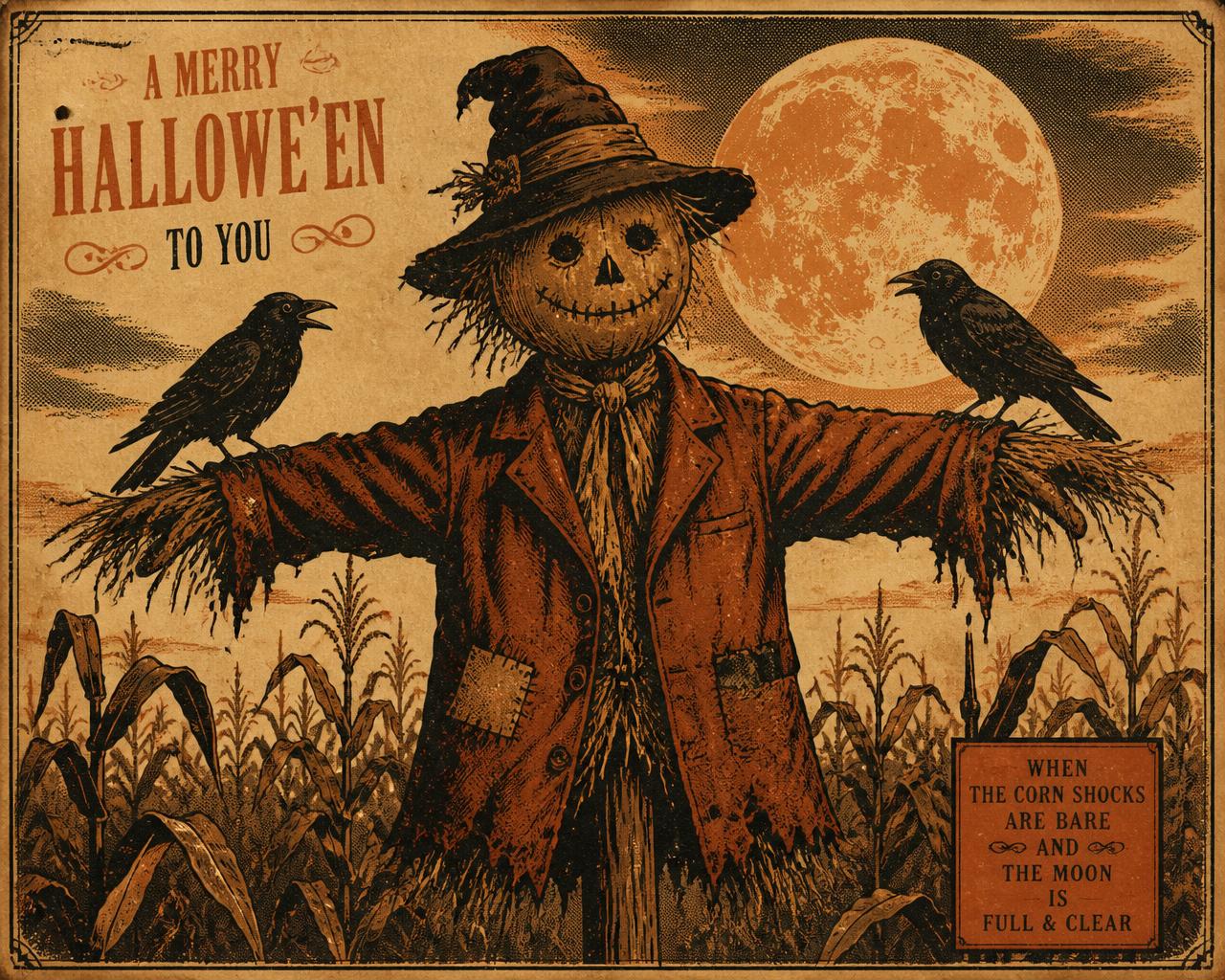
Where scarecrows come from
Scarecrows are not one invention. Almost every farming culture arrived at the same idea independently, because the problem is universal: birds eat seed and ripening grain, and a farmer cannot stand in the field all day.
Ancient field guardians
The earliest scarecrows were part practical, part religious — a guard against birds and a charm for fertility.
At a glance
- Egypt: wooden frames draped in netting along the Nile
- Greece: carved wooden figures of Priapus, god of gardens and fertility
- Rome: Priapus figures carried through the empire with Roman farming
- Japan: kakashi, from a word meaning 'something that smells badly'
Egyptian farmers set wooden frames in wheat fields along the Nile and hung nets from them to trap quail, which were then eaten — the scarecrow both protected the crop and fed the household.
Greek farmers carved ugly wooden figures of Priapus, painted them purple and gave them a club and a sickle; the ugliness scared birds, the god was meant to bless the harvest.
Roman farms adopted the Priapus figure and carried the practice north and west across Europe.
Japanese rice growers hung old rags, meat and fish bones on poles and set them smouldering; the smell drove birds off and gave the kakashi its name. Later kakashi took human form, in a straw raincoat and conical hat, sometimes with a bow.
Medieval Europe and the straw man
For centuries the 'scarecrow' in Britain was a person. The straw figure replaced a job.
At a glance
- Wooden clappers and bags of stones
- Sacking, straw and cast-off clothing
- Turnip or gourd heads in some regions
Medieval English manors employed boys as 'bird-scarers' or 'bird-shooers', who patrolled fields from dawn with clappers and stones to drive off crows and starlings.
After the Black Death of 1348 cut the labour force, landowners could no longer spare the workers, and farmers began stuffing sacks with straw, adding a carved gourd or turnip head, and staking the figure in the field.
Regional names multiplied and still survive in dialect: hodmedod, murmet, tattie bogle, mommet, bwbach.
German farmers made wooden witch figures called Bootzamon and set them out at the end of winter to hurry the season along — a scarecrow with a calendar function rather than a bird one.
The American cornfield
North America is where scarecrows became inseparable from corn — and from the imagery Halloween later borrowed.
At a glance
- Maize fields and raised watch platforms
- Straw, flannel, denim and feed sacks
- Fence posts and cross-braced poles
Indigenous farming nations across the eastern woodlands and southwest guarded maize directly: adults and children kept watch from raised platforms, and some communities used carved or draped figures.
European settlers combined their own effigy tradition with corn agriculture, and the straw man in a farmer's cast-offs became the standard American form.
Nineteenth-century immigrant communities each brought a variant — the Pennsylvania German Bootzamon among them — which is why regional scarecrow styles differ so sharply.
By the mid-20th century mechanised farming and chemical seed treatments made scarecrows largely obsolete as tools, which freed them to become purely decorative.
What the scarecrow means
The scarecrow carries more symbolic weight than almost any other farm object. It is a guardian, a stand-in for a person, and — when the season turns — something closer to a warning.
Guardian, effigy, uncanny double
Three overlapping meanings explain almost every scarecrow story ever told.
At a glance
- Guardian: protection of the harvest
- Effigy: a body made to stand in for a person
- Uncanny double: human shape without a human inside
As guardian, the scarecrow is a benign figure — the field's caretaker, tied to fertility gods in the ancient world and to good luck in folk practice.
As effigy, it borrows the unease of every straw figure ever burned or paraded: Wicker Man accounts in Caesar's writing, harvest 'corn dollies' made from the last sheaf, and effigy-burning customs across Europe.
As uncanny double, it triggers a real perceptual response. A shape with a head, shoulders and arms reads as a person at the edge of vision, and the mind supplies intent that is not there.
L. Frank Baum inverted all three in 1900 with the Scarecrow of Oz — a straw man who is kind, anxious and convinced he has no brain — which is why the modern scarecrow can be either friendly harvest decor or a horror figure with no contradiction.
How it became a Halloween icon
The link is seasonal first and psychological second.
At a glance
- Harvest timing: late October is the end of the corn season
- Vintage postcards and decorations from the 1900s–1930s
- Post-war suburban yard displays
- Corn mazes and haunted farm attractions
Halloween sits at the close of harvest, the same moment the scarecrow's working year ends — the fields are cut, and the figure is left standing in stubble.
Early 20th-century Halloween postcards and die-cut decorations put scarecrows alongside pumpkins, corn shocks, black cats and witches, fixing the visual set that still defines vintage Halloween.
As Halloween moved outdoors in the 1950s and 60s, the scarecrow was the ideal yard decoration: cheap, large, weatherproof and already associated with autumn.
Corn mazes and haunted hayrides from the 1990s onward gave scarecrows a horror role, and film and television leaned on the same image — the figure that might not be a figure.
Build a vintage-style scarecrow
A good porch or yard scarecrow is mostly about posture and silhouette. Get the frame and the slump right and cheap materials look a century old.
The frame and the stuffing
A cross-braced frame that holds a slight lean reads far better than a rigid T.
At a glance
- One 6–7 ft post (2x2 or a fence stake) for the spine
- One 4 ft crosspiece for the arms
- Screws, wire and jute twine
- Straw, dry leaves or crumpled newspaper for stuffing
- Old flannel shirt, trousers, gloves and a felt hat
- A burlap sack or pillowcase for the head
Screw the crosspiece to the spine about a foot below the top, then add a short diagonal brace on the back so the arms hold a slight droop rather than a rigid horizontal.
Dress the frame before stuffing: shirt over the crosspiece first, then trousers wired to the spine at the waist.
Stuff loosely, working from the hands and boots inward, so the limbs sag at the elbows and knees. Overstuffing is the single most common mistake — it makes the figure look inflated instead of hung.
Tie off the wrists, ankles and waist with jute so straw pushes out at the cuffs.
Fill the sack head about two-thirds full, gather the neck around the top of the spine and tie hard, then let the head tilt a few degrees to one side.
Drive the spine at least 18 inches into the ground, or clamp it to a porch rail, and lean it very slightly forward.
Aging and finishing
New fabric is the giveaway. Weather it before it goes outside.
At a glance
- Strong brewed black tea or diluted coffee
- Fine sandpaper
- Watered-down brown and black acrylic paint
- Buttons, twine, a lantern or a corn shock
Soak the shirt, trousers and head sack in strong tea, wring them out and dry them in the sun for an uneven tobacco-brown base.
Sand the collar, cuffs, knees and hat brim to break the fibres, then tear one or two small holes and fray the edges by hand rather than cutting them.
Dry-brush thinned brown paint into the seams and creases, and dust the boots and lower trousers with black to suggest field dirt.
Stitch the face rather than painting it — running-stitch eyes and a cross-stitch mouth in dark twine look older and read better at a distance than paint.
Set a corn shock, a rusted bucket or an LED lantern at the base to finish the vignette, and keep any light source flameless around dry straw.
Frequently Asked Questions
- What is the history of scarecrows?
- Scarecrows date back at least 3,000 years. Egyptian farmers set netted wooden frames in Nile wheat fields to catch quail, Greek and Roman farms used carved figures of the fertility god Priapus, and Japanese rice growers burned rags and bones on poles in a device called the kakashi. Medieval England employed children as live bird-scarers until the Black Death reduced the workforce, after which farmers switched to straw-stuffed effigies. European settlers carried the practice to North America, where it merged with Indigenous corn-guarding traditions to produce the familiar straw man in a cornfield.
- Why are scarecrows associated with Halloween?
- Three reasons stack up. Halloween falls at the end of the corn harvest, which is exactly when scarecrows finish their working year and stand alone in cut fields. Early 20th-century Halloween postcards and die-cut decorations grouped scarecrows with pumpkins, corn shocks and black cats, locking them into the holiday's visual vocabulary. And a human-shaped figure that is not human is genuinely unsettling after dark — the same quality that makes it useful against birds makes it effective as a Halloween image.
- What do scarecrows symbolise?
- Protection of the harvest, first and foremost — in the ancient world they were tied to fertility gods and blessed the field as well as guarding it. They also carry the weight of effigy traditions, standing in for a human body in the way corn dollies and burned figures did across Europe. The third meaning is modern and psychological: the uncanny sense of a person-shape with nobody inside, which is where the horror scarecrow comes from.
- Do scarecrows actually scare crows?
- Only briefly. Crows are highly intelligent and habituate to a static figure within days, after which they will perch on it. Working farms get results from movement and unpredictability instead — reflective tape, spinning or flapping attachments, sound devices, and moving the figure to a new position every few days. A traditional scarecrow left in one place all season is decoration, not deterrence.
- What is a kakashi?
- The Japanese scarecrow. The name derives from a word meaning 'something that smells badly', because the original version was a pole hung with burning rags, meat and fish bones whose smoke and stench drove birds off the rice. Later kakashi took human form, typically wearing a straw raincoat and a conical hat, and sometimes carrying a bow and arrow. In Shinto folklore the scarecrow deity Kuebiko is a figure who cannot walk but knows everything in the world.
- Where did the word scarecrow come from?
- It is a plain compound of 'scare' and 'crow', recorded in English from around the 16th century, and it originally described the person doing the job rather than the object. Dozens of regional dialect names survive: hodmedod in Berkshire, murmet in Devon, mommet in Somerset, tattie bogle in Scotland, and bwbach in Wales. Pennsylvania German communities in America called theirs a Bootzamon, or bogeyman.
- When did scarecrows become horror figures?
- Mostly in the late 20th century. L. Frank Baum's 1900 Scarecrow of Oz set the friendly template that still dominates harvest decor, and the sinister version grew out of 1970s and 80s film and television, then accelerated with the spread of corn mazes and haunted farm attractions in the 1990s. The underlying unease is much older — effigy and Wicker Man traditions long predate any of it — but the scarecrow-as-monster is a recent character.
- How do you make a scarecrow look old and weathered?
- Soak the clothing and head sack in strong black tea and sun-dry it for an uneven brown base, sand the collar, cuffs, knees and hat brim to break the fibres, and tear rather than cut any holes so the edges fray naturally. Dry-brush thinned brown paint into the seams and dust the boots with black for field dirt. Stitch the face in dark twine instead of painting it — stitched features read as older and hold up better at a distance.