The Black Flock
Crows & Ravens: Folklore, Omens & Halloween
Follow the scarecrow's story far enough and you arrive at the bird it was built for. Crows and ravens have been read as messengers, war spirits, prophets and death-omens for as long as people have written anything down — and unlike most folklore animals, they earned a good deal of the reputation honestly. They are among the most intelligent animals alive, they remember individual human faces, and they do gather at bodies.
The short answer
Crows and ravens became Halloween birds through a long chain of associations: Celtic war goddesses like the Morrígan took crow form on battlefields, Norse myth gave Odin the ravens Huginn and Muninn, medieval Europe read the birds as plague and death omens because they scavenged the dead, and Edgar Allan Poe's 1845 poem fixed the raven as the literary bird of grief. Their black plumage, harsh call, graveyard roosts and autumn flocking do the rest.
Key points
- A group of crows is a 'murder'; a group of ravens is an 'unkindness' or 'conspiracy' — both are 15th-century poetic coinages, not scientific terms.
- The Morrígan, an Irish goddess of war and fate, appears as a crow over battlefields; Welsh Brân the Blessed means 'crow' or 'raven'.
- Odin's ravens Huginn (thought) and Muninn (memory) fly the world daily and report back — ravens as intelligence, not evil.
- Legend holds that if the ravens leave the Tower of London, the kingdom falls; six are kept there with a spare.
- Crows recognise individual human faces, hold grudges for years, use and shape tools, and pass warnings socially.
- Corvids do gather around dead members of their own species — a real behaviour that reads as a 'crow funeral'.
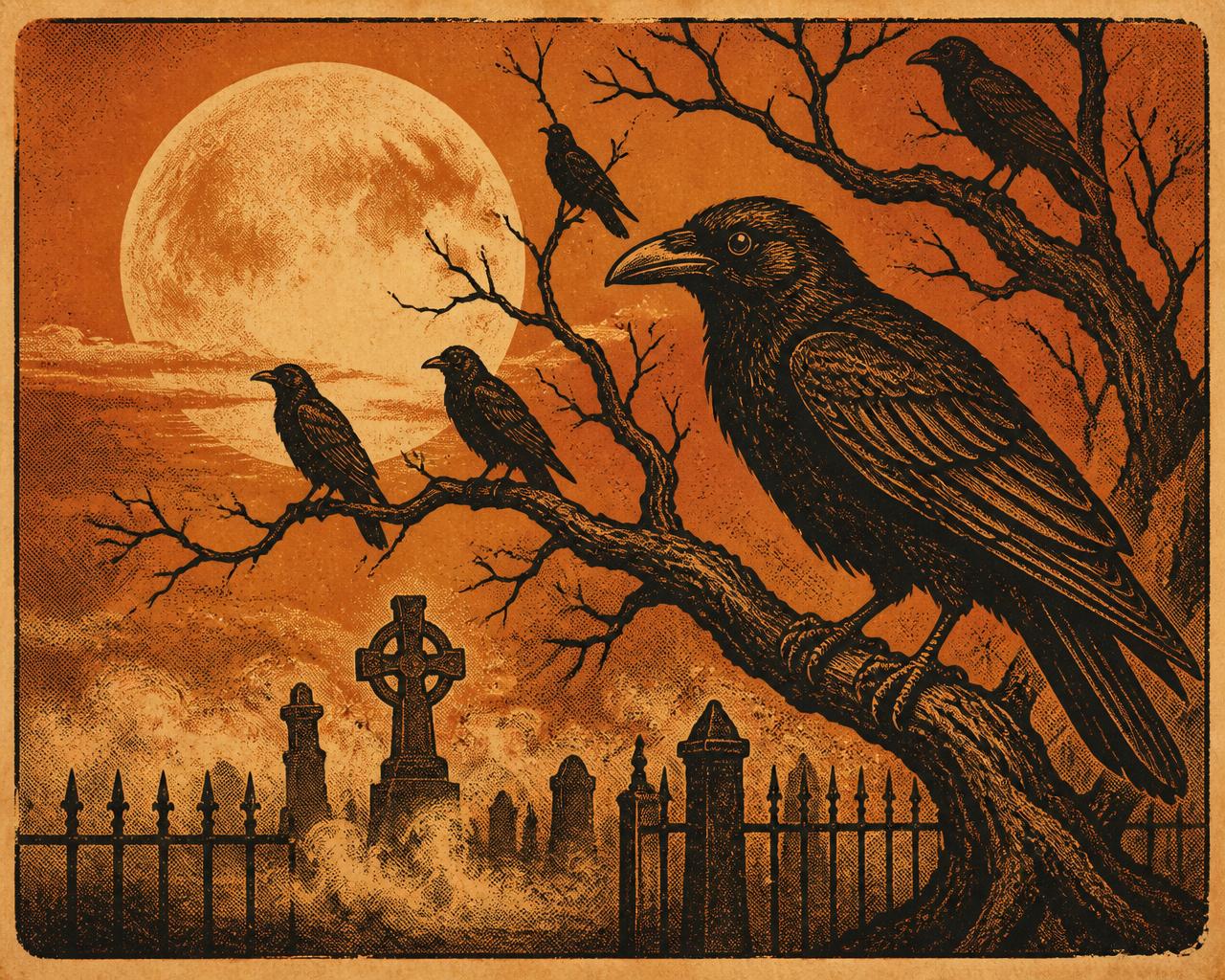
Crows and ravens in world folklore
Almost no culture treats these birds as ordinary. They are either divine messengers, tricksters who made the world, or a warning that someone is about to die — and often all three at once.
Celtic war goddesses and Irish lore
In Irish and Welsh tradition the crow is not a symbol of death so much as a shape death wears.
At a glance
- The Morrígan — Irish goddess of war, fate and sovereignty
- Badb Catha, 'battle crow', one of her aspects
- Brân the Blessed — Welsh giant-king whose name means crow or raven
- Samhain-season battlefield lore
The Morrígan appears in the Ulster Cycle as a crow over battle, prophesying deaths and deciding outcomes rather than merely watching them; she settles on the shoulder of the dying hero Cú Chulainn.
Badb Catha, the 'battle crow', shrieks over armies to sow panic — a bird whose call is itself the weapon.
In the Welsh Mabinogi, Brân the Blessed's severed head is buried facing France to protect Britain from invasion, a legend later attached to the Tower of London ravens.
Because Samhain marks the season when the boundary between worlds thins, birds already understood as psychopomps — carriers between the living and the dead — belong to it naturally.
Norse thought and Indigenous creators
Elsewhere the same bird stands for intelligence and creation rather than doom.
At a glance
- Huginn and Muninn — Odin's ravens
- Raven banners of Norse and Anglo-Saxon armies
- Pacific Northwest Raven, the trickster-creator
- Ravens in Haida, Tlingit and Tsimshian tradition
Odin, called Hrafnaguð or 'raven-god', sends Huginn (thought) and Muninn (memory) across the world each dawn to return with everything they have seen.
Norse and Anglo-Saxon war bands flew raven banners, treating the bird as a sign of Odin's favour rather than of death.
Along the Pacific Northwest coast, Raven is a creator and trickster who steals the sun and releases daylight into the world — powerful, greedy, funny, and central rather than sinister.
The pattern holds broadly: cultures that watched ravens closely tended to credit them with intelligence; cultures that mainly saw them on battlefields credited them with death.
Omens, plague birds and Poe
The European death-omen reading hardened in the medieval period and was sealed by a single poem.
At a glance
- Medieval plague-era scavenging
- Counting rhymes: 'One for sorrow, two for joy'
- Gallows and battlefield associations
- Edgar Allan Poe, 'The Raven' (1845)
During plague years crows and ravens fed on unburied dead, and their presence became a practical signal of disease — an association that outlived any epidemic.
European folk rhymes counted corvids for fortune-telling; the familiar 'one for sorrow, two for joy' version is applied to magpies and crows alike.
A crow calling three times near a house, or landing on a roof, was widely read as a death in the family, and a crow crossing your path from left to right carried its own meaning depending on region.
Poe's 'The Raven' gave the bird an unforgettable literary role — the visitor who arrives at midnight in bleak December and refuses to leave — and that single poem does more for the modern Halloween raven than any folklore source.
What crows actually do
The unnerving thing about crow folklore is how much of it survives contact with ornithology. These birds really do watch, remember and plan.
Intelligence and memory
Corvid cognition sits alongside great apes and dolphins in the animal world.
At a glance
- Facial recognition studies using masked researchers
- New Caledonian crow tool manufacture
- Documented gift-giving to regular feeders
- Multi-year social transmission of grudges
Researchers wearing distinctive masks trapped and released crows; the birds scolded that specific mask for years afterwards, and untrapped crows learned to scold it too — the grudge spread socially.
New Caledonian crows shape hooked tools from twigs and leaves, select the right tool for a task, and keep favoured tools for reuse.
Crows that are regularly fed by a person have been documented bringing back small objects — buttons, beads, bits of glass — in what looks like exchange.
Ravens cache food, watch who is watching them, and re-hide caches when observed, which implies they model what another bird knows.
Murders, roosts and 'funerals'
Autumn is exactly when crows are most visible — which is why they read as a Halloween bird.
At a glance
- Winter communal roosts of hundreds to tens of thousands
- Late-afternoon flight lines toward roost sites
- Bare autumn trees and open sightlines
- Alarm-gathering around dead crows
From autumn through winter crows abandon solitary territories and form huge communal roosts, so October evenings genuinely fill with black birds streaming across the sky.
Leaves drop at the same time, which puts every silhouette on a bare branch in plain view — the classic vintage Halloween image is just late-October ecology.
When a crow dies, others gather and call loudly around the body. Research suggests they are learning about a danger rather than mourning, but the behaviour looks unmistakably like a funeral.
Graveyards and churchyards attract roosting corvids for ordinary reasons: mature trees, open ground for foraging and very little human disturbance after dark.
Using crows in vintage Halloween decor
Crows are the cheapest high-impact Halloween prop there is, and the most commonly overdone. A few placed well beat a dozen scattered.
Placement and staging
Treat crows as punctuation, not wallpaper.
At a glance
- Three to five feathered craft crows
- Floral wire or hot glue
- A bare branch, fence rail or lantern hook
- Corn shocks, a scarecrow or a weathered sign
Group crows in odd numbers and vary the heights — one on a post finial, one lower on a rail, one on the ground looking away.
Wire the feet properly rather than balancing the bird; a crow that has visibly fallen over ruins the effect faster than no crow at all.
Give at least one bird a turned head or open beak so the group reads as alert rather than static.
Pair them with a scarecrow, corn shock or lantern so the scene tells the harvest story instead of just adding black shapes.
Aging craft crows
Craft-store crows look plastic because of the shine. Kill the shine and they look real.
At a glance
- Matte black spray or acrylic paint
- Thinned brown and grey acrylic
- Cornstarch or fine dust
- Stiff dry brush
Mist the whole bird with matte black to knock down the factory sheen, especially on the beak and feet.
Dry-brush thinned brown into the wing edges and tail tips so the feathers separate visually.
Dust a little cornstarch into the body feathers and brush most of it out; the residue reads as dust and weather.
Leave the eyes untouched — a small point of gloss on an otherwise matte bird is what makes it look alive.
Frequently Asked Questions
- Why are crows associated with Halloween?
- Partly folklore, partly the calendar. Celtic war goddesses such as the Morrígan took crow form over battlefields, medieval Europe read the birds as plague and death omens because they scavenged the dead, and Poe's 'The Raven' made the bird the literary emblem of grief. On top of that, crows form enormous communal roosts from autumn onward and the leaves are down, so late October is genuinely when you see the most black birds on the most bare branches.
- What is a group of crows called?
- A murder of crows. A group of ravens is an unkindness or a conspiracy. These are 'terms of venery' — poetic collective nouns coined largely in 15th-century English hunting manuals such as the Book of Saint Albans, not scientific terminology. Ornithologists just say a flock. The dramatic names survive because they are memorable, and they feed straight back into the birds' sinister reputation.
- What is the difference between a crow and a raven?
- Ravens are noticeably larger, roughly the size of a red-tailed hawk against a crow's pigeon-plus build. Ravens have a wedge-shaped tail in flight, crows a fan-shaped one. The raven's bill is heavier and curved with shaggy throat feathers, and its call is a deep croak against the crow's higher, flatter caw. Ravens tend to soar and travel in pairs; crows flap steadily and gather in large flocks.
- Are crows a bad omen?
- Only in some traditions. European folklore leaned heavily on the death-omen reading — a crow calling three times near a house meant a death in the family — because the birds scavenged battlefields and plague dead. Norse tradition treated ravens as Odin's intelligence-gatherers and a mark of favour, and Pacific Northwest cultures cast Raven as a creator who brought daylight into the world. The bird's meaning depends entirely on who is watching it.
- What were Odin's ravens?
- Huginn and Muninn, whose names mean 'thought' and 'memory'. In Norse myth they fly out over the world at dawn each day and return to Odin's shoulders by evening to tell him everything they have seen. Odin is called Hrafnaguð, the raven-god, and worries in the Poetic Edda about losing them — a striking image of a god who depends on birds for what he knows.
- Why are there ravens at the Tower of London?
- Legend holds that if the ravens ever leave the Tower, the Crown will fall and Britain with it, so at least six are kept there along with a spare, cared for by a Ravenmaster. The story is usually traced to Charles II, though the documented tradition appears to be considerably more recent than that. It likely draws on the older Welsh legend of Brân the Blessed, whose name means raven and whose buried head was said to guard Britain from invasion.
- How intelligent are crows really?
- Exceptionally. Crows recognise individual human faces and remember people who threatened them for years, teaching that grudge to other crows who were never involved. New Caledonian crows manufacture hooked tools from twigs and keep good ones for reuse. Ravens re-hide their food caches when another bird is watching, which implies they can model what a competitor knows. Corvid problem-solving is routinely compared to that of great apes and young children.
- Do crows really hold funerals?
- They gather noisily around a dead crow, which looks exactly like mourning. Research indicates the function is learning rather than grief: the birds are studying the place and any nearby predator or person so they can associate that danger with that location. Crows shown a dead crow held by a masked person went on to scold and avoid that mask afterwards. The behaviour is real; the interpretation is ours.