From the Old Cookbook
Vintage Halloween Recipes: Old-Fashioned Treats, 1920s-1960s
Before miniature factory-wrapped bars, Halloween was a homemade holiday: popcorn balls wrapped in waxed paper, taffy pulled at the kitchen table, apples dipped in caramel, and a pot of cider on the stove all evening. These are the treats that actually filled the bags, with the period methods explained in modern terms.
The short answer
Classic vintage Halloween treats are popcorn balls, molasses taffy, caramel or candy apples, molasses and ginger cookies, doughnuts, spiced cider and fruit punch. Most rely on cooked sugar syrup, so a candy thermometer and the traditional cold-water test are the two skills that unlock the whole era. Soul cakes and barmbrack are the older European ancestors of the same tradition.
Key points
- Cooked sugar stage is everything: soft ball for taffy, hard ball for popcorn balls, hard crack for candy apples.
- Popcorn balls were the single most common homemade Halloween treat of the era.
- Molasses was the defining flavour of pre-war Halloween baking.
- Handing out unwrapped homemade treats stopped in the 1970s — make these for people you know.
- Barmbrack and soul cakes connect the American treats to much older European customs.
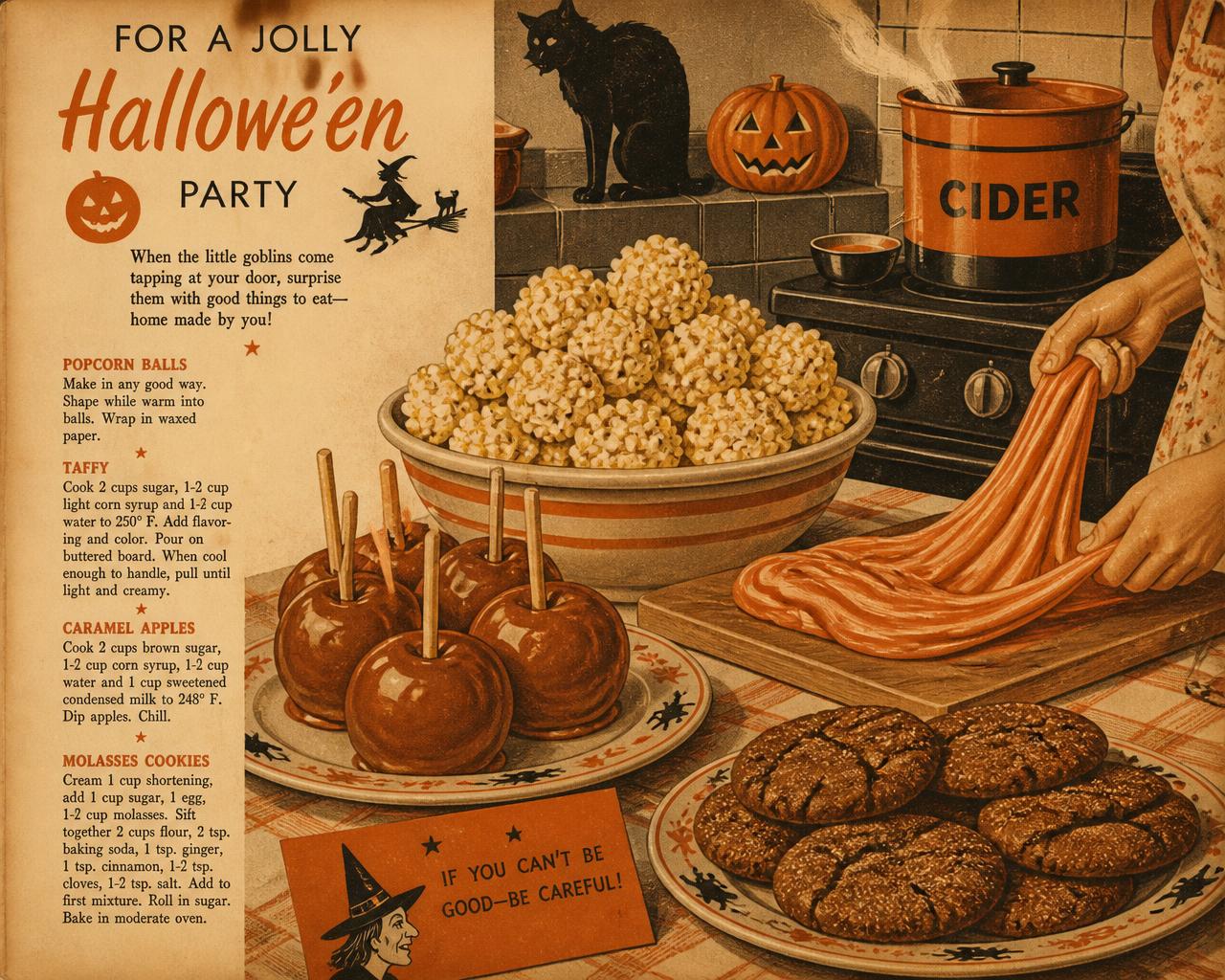
Cooked-Sugar Classics
Three treats, one skill. Learn to read sugar stages and the whole vintage repertoire opens up.
Molasses Popcorn Balls
The definitive homemade Halloween treat: popped corn bound in cooked molasses syrup and shaped by hand.
What you need
- 10 cups popped corn, unsalted, hulls removed
- 1 cup molasses
- 1 cup granulated sugar
- 2 tablespoons butter, plus more for your hands
- 1/4 teaspoon salt
- Waxed paper for wrapping
How to do it
- Pop the corn and keep it warm in a very large buttered bowl; discard unpopped kernels.
- Boil molasses, sugar, butter and salt to the hard-ball stage, 250-265F (121-129C).
- Pour the syrup over the corn in a thin stream while tossing with a buttered spoon.
- Butter your hands well and press into balls as soon as it is cool enough to touch — waiting makes it unworkable.
- Wrap each ball in waxed paper and twist the ends; they keep two to three days.
Old-Fashioned Molasses Taffy
The centrepiece of a taffy pull — cooked syrup worked by hand until it turns pale and satiny.
What you need
- 2 cups granulated sugar
- 1 cup light molasses
- 1/2 cup water
- 2 tablespoons butter
- 1/2 teaspoon baking soda
- A buttered marble slab or large baking sheet
How to do it
- Cook sugar, molasses and water to the soft-ball stage, 245-250F (118-121C), without stirring once it boils.
- Stir in the butter and soda off the heat — it will foam sharply.
- Pour onto the buttered slab and let it cool until you can handle the edges.
- Butter your hands and pull: stretch to arm's length, fold back, repeat until it lightens to pale tan and holds its shape.
- Twist into a rope, cut with buttered scissors, and wrap each piece in waxed paper.
Caramel and Candy Apples
Small tart apples on sticks, dipped in either soft brown caramel or a hard red candy shell.
What you need
- 8 small tart apples, stems removed
- 8 wooden sticks
- For caramel: 2 cups brown sugar, 1 cup corn syrup, 1 cup sweetened condensed milk, 1/2 cup butter
- For candy shell: 2 cups sugar, 1/2 cup water, 1/2 cup corn syrup, red colouring
- Buttered parchment or waxed paper
How to do it
- Wash and dry the apples thoroughly and rub off any wax — the coating will slide off otherwise.
- Push a stick firmly into each apple through the stem end.
- For caramel, cook the ingredients to 245F (118C); for a candy shell, cook to the hard-crack stage, 300-310F (149-154C).
- Dip and turn each apple, letting the excess run back into the pan, then set on buttered paper.
- Chill briefly to set; eat the same day, as the coating weeps by the next morning.
Molasses Baking and Doughnuts
Molasses, ginger and cloves are the flavours of a pre-war Halloween kitchen.
Cider Doughnuts
Cake doughnuts made with reduced cider, fried and tossed in cinnamon sugar.
What you need
- 1 1/2 cups apple cider, reduced to 1/2 cup
- 3 1/2 cups flour
- 2 teaspoons baking powder, 1/2 teaspoon baking soda
- 1 teaspoon cinnamon, 1/2 teaspoon nutmeg, 1 teaspoon salt
- 1/2 cup sugar, 2 eggs, 4 tablespoons melted butter, 1/2 cup buttermilk
- Neutral oil for frying and cinnamon sugar for tossing
How to do it
- Simmer the cider down to a scant half cup and cool it completely — this is where the flavour comes from.
- Mix the wet ingredients with the reduced cider, then fold in the combined dry ingredients to a soft dough.
- Chill 30 minutes, roll to about 1cm and cut with a doughnut cutter.
- Fry at 350-365F (175-185C), roughly 90 seconds per side, working in small batches.
- Toss in cinnamon sugar while still warm and serve within the hour.
Cider, Punch and Older Traditions
The drinks table and the two European breads that started the whole custom of Halloween food.
Spiced Cider and Party Punch
A stovetop cider pot for the evening and a cold fruit punch for the bowl.
What you need
- 2 litres apple cider
- 2 cinnamon sticks, 6 whole cloves, 3 allspice berries, 1 star anise
- 1 orange, sliced
- For punch: cider, ginger ale, cranberry and orange juice, lemon slices
- A bundt-pan ice ring with fruit frozen inside
How to do it
- Warm the cider with the whole spices and orange slices for 20 minutes without boiling.
- Keep it on the lowest heat all evening and top up rather than reheating from cold.
- For the cold punch, mix the juices and cider ahead and add the ginger ale in the last five minutes.
- Freeze the ice ring a day ahead; it lasts hours where cubes last minutes.
- Set out a small dish of cinnamon sticks so guests can use them as stirrers.
Soul Cakes and Barmbrack
The European ancestors — small spiced cakes given for prayers, and an Irish fruit loaf with fortunes baked inside.
What you need
- For soul cakes: flour, butter, sugar, currants, allspice, nutmeg, milk, an egg
- For barmbrack: strong tea, mixed dried fruit, flour, sugar, mixed spice, an egg
- Wrapped charms for the brack: a ring, a coin, a thimble
How to do it
- Soul cakes: rub butter into flour, add sugar, spice and currants, bind with egg and milk, cut rounds and mark a cross on top before baking at 350F (175C) for 15 minutes.
- Barmbrack: soak the dried fruit in strong tea overnight, then mix with flour, sugar, spice and egg into a wet batter.
- Wrap each charm tightly in parchment and press it into the barmbrack batter before baking.
- Bake the brack in a loaf tin at 340F (170C) for about an hour, until a skewer comes out clean.
- Serve sliced and buttered, and warn everyone that there are charms inside before anyone bites down.
Frequently Asked Questions
- What were traditional Halloween treats before candy bars?
- Homemade popcorn balls, molasses taffy, caramel and candy apples, molasses and ginger cookies, doughnuts, salted nuts, and cups of cider or punch. Trick-or-treaters in the 1930s through the 1950s commonly received home-made items, small coins or fruit rather than wrapped candy. Factory-sealed miniature bars only became the norm in the 1970s, largely for safety and convenience.
- How do you make old-fashioned popcorn balls?
- Pop about ten cups of unsalted corn and keep it warm in a large buttered bowl. Boil one cup molasses, one cup sugar, two tablespoons butter and a quarter teaspoon salt to the hard-ball stage, 250-265F (121-129C). Pour the hot syrup over the corn while tossing, then butter your hands and press into balls immediately — the mixture becomes unworkable as it cools. Wrap each in waxed paper.
- Why was molasses used in so many vintage Halloween recipes?
- It was cheap, shelf-stable and widely available long before refined sugar was inexpensive, and it was already the standard sweetener in American home baking. It also cooks into a firm, chewy candy that holds a shape well, which suited popcorn balls, taffy and pulled candy. Its dark colour and spiced-bitter edge became so associated with the season that molasses still tastes like autumn.
- What is a taffy pull?
- A social event, common at Halloween parties from the 1800s through the mid-1900s, where guests cooked a molasses or sugar syrup, poured it onto a buttered slab, then worked it in pairs — stretching, folding and stretching again with buttered hands. The pulling aerates the candy so it lightens from dark brown to pale tan and turns satiny. It was as much a party game as a recipe.
- Are homemade Halloween treats safe to hand out to trick-or-treaters?
- Most families will not accept unwrapped homemade items from strangers, and many communities actively advise against it, so make these for your own household, party guests and neighbours who know you. If you do share homemade treats, wrap them individually, label them with ingredients and your name, and hand them to people you know. Keep factory-sealed candy for the door.
- What is barmbrack?
- An Irish tea-soaked fruit loaf traditionally eaten at Halloween, with small charms baked inside for fortune telling: a ring meant marriage within the year, a coin meant wealth, a thimble meant spinsterhood, a rag meant poverty. It is made by soaking dried fruit in strong tea overnight, then mixing it with flour, sugar, spice and egg. Wrap the charms in parchment and warn everyone before they eat.
- Do I need a candy thermometer for vintage candy recipes?
- It makes everything easier, but the traditional cold-water test works. Drop a little syrup into cold water: a ball that flattens between your fingers is soft ball (taffy), a ball that holds its shape is hard ball (popcorn balls), and syrup that separates into brittle threads is hard crack (candy apples). Period cookbooks give only these tests, which is why so many old recipes list no temperatures.
- How long do vintage Halloween treats keep?
- Popcorn balls keep two to three days wrapped in waxed paper. Taffy keeps a week or two individually wrapped in a cool dry place. Molasses cookies stay soft for about five days in a sealed tin, and improve on the second day. Caramel and candy apples should be eaten the same day, since the fruit weeps and softens the coating overnight. Doughnuts are best within hours.