The Séance Room
Are Ghosts Real? Classic Ghost Myths Explained
Nobody has ever produced a ghost under conditions that hold up to scrutiny — and almost everyone knows a story they cannot quite explain away. Both of those things are true at once, and that gap is where ghost folklore lives. Here is what the evidence says, what the traditional types of ghosts are, how to check a haunting for ordinary causes, and which classic tales still do the most damage to a good night's sleep.
The short answer
There is no scientific evidence that ghosts exist. No study has produced a repeatable, verifiable observation of the dead, and the great majority of hauntings resolve into ordinary causes: infrasound below 20 Hz, carbon monoxide, drafts, sleep paralysis, electromagnetic and temperature oddities, pareidolia and expectation. Roughly a third to a half of people in the US and UK nonetheless say they believe in ghosts, and about one in five report a personal encounter — so ghosts are real as an experience and as folklore, without being demonstrated as fact.
Key points
- No controlled study has ever verified a ghost; the scientific answer to 'are ghosts real' is no evidence, not proof of absence.
- Most hauntings have mundane explanations — infrasound, carbon monoxide, drafts, mold, electrical fields, sleep paralysis and pareidolia.
- Folklore sorts ghosts into recognizable types: apparitions, residual hauntings, poltergeists, crisis apparitions, revenants, wraiths and phantom animals.
- Belief is widespread: surveys repeatedly find roughly 35–45% of Americans believe in ghosts and about 20% report an encounter.
- Check for carbon monoxide first — a detector is the single most useful piece of ghost-hunting equipment ever made.
- The most famous ghost stories — A Christmas Carol, The Turn of the Screw, The Canterville Ghost, the Bell Witch, Borley Rectory — shaped what we now expect a ghost to do.
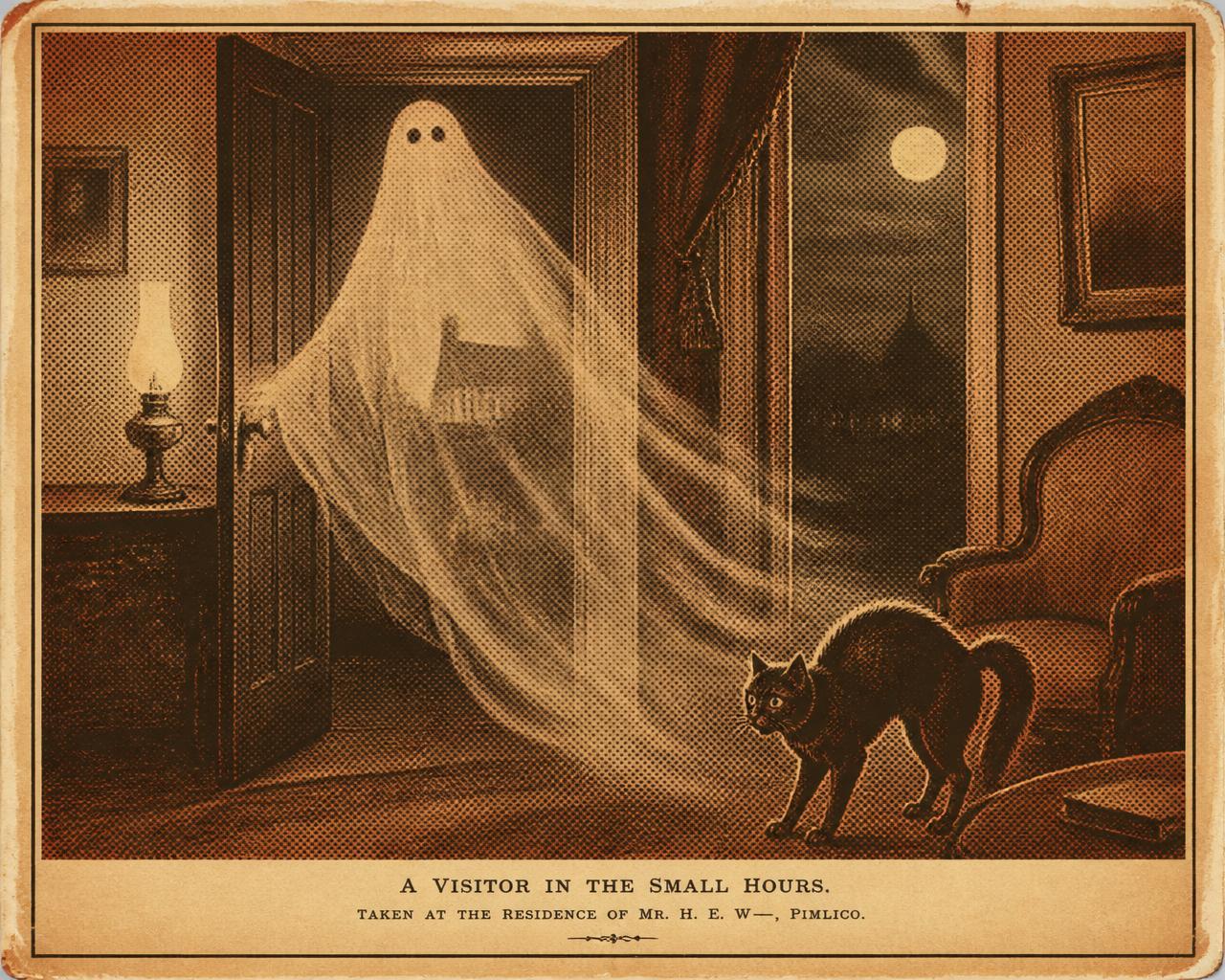
Are Ghosts Real? What the Evidence Shows
The honest answer has two halves: no verified evidence, and a very large body of sincere human experience. Take them in order.
The Scientific Position
Ghost claims fail the two tests that matter: repeatability and independent verification.
At a glance
- A skeptical but open mind
- Any account of a haunting you find convincing
Ask whether the event can be reproduced. Ghost phenomena never repeat on demand under observation, which is why no laboratory result supports them.
Ask what instrument recorded it. EMF meters detect wiring and appliances; spirit boxes and EVP recordings capture radio bleed and noise the listener then interprets.
Ask who else saw it, independently, without being told what to expect — expectation is the strongest predictor of a ghostly experience.
Separate 'unexplained' from 'supernatural'. An event nobody has explained yet is a gap in information, not evidence of the dead.
Conclude carefully: there is no scientific evidence that ghosts exist, and no way to prove they never could. That is the whole of the defensible position.
Why Sane People See Ghosts
The experiences are real even when the ghost is not. Several ordinary mechanisms produce them reliably.
At a glance
- A carbon monoxide detector
- A thermometer and a torch
- A notebook for dates, times and weather
Rule out carbon monoxide. Faulty heaters and flues cause dread, hallucination, headache and a felt presence — several classic 'haunted rooms' turned out to be poisoned ones.
Consider infrasound. Sound below about 20 Hz, from fans, traffic or wind in a flue, is inaudible but produces unease, chills and peripheral shimmering.
Consider sleep paralysis. Waking mid-REM with the body still immobile produces a pressing weight on the chest and a figure in the room — the origin of the Old Hag and countless bedroom hauntings.
Consider pareidolia and expectation. The brain completes faces and figures out of shadow and grain, far more readily in a place it has been told is haunted.
Consider grief. Bereavement hallucinations are common, well documented and not a sign of illness — many people see or hear a spouse in the year after a death.
Log everything with dates, times, weather and who else was present. Patterns tied to wind, cold or the boiler firing usually appear within a fortnight.
The Types of Ghosts in Folklore
Folk tradition is far more precise than film. These categories come out of centuries of storytelling, and each behaves by its own rules.
Apparitions, Residuals and Crisis Apparitions
The three commonest reported forms, and the easiest to tell apart by whether the ghost notices you.
At a glance
- An account to classify
- Patience
An intelligent apparition responds — it looks at witnesses, moves around them, sometimes speaks. These are the ghosts of the classic tale.
A residual haunting repeats a fixed action on a loop, indifferent to the living: footsteps on the same stair, a figure walking the same corridor at the same hour.
A crisis apparition appears once, to a friend or relative, at or near the moment of a death elsewhere. It is the best attested category in Victorian psychical research and the one most tied to grief and coincidence.
Note which you are dealing with before anything else — a repeating residual almost always has a structural or acoustic cause.
Poltergeists, Revenants and Wraiths
The noisy and physical end of the tradition, plus the ghosts that arrive on their own errand.
At a glance
- A house with a history
- A story worth retelling
A poltergeist ('noisy spirit') throws, knocks and moves objects. Cases cluster around a household under strain, frequently with an adolescent present, and a large proportion have been traced to hoaxing or settling structures.
A revenant is the body returned — the older European tradition behind vampires and the restless dead, laid by proper burial rather than exorcism.
A wraith is a double or fetch: seeing your own, or another's, foretells a death. This is folklore, not report.
Phantom animals — black dogs like Black Shuck, spectral horses and coaches — guard roads, churchyards and boundaries in British and Irish tradition.
The White Lady and the weeping woman appear worldwide, tied to betrayal, drowning or a lost child; La Llorona is the best-known form.
The Most Famous Ghost Stories and Hauntings
Modern expectations of ghosts were largely written, not witnessed. These are the tales that set the rules.
The Classic Literary Ghost Stories
A short reading list that covers nearly every ghost convention still in use.
At a glance
- An evening
- A lamp, and preferably a fire
Start with Dickens's A Christmas Carol (1843) — the most widely read ghost story ever written, and the source of the chained, purposeful, moralizing ghost.
Read Henry James's The Turn of the Screw (1898) for the ambiguous haunting where the reader is never told whether the ghosts are real.
Read M. R. James — 'Oh, Whistle, and I'll Come to You, My Lad' and 'Casting the Runes' — for the antiquarian ghost story, the model for most modern horror short fiction.
Read Wilde's The Canterville Ghost (1887) for the comic ghost, and Le Fanu's 'Green Tea' for the pursuing phantom.
Read W. W. Jacobs's 'The Monkey's Paw' (1902) and Susan Hill's The Woman in Black (1983) for the two most reliably frightening short hauntings in English.
The Famous Real-World Cases
The named hauntings people mean when they ask whether ghosts are real — and what became of each.
At a glance
- A skeptical eye
- The dates
The Bell Witch (Tennessee, 1817–1821): America's most famous poltergeist case, known entirely through later retellings and an 1894 book.
Borley Rectory (Essex, 1929–1939): called 'the most haunted house in England' by Harry Price, whose investigation was later shown to involve manipulation and exaggeration.
The Brown Lady of Raynham Hall: the subject of a famous 1936 photograph, most plausibly a double exposure.
The Tower of London and Anne Boleyn: centuries of sightings, no contemporary record — a haunting largely built in the Victorian period.
The Amityville case (1975–76): later acknowledged by those involved to have been substantially invented, and still the template for the haunted-house film.
Frequently Asked Questions
- Are ghosts real?
- There is no scientific evidence that ghosts are real. No study has produced a repeatable, independently verified observation of a spirit of the dead, and the majority of hauntings resolve into ordinary causes such as infrasound, carbon monoxide, drafts, sleep paralysis and pareidolia. At the same time, surveys consistently find that around 35–45% of people in the US believe in ghosts and roughly one in five report a personal encounter — so the experiences are real and widespread, even though the ghost has never been demonstrated.
- What types of ghosts are there in folklore?
- The main traditional types are intelligent apparitions that interact with witnesses; residual hauntings that repeat a fixed action on a loop; poltergeists that make noise and move objects; crisis apparitions seen once at the moment of a distant death; revenants, the returned body behind vampire folklore; wraiths or fetches, doubles that foretell a death; and phantom animals such as spectral black dogs and coaches.
- What is the most famous ghost story ever written?
- Charles Dickens's A Christmas Carol (1843) is the most widely read ghost story in English. For pure fright, the usual candidates are Henry James's The Turn of the Screw (1898), M. R. James's 'Oh, Whistle, and I'll Come to You, My Lad' (1904), W. W. Jacobs's 'The Monkey's Paw' (1902) and Susan Hill's The Woman in Black (1983).
- Why do people see ghosts?
- Well documented causes include carbon monoxide exposure, which produces dread and hallucination; infrasound below 20 Hz, which causes unease and visual shimmer; sleep paralysis, which places a pressing figure at the bedside; pareidolia, which builds faces and figures out of shadow; bereavement hallucinations, which are common and normal after a death; and expectation, which makes a ghostly interpretation far more likely in a place said to be haunted.
- Are ghosts a myth?
- Ghosts are best described as folklore rather than fact. Belief in the returning dead is recorded in nearly every culture and is far older than written history, which makes ghosts a genuine and durable myth-tradition — a set of stories that explain grief, place and memory — rather than a verified phenomenon.
- What is the difference between a ghost and a poltergeist?
- A ghost is usually reported as a seen or heard presence, often a recognizable figure. A poltergeist — German for 'noisy spirit' — is reported through physical effects rather than an appearance: knocking, thrown objects, moved furniture. Poltergeist cases tend to be short-lived, centered on a person rather than a place, and have a notably high rate of proven hoaxing.
- How do ghost hunters try to detect ghosts?
- Commonly with EMF meters, thermal cameras, audio recorders for EVP and motion sensors. None of these detects ghosts: EMF meters read household wiring and appliances, thermal cameras read drafts and insulation gaps, and EVP recordings capture radio interference and noise that listeners then interpret as speech. The genuinely useful instruments in a suspected haunting are a carbon monoxide detector and a written log of dates, times and weather.
- Why are ghost stories told at Halloween?
- Because Samhain and All Hallows' Eve were understood as the night when the boundary between the living and the dead thinned, so the dead were spoken of, fed and appeased. The Victorians then made telling ghost stories a fireside custom of the dark half of the year, and Halloween inherited it.