The Uncanny Files
Why Vintage Halloween Costumes Look So Scary
Everyone has seen the photographs: a row of children on a porch in sackcloth and hand-stitched masks, staring flatly into the lens. Nothing in the picture is trying to frighten you, and it is far more frightening than anything sold today. There are concrete reasons why.
The short answer
Vintage Halloween costumes look scary because they were homemade from cloth, sacking and papier-mache with crude, asymmetrical features that land squarely in the uncanny valley — near-human but wrong. Long camera exposures forced unsmiling, motionless poses; sepia decay, grain and harsh flash strip away colour and context; and the costumes came from a genuine ritual of disguise meant to hide the wearer from spirits, not to entertain a crowd. Modern costumes are mass-produced, symmetrical and legible, so they read as play rather than threat.
Key points
- Homemade, asymmetrical faces sit in the uncanny valley in a way factory masks do not.
- Long exposures and period portrait convention produced still, unsmiling figures.
- Sepia fading, grain and flash strip colour and context, leaving only the mask.
- Early costumes served a real ritual of concealment, not a costume contest.
- 'Vintage' generally means pre-1965 construction: cloth, gauze, buckram, papier-mache, stiff Halco or Ben Cooper mask-and-smock sets.
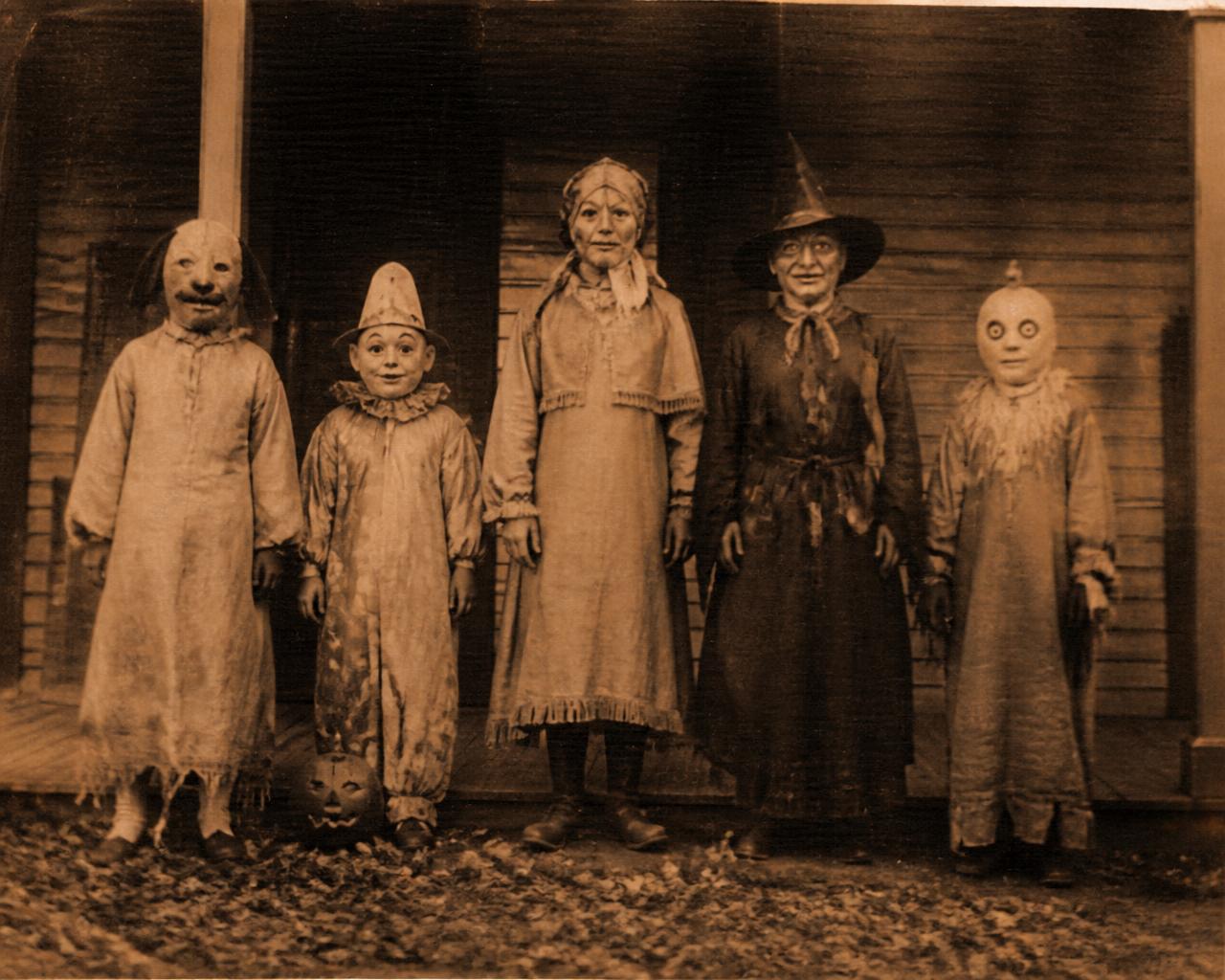
Why the Old Photographs Unsettle Us
Four separate forces stack up in a single vintage Halloween photograph, and each one is doing real work.
The Uncanny Valley of a Homemade Face
A hand-made mask is close enough to a face to read as one, and wrong enough to trigger alarm.
What triggers it
- Asymmetrical eye holes and a mouth in slightly the wrong place
- Flat, matte cloth where skin should have highlights
- A fixed expression that never changes as the body moves
- Human proportions rendered by hand rather than from a mould
Human vision is exceptionally tuned to faces, so small errors register as threat rather than as error.
Hand-cut features are always slightly off-centre, and asymmetry reads as damage or illness.
A static expression paired with a living body creates a mismatch our brains flag immediately.
Factory masks are symmetrical and cartoon-exaggerated, so we file them as drawings, not faces.
The unsettling effect is strongest at a distance, where the mask most nearly passes for real.
What Old Photography Did to Them
The medium is half the horror: long exposures, harsh flash, grain and colour loss.
The photographic factors
- Exposures long enough to require holding still
- Portrait convention that discouraged smiling
- Magnesium and early flashbulb light, harsh and directional
- Sepia toning, silver fading and heavy grain
Subjects were told to stand still, so groups line up stiffly and stare straight at the lens.
Smiling was not yet the photographic default, so faces beneath the masks give nothing away.
Hard frontal flash flattens features and drops everything behind the group into blackness.
Colour loss removes the orange-and-black cheer, leaving only shape and shadow.
Grain and emulsion damage add texture the photographer never intended, which reads as decay.
They Were Not Trying to Be Fun
Early disguise was protective and transgressive — concealment first, entertainment second.
The customs behind them
- Guising: going door to door in disguise to perform for food
- Mumming and souling traditions across Britain and Ireland
- The belief that a disguise hid you from wandering spirits at Samhain
- Anonymity that licensed pranks and mischief night vandalism
The original purpose of a Halloween disguise was to not be recognised, by neighbours or by the dead.
That goal produces full-face coverage, shapeless robes and no identifiable character.
A costume with no character to identify gives the viewer nothing safe to latch onto.
Anonymity also enabled real mischief, so masked figures on a porch once meant genuine trouble.
Modern costumes advertise a known character, which is exactly what makes them harmless.
What Makes a Costume 'Vintage'
Collectors and costume historians draw the lines by material and manufacture, not by look alone.
The Eras and Their Materials
Four distinct construction periods, each identifiable at a glance.
The eras
- 1900s-1920s: homemade cloth, sacking, gauze and papier-mache; entirely hand-made
- 1930s-1940s: buckram and starched-gauze mask faces, printed cloth, early commercial sets
- 1950s-early 1960s: Halco, Ben Cooper and Collegeville stiff mask-and-smock sets in boxes
- Mid 1960s onward: soft vinyl masks and polyester — generally 'retro' rather than vintage
Check the mask material first: gauze and buckram mean pre-war, hard styrene means the 1950s-60s, soft vinyl means later.
Look for a printed maker's name inside the chin or on the smock — Ben Cooper, Halco and Collegeville are the big three.
Original boxes with cellophane windows are a strong 1950s-60s marker and add most of the value.
Hand-stitched seams, mismatched fabric and no label point to a genuinely homemade early piece.
Treat pre-1965 construction as vintage and 1965-1990 as retro; that is the line most collectors use.
Making a Convincingly Vintage Costume
Build for concealment and imperfection rather than for a recognisable character.
At a glance
- Unbleached muslin, burlap or an old bedsheet
- Buckram, stiffened gauze or papier-mache and paste for the mask
- Cold tea, coffee or diluted brown dye for ageing
- Cotton thread for visible hand-stitching
- Fine sandpaper and matte paint
Choose a nameless figure — a plain face, an animal, a clown, a hooded shape — rather than a known character.
Cover the whole face and let the mask sit slightly loose so it shifts as you move.
Cut features by hand and deliberately off-centre; symmetry is what kills the effect.
Age everything with cold tea, then sand the high points and finish matte so nothing catches light.
Hand-stitch visibly, leave hems raw, and keep the whole palette to cream, brown and black.
Frequently Asked Questions
- Why do vintage Halloween costumes look so creepy?
- Three things combine. The costumes were homemade from cloth, sacking and papier-mache with hand-cut, asymmetrical features that land in the uncanny valley — close enough to a face to read as one, wrong enough to alarm us. Period photography forced still, unsmiling poses under harsh flash, then sepia fading and grain stripped away colour and context. And the costumes were built to conceal identity rather than to depict a fun character, so there is nothing recognisable to reassure the viewer.
- What is the uncanny valley and how does it apply to old masks?
- The uncanny valley is the discomfort we feel toward something that is almost human but not quite. Our visual system is exceptionally tuned to faces, so small errors — an eye hole slightly too low, a mouth off-centre, matte cloth where skin should shine — register as threat rather than as craft error. Modern factory masks are symmetrical and cartoon-exaggerated, so we file them as drawings instead of faces and feel nothing.
- What counts as a vintage Halloween costume?
- Most collectors treat pre-1965 construction as vintage. That covers hand-made cloth, sacking, gauze and papier-mache costumes from the 1900s-1920s, buckram and starched-gauze mask faces of the 1930s-40s, and the boxed stiff mask-and-smock sets by Halco, Ben Cooper and Collegeville in the 1950s and early 60s. Soft vinyl masks and polyester suits from the mid-1960s onward are usually described as retro rather than vintage.
- Why is nobody smiling in old Halloween photographs?
- Partly technical and partly convention. Exposures were long enough that subjects had to hold still, and photographic portrait convention through the early twentieth century did not treat smiling as the default expression. Add hard frontal flash that flattens faces and drops the background into black, and a group of masked figures ends up lined up, motionless and blank — which is precisely what makes the images so effective.
- What were old Halloween masks made of?
- The earliest homemade masks were cloth, sacking, gauze and papier-mache, sometimes with painted features and hand-cut eye holes. Commercial masks of the 1930s and 40s used buckram or starched gauze moulded to a face shape. The 1950s and early 60s brought stiff moulded styrene masks sold with printed smocks. Soft flexible vinyl arrived in the mid-1960s and became the standard afterwards.
- Who were Ben Cooper and Halco?
- Two of the largest American Halloween costume manufacturers of the mid-twentieth century, alongside Collegeville. From the 1930s onward they sold boxed sets pairing a stiff moulded mask with a printed fabric or plastic smock, often licensed from comics, cartoons and film. Their boxes with cellophane windows are highly collectible, and a maker's name printed inside a mask's chin is the quickest way to date and attribute a piece.
- How do I make a costume look authentically vintage?
- Pick a nameless figure rather than a known character, cover the whole face, and cut the features by hand and slightly off-centre. Use unbleached muslin, burlap or an old sheet with visible hand-stitching and raw hems. Age everything with cold tea or diluted brown dye, sand the high points, and finish matte so nothing catches the light. Keep the palette to cream, brown and black — no bright colour and no symmetry.
- Were vintage Halloween costumes meant to be frightening?
- Some were, but not in the way modern horror costumes are. Early guising and mumming disguises existed to conceal the wearer — from neighbours, and in older belief from spirits abroad at Samhain — so full-face coverage and shapeless robes were practical, not theatrical. Anonymity also licensed real mischief, so a masked figure at the door genuinely could mean trouble. The frightening effect we feel now is largely a by-product of that concealment.