The Candy Countdown
Halloween Candy: The Countdown, the Classics & Why Candy at All
Halloween was a candy holiday for a surprisingly short part of its long life. For centuries the treat was food — soul cakes, apples, nuts, a coin if you were lucky — and the switch to wrapped, branded, factory-made sugar happened almost entirely within living memory. What follows is the countdown of the candy that won, the vintage sweets your grandparents actually pulled out of a paper sack, and how the whole tradition got here.
The short answer
Candy is at Halloween because of a chain of substitutions: medieval souling and guising traded prayers or a performance for food, that custom crossed to North America with Irish and Scottish immigrants, 1930s neighbourhoods began offering treats to head off pranks and vandalism, and postwar candy companies seized on individually wrapped sweets as the safest, cheapest, most convenient treat. The 1970s and 80s razor-blade panics finished the job by making commercially sealed candy the only treat many parents would accept.
Key points
- Trick-or-treating descends from souling and guising — performing or praying door to door in exchange for food, not sweets.
- Treats were homemade or whole foods into the 1940s: popcorn balls, apples, doughnuts, nuts, coins and cookies.
- The word 'trick-or-treat' first appears in print in North America in the 1920s-30s, alongside efforts to curb Halloween vandalism.
- Sugar rationing during the Second World War paused Halloween candy; it exploded once rationing ended in 1947.
- Candy corn dates to the 1880s as 'Chicken Feed' and predates trick-or-treating by decades.
- Reese's, Snickers, Kit Kat, M&M's and Twix consistently top modern Halloween sales; candy corn is the most divisive.
- Individually wrapped miniatures became standard partly for cost and partly because of 1970s poisoned-candy scares.
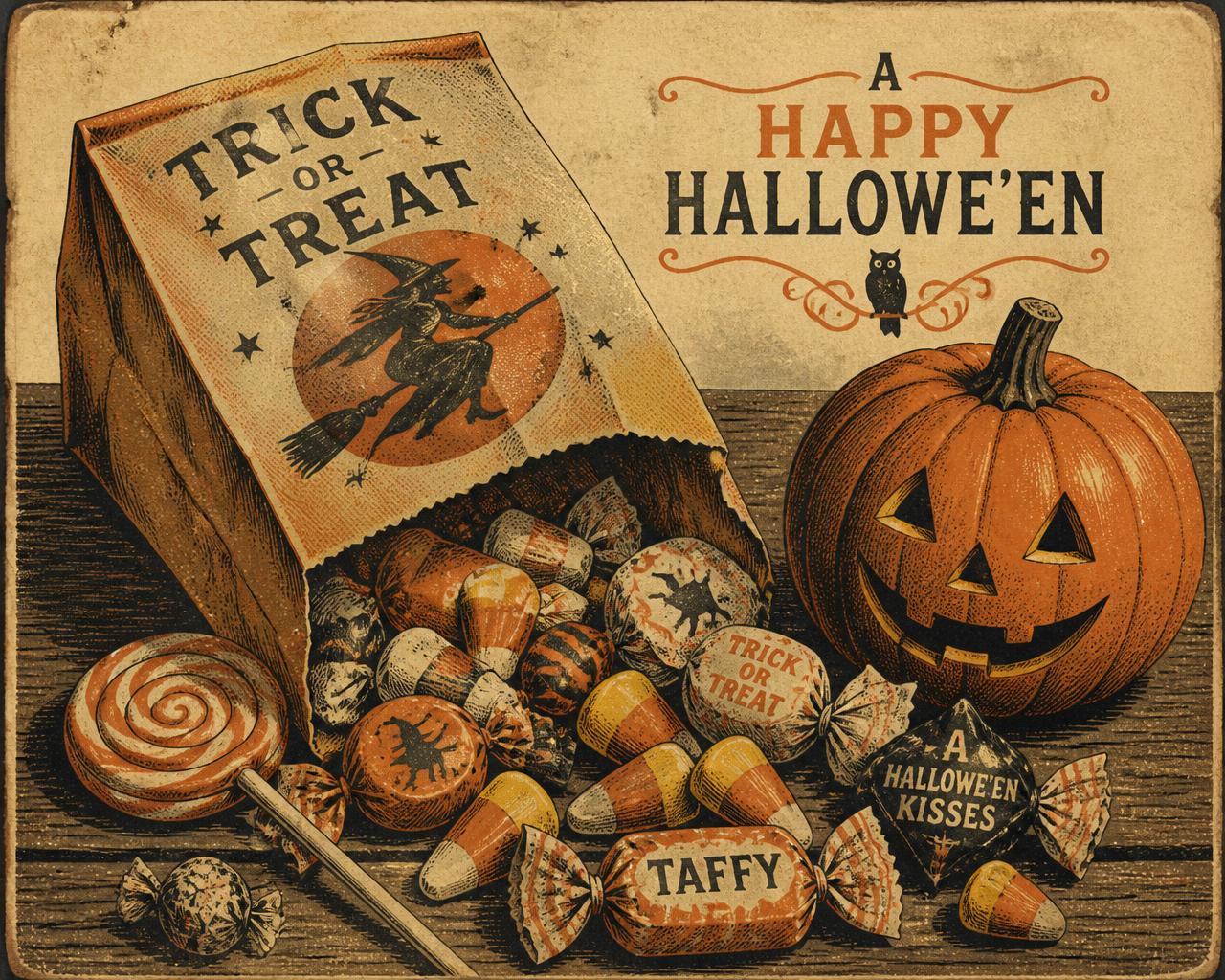
The countdown: best Halloween candy of all time
Ranked on the only measures that matter for Halloween — trade value in the schoolyard, how well it survives a night in a pillowcase, and whether anyone has ever been disappointed to find it. Sales data from major US retailers and confectioners consistently puts the top three in this order.
1-3: The undisputed top of the bag
These are the candies children trade up for and adults quietly steal from the bowl.
The ranking
- 1. Reese's Peanut Butter Cups (1928)
- 2. Snickers (1930)
- 3. Kit Kat (1935 UK, 1970 US)
Why they win
Reese's has topped national Halloween sales lists for years running. Salt against sweet is the reason: it is the only major Halloween candy that reads as savoury, so it never cloys the way straight chocolate does by the tenth piece.
Snickers is the most substantial bar in the bag — nougat, caramel, peanuts — which made it the classic 'full-size bar house' currency and the highest-value single trade of the night.
Kit Kat wins on texture. Wafer keeps its snap in a bag that has been dragged around the neighbourhood for two hours, and the break-apart format makes it the easiest candy to share or split in a trade.
4-10: The rest of the good bag
Reliable, universally accepted, and the backbone of any honest Halloween haul.
The ranking
- 4. M&M's (1941)
- 5. Twix (1967)
- 6. Skittles (1974 UK, 1979 US)
- 7. Butterfinger (1923)
- 8. Sour Patch Kids (1985)
- 9. Hershey's Miniatures (1939)
- 10. Nerds (1983)
Why they win
M&M's earned their place through sheer engineering — a shell built for soldiers' pockets in the 1940s is exactly what a candy needs to survive a paper bag.
Twix and Butterfinger both trade on crunch, which is rare in a bag dominated by soft chocolate and chew.
Skittles, Sour Patch Kids and Nerds cover the non-chocolate half of the night; a bowl with no fruit or sour option leaves out a serious share of trick-or-treaters.
Hershey's Miniatures is the diplomat of the list — Mr. Goodbar, Krackel, Special Dark and milk chocolate in one handful means everyone in a group finds something.
The bottom of the bag
Every Halloween has its casualties. These are the pieces that survived until November because nobody wanted them.
The usual suspects
- Circus peanuts
- Black-and-orange wrapped molasses taffy
- Necco Wafers
- Raisins, pennies and toothbrushes
The verdict
Circus peanuts are banana-flavoured marshmallow shaped like a peanut and coloured orange — three decisions that do not agree with each other.
The orange-and-black wrapped molasses chews, often called 'Mary Janes' or simply 'peanut butter kisses', are genuinely historic and genuinely unloved. They are the last true survivor of the pre-chocolate Halloween.
Necco Wafers taste, by broad consensus, like flavoured chalk — which is precisely why some people are fiercely loyal to them.
Raisins and toothbrushes are a lovely idea and a social miscalculation. If you must go non-candy, small toys, stickers or glow bracelets trade far better and are the standard for the Teal Pumpkin Project, which flags allergy-friendly houses.
Vintage Halloween candy
Before the miniature chocolate bar took over, Halloween tasted of molasses, wax and boiled sugar. Some of these are still made; some vanished and are missed anyway.
Candy corn and the confectioner's era
The oldest candy on the Halloween table, and older than trick-or-treating itself.
The classics
- Candy corn (1880s, originally 'Chicken Feed')
- Mellowcreme pumpkins
- Molasses and peanut butter kisses
- Horehound and boiled sugar drops
The history
Candy corn was developed by the Wunderle Candy Company in the 1880s and popularised by the Goelitz Confectionery Company from 1898 under the name Chicken Feed, aimed at a largely agricultural market rather than at Halloween.
Each kernel was originally made by hand: hot mellowcreme slurry poured in three passes into cornstarch moulds, white tip first, then orange, then yellow.
The black-and-orange waxed-paper molasses kisses appeared in the early twentieth century and are the reason so many vintage Halloween memories involve chewing for a very long time.
Because candy corn belonged to autumn generally, it slid into Halloween naturally once the holiday needed a signature sweet — which is why it feels older than everything else in the bowl. It is.
Wax lips, teeth and penny-candy novelties
Half candy, half costume — the vintage novelties that were bought for the joke.
The classics
- Wax lips, fangs and moustaches
- Wax bottles (Nik-L-Nip)
- Candy cigarettes and pipes
- Bit-O-Honey, Mary Jane, Squirrel Nut Zippers, Necco Wafers
- Popcorn balls, taffy apples, doughnuts
The history
Wax lips and vampire fangs date to the early 1900s and were the original wearable candy — you performed with them first and chewed the flavourless paraffin second.
Nik-L-Nip wax bottles held a mouthful of syrup and cost a nickel, hence the name; you nipped the top off and spat out the bottle.
Candy cigarettes were an ordinary five-cent purchase for decades and are the clearest marker of how much the era differed from ours.
Homemade treats were the real vintage Halloween: popcorn balls, taffy apples, molasses cookies and cider doughnuts handed over at the door. That practice faded in the 1970s as parents grew wary of unwrapped food from strangers.
Why is there candy at Halloween?
The honest answer is that candy is the last step in a thousand-year chain of trading something for food at a stranger's door — with a hard commercial push in the middle of the twentieth century.
Souling, guising and soul cakes
The medieval original: food given in exchange for prayers or a performance.
The old customs
- Samhain offerings left for the dead
- Souling at Allhallowtide (All Saints and All Souls)
- Soul cakes — spiced, currant-topped small buns
- Scottish and Irish guising
How it worked
At Samhain, food and drink were set out for the dead and for whatever else was abroad on a night when the boundary between worlds was thin. Feeding the visitor is the root of the whole custom.
By the medieval period, souling had the poor and children going door to door at Allhallowtide offering prayers for the household's dead in exchange for soul cakes — one cake, one soul out of purgatory.
Guising in Scotland and Ireland added the costume and the performance: a song, a rhyme, a trick, and only then the food. The modern demand for a joke before candy is a direct survival of it.
Irish and Scottish emigrants carried both customs to North America in the nineteenth century, where they blended with existing harvest-night mischief.
The 1930s: treats as a truce
American Halloween in the 1920s was closer to vandalism than to cute, and candy was the peace offering.
What was happening
- Widespread Halloween property damage in the 1910s-20s
- Organised community parties and parades
- First printed uses of 'trick or treat' (1927 onward)
- Wartime sugar rationing, 1942-1947
How candy won
Halloween mischief had escalated badly — tipped outhouses, soaped windows, greased tracks, real destruction — and civic groups pushed hard to redirect children into parties and door-to-door visiting instead.
Offering a treat was explicitly framed as buying off the trick, and the phrase 'trick or treat' shows up in North American newspapers from the late 1920s describing exactly that bargain.
Sugar rationing during the Second World War flattened the practice; when rationing ended in 1947 the confectionery industry marketed Halloween candy hard, and children's magazines and radio spread the trick-or-treat script nationally.
By the 1950s candy had beaten homemade treats on every practical measure: no preparation, no plates, no doubt about what was inside, and a bag of miniatures cost less than baking for a hundred children.
Why everything is individually wrapped
The last shift was about trust, not taste.
What changed
- 1970s-80s poisoned-candy and razor-blade panics
- Sealed miniature ('fun size') formats
- Mall and trunk-or-treat events
- The Teal Pumpkin Project (2014)
The result
A wave of widely reported scares in the 1970s convinced a generation of parents that unwrapped treats were dangerous. Documented cases of random strangers poisoning trick-or-treaters are vanishingly rare, but the fear reshaped the holiday permanently.
Factory-sealed miniatures answered the fear perfectly, and 'fun size' became the default unit of Halloween.
Homemade popcorn balls and apples effectively disappeared from doorsteps except among close neighbours, which is why vintage treat lists read so strangely now.
The most recent shift is inclusion rather than safety: teal pumpkins signal non-food treats for children with allergies, and plenty of houses now hand out both.
Frequently Asked Questions
- Why do we give out candy on Halloween?
- It is the modern end of a very old exchange. Medieval souling traded prayers for the dead for spiced soul cakes, and Scottish and Irish guising traded a song or trick for food. Immigrants brought both to North America, where 1930s communities began offering treats specifically to stop Halloween vandalism — 'trick or treat' was a literal bargain. After sugar rationing ended in 1947, candy companies marketed Halloween heavily, and wrapped candy beat homemade treats on cost, convenience and, later, parents' safety worries.
- What is the best Halloween candy of all time?
- Reese's Peanut Butter Cups, by both sales data and schoolyard trade value. The salt-and-sweet combination is the only major Halloween candy that does not cloy after several pieces. Snickers takes second on substance and Kit Kat third on texture, since wafer survives a night in a bag better than soft chocolate. M&M's, Twix, Skittles and Butterfinger round out the top of most lists.
- What was the first Halloween candy?
- Candy corn has the strongest claim. It was created by the Wunderle Candy Company in the 1880s and sold widely by the Goelitz Confectionery Company from 1898 as 'Chicken Feed', decades before trick-or-treating was a national custom. It was an autumn candy rather than a Halloween one, and it drifted into the holiday as Halloween grew. Molasses and peanut butter kisses in orange-and-black wax paper followed in the early 1900s.
- What candy did people get in the 1950s and 60s?
- A mixed bag in the literal sense. Homemade popcorn balls, taffy apples, molasses cookies and cider doughnuts sat alongside penny candy and early miniatures: candy corn, Mary Janes, Bit-O-Honey, Necco Wafers, Squirrel Nut Zippers, wax lips, wax bottles and candy cigarettes. Whole apples, nuts and loose coins were completely normal. Individually wrapped chocolate miniatures only became the default later.
- Why is candy corn a Halloween candy?
- Because it was already an autumn candy when Halloween needed one. Its three-colour kernel imitated a grain of corn for an agricultural market in the 1880s and 1890s, which tied it to the harvest season. As Halloween commercialised in the mid-twentieth century, the orange, yellow and white palette matched the holiday exactly and candy corn was adopted wholesale. Roughly 35 million pounds are still made each year, and opinion on it remains sharply divided.
- Was Halloween candy ever poisoned?
- Essentially never by a random stranger. Researchers who have examined decades of reports have found no confirmed case of a stranger killing a child with poisoned Halloween candy. The best-known incidents were something else entirely: a 1974 Texas case in which a father poisoned his own son for insurance money, and a death initially blamed on candy that turned out to involve a family member's drugs. The razor-blade and poison panics of the 1970s and 80s were mostly rumour and a handful of hoaxes, but they permanently changed the holiday.
- What are soul cakes?
- Small round spiced buns, sweetened and often marked with a cross and studded with currants, given to soulers who went door to door at Allhallowtide offering prayers for a household's dead. The understanding was one cake for one soul helped out of purgatory. They are the direct ancestor of the Halloween treat, and the surviving souling rhymes — 'a soul cake, a soul cake, have mercy on all Christian souls' — are the ancestor of trick-or-treat chants.
- What is the most popular Halloween candy in the US?
- Reese's Peanut Butter Cups lead national Halloween sales year after year, with Skittles, M&M's, Snickers, Hot Tamales and Starburst rotating through the rest of the top ten depending on whose data you read. Preferences vary strongly by state, and candy corn manages to appear on both most-loved and most-hated lists at the same time.
- How much candy should I buy for trick-or-treaters?
- Plan on two to four pieces per child and estimate turnout from last year rather than from hope. On a busy street, 200 to 300 pieces is a reasonable target; on a quiet one, 60 to 100. Buy something you like, since you will be eating the remainder, and keep a small bowl of non-food treats such as stickers or glow bracelets for children with allergies.