The Paper Cabinet
Beistle Halloween Cutouts
The arched black cat, the broom-riding witch, the skeleton with movable joints: Beistle Halloween cutouts helped give American October its paper silhouette. This companion to our vintage Halloween collectibles guide focuses on those fragile die-cuts — what to look for, what to ask a seller, and how to enjoy them without losing another corner.
The short answer
Beistle Halloween cutouts are printed, shaped paper or cardboard decorations, often embossed, depicting cats, witches, skeletons and other Halloween subjects. Early examples are collectible; classic designs also appear as modern reproductions. Check maker's marks, construction, condition and documented provenance together before paying a vintage price. A familiar design alone does not establish age.
Key points
- Our collectibles guide places classic vintage die-cut cardboard broadly in the 1920s–1960s.
- Look for Bee-line or H.E. Luhrs marks, but do not treat a mark alone as proof of age.
- Classic designs have been reissued; reproductions are useful decorations, not automatically antiques.
- Unfaded printing, intact edges and original hanging holes matter when comparing condition.
- Keep originals flat, dry and away from sunlight; never tape or laminate them.
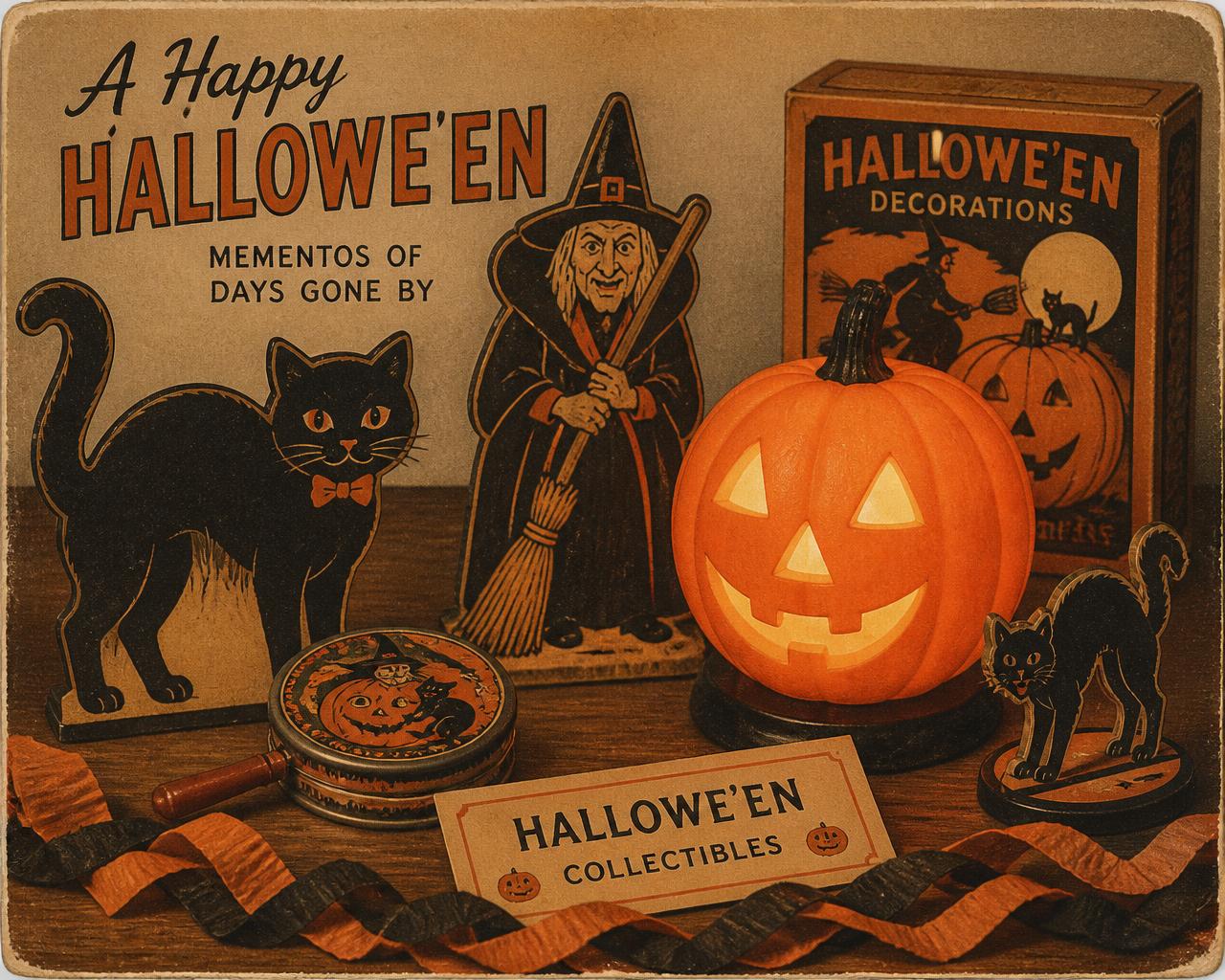
Black Cats, Witches & Skeleton Die-Cuts
Begin with the subject you actually want to live with, rather than a claim of rarity. Beistle paper belongs to a wider world of Halloween postcards, crepe paper and party ephemera; not every old paper cat is a Beistle cat.
Recognizing the Paper Families
Flat cutouts, articulated figures and tissue decorations are related, but their construction and condition checks differ.
Common forms
- Embossed black cats, witches and owls
- Skeleton cutouts with movable joints
- Fold-out decorations with honeycomb tissue
- Printed cardboard with punched hanging holes
How to compare
- Check whether the listing is for one cutout, a set, or mixed paper decorations.
- Look closely at thin tails, hat tips and jointed limbs, where losses are easy to miss.
- For honeycomb pieces, request a photograph opened gently as well as folded.
- Use dated catalog references or reliable comparison examples to identify a particular design.
Dating Without Guesswork
The collectibles page describes early designs as more grotesque and later ones as friendlier. That is context, not a dating certificate.
Useful evidence
- Photographs of the front and reverse
- A readable maker's mark
- Packaging or a dated catalog match
- Measurements and construction details
What to ask
- Ask what supports the seller's date, rather than accepting 'very old' as evidence.
- Compare size, printing and construction with a documented example.
- Treat fading and embossing as clues, not proof: storage changes appearance.
- If the evidence is incomplete, buy it as an undated decoration rather than a confirmed early original.
Original Beistle or Modern Reproduction?
Reissues let you hang a classic Halloween shape without risking an antique. The distinction matters most when the price depends on an early production date.
Read the Reverse First
Our collectibles guide highlights Bee-line and H.E. Luhrs marks, embossing and ink as starting points.
Inspection clues
- Diamond-shaped Bee-line or H.E. Luhrs printing
- Embossed relief in the cardboard
- Original punched holes
- Edges, joints and printed surfaces
A careful check
- Request a clear close-up of any mark rather than relying on the listing title.
- Compare embossing and color with known examples of the same design.
- Ask whether the piece is a reissue, has been repaired, or has replacement parts.
- Do not assume an unmarked cutout is modern, or a marked one is antique; weigh all the evidence together.
Condition Before Rarity
A complete, clean example is a different purchase from a cutout with a missing tail or tape stains.
Damage to record
- Creases and tears
- Missing corners, tabs or limbs
- Tape residue and added holes
- Sun fading and damp stains
Before buying
- Inspect the reverse for repairs that do not show in the front photograph.
- Compare completed sales for similar size, design and condition, not asking prices alone.
- Set a price ceiling before bidding; there is no universal price for a Beistle cutout.
- Choose a clearly labeled reproduction if your main goal is a busy party display.
Finding, Displaying & Storing Paper Cutouts
Estate sales, antique malls, flea markets and online auctions are the same hunting grounds recommended in our collectibles guide. A modest collection benefits from good storage as much as an expensive one.
Search Beyond the Maker's Name
Specific searches find a design; broader searches sometimes uncover a mixed box of holiday paper.
Search terms
- Beistle Halloween cutouts
- Vintage Halloween die-cuts
- Old paper cat or Halloween paper lot
- Beistle skeleton or witch decoration
Buying habits
- Ask estate-sale sellers whether boxed holiday decorations remain to be unpacked.
- Shop outside the October rush when you can compare more patiently.
- Ask how the seller will protect thin cardboard during shipping.
- Save photographs, measurements and purchase details with your collection records.
Protect the Original Surface
The printed paper is the collectible. Repairing it for convenience can permanently change it.
Storage supplies
- Acid-free sleeves
- Flat archival boxes
- A soft dry brush
- A cool, dry storage space
Care routine
- Dust gently with a soft dry brush; do not wet-clean printed paper.
- Keep cutouts out of direct sun and away from damp rooms.
- Store flat without folding, rolling, taping or laminating.
- Use reproductions near food, open doors or crowded party tables; reserve originals for protected display.
Frequently Asked Questions
- What are Beistle Halloween cutouts?
- They are shaped paper or cardboard Halloween decorations, including black cats, witches, skeletons and owls. Vintage embossed die-cuts are collectible, while modern reissues make the same style accessible for decorating.
- How can I tell whether a Beistle cutout is vintage?
- Check the reverse, maker's mark, dimensions, embossing and printing, then compare them with documented examples or dated catalogs. Bee-line and H.E. Luhrs marks are useful clues, but neither a mark nor faded orange ink proves age on its own.
- Are Beistle Halloween decorations still reproduced?
- Yes. Classic designs have been reissued. A reproduction is a practical choice for party decorating; ask sellers to distinguish modern reissues from the vintage examples whose price depends on age and originality.
- How much are vintage Beistle cutouts worth?
- There is no single price. Design, age, condition, completeness and evidence of originality all matter. Compare completed sales for the same design and similar condition, and account for repairs, missing pieces and shipping costs.
- How should I store vintage Halloween paper decorations?
- Keep them flat in acid-free sleeves or boxes, in a cool, dry place out of sunlight. Dust only with a soft dry brush. Avoid tape, lamination, folding and wet cleaning.