The Old Almanac
Halloween Superstitions and Their Origins
Long before Halloween meant candy and costumes, the night before All Saints' was treated as a hinge in the calendar — a moment when the ordinary rules loosened and small omens carried real weight. Most of the superstitions still repeated today, often as jokes, began as serious attempts to read luck, love and death in ordinary objects. Here is where the best-known ones actually come from.
The short answer
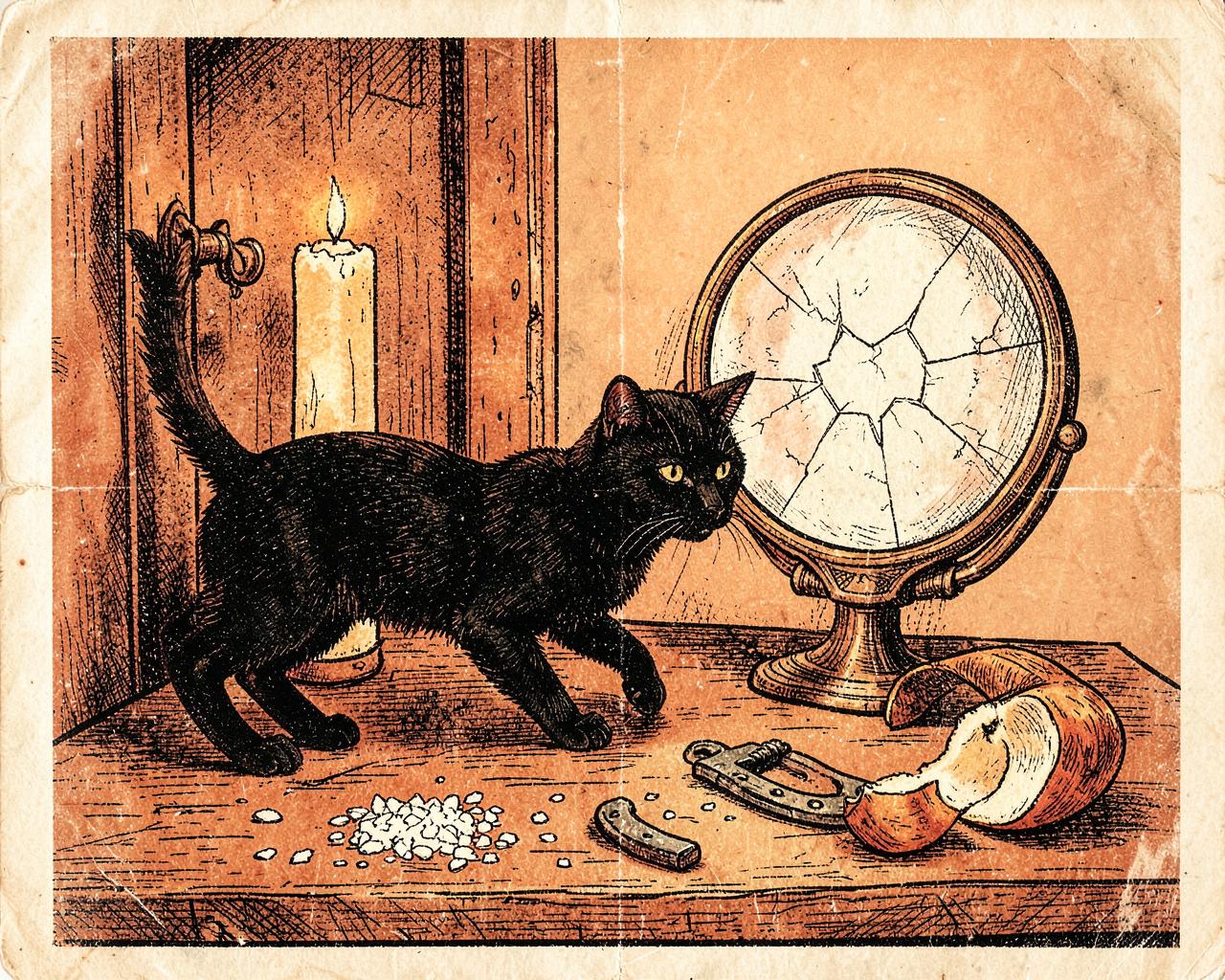
Most Halloween superstitions trace back to Samhain, the Celtic new-year festival marking the border between the living and the dead, later folded into the Christian Allhallowtide calendar. Black cats, mirrors, candles, salt, ladders and apple peels all became omens because they were common household objects pressed into service as tools for reading fortune, warding off spirits, or marking a night when the boundary between worlds was said to be thin.
Key points
- Most Halloween omens descend from Samhain, the Celtic festival marking the turn from harvest to winter.
- Black cats were feared mainly through their association with witches during the European witch trials, not ancient Celtic belief.
- Mirror and candle divination games were courtship rituals aimed at revealing a future spouse, not warnings of doom.
- Salt's protective power comes from its rarity and preservative use in the ancient and medieval world.
- Ladders, umbrellas indoors, and spilled salt share a common root: disrupting the shape of a protective triangle or barrier.
Where Halloween Superstition Comes From
Nearly every omen on this list can be traced to one of two sources: the Celtic festival of Samhain, or the centuries of European folk magic and witch panic that followed it.
Samhain and the Thin Veil
The Celtic new year fell on what is now October 31st, and it was treated as a night when spirits crossed easily into the human world.
At a glance
- Bonfires lit on hilltops
- Offerings of food left on doorsteps
- Costumes and masks to disguise the wearer from wandering spirits
Samhain marked the end of the harvest and the start of the dark half of the year for the ancient Celts of Ireland, Scotland and the Isle of Man.
Communities believed the wall between the living and the dead grew thin on this one night, letting spirits, fairies and the recently dead wander freely.
Bonfires were lit to represent the sun's power and to ward off wandering spirits through the coming winter.
People left out food and drink to placate visiting spirits, a custom later echoed in trick-or-treating.
Costumes and blackened faces were worn so that a person might pass unnoticed among the spirits abroad that night.
All Hallows' Eve and the Church Calendar
The Christian church absorbed Samhain into its own calendar rather than erasing it, which preserved much of the older folklore.
At a glance
- All Saints' Day, November 1st
- All Souls' Day, November 2nd
- Souling and guising customs
In the 8th and 9th centuries the church moved All Saints' Day to November 1st, placing it directly after Samhain.
The night before became All Hallows' Eve, later shortened to Halloween.
Souling — going door to door offering prayers for the dead in exchange for soul cakes — blended pagan and Christian practice.
Superstitions about wandering spirits survived because the new holiday kept the same date and the same nighttime character.
Irish and Scottish emigrants carried these blended customs to North America in the 19th century, where they took the shape familiar today.
Black Cats: How a Housecat Became an Omen
The fear of a black cat crossing your path is far younger than most people assume, and it owes more to the witch trials of early modern Europe than to ancient Celtic belief.
The Witch's Familiar
Black cats were tied to accusations of witchcraft in medieval and early modern Europe, which is where the fear really hardens.
At a glance
- Medieval bestiaries linking cats to night and darkness
- Witch trial records naming animal familiars
- Pope Gregory IX's 1233 decree associating black cats with the devil
Cats' nocturnal habits and silent movement made them easy to cast as supernatural in medieval imagination.
A 1233 papal decree linked black cats to devil worship, giving the association official religious weight.
During the witch trials of the 15th through 17th centuries, accused witches were often said to keep a black cat as a familiar spirit.
Killing black cats on sight became common in parts of Europe, occasionally blamed for worsening rat-borne plague outbreaks.
The superstition crossed the Atlantic with European settlers and attached itself to American Halloween imagery in the 19th century.
Not Universally Bad Luck
The 'bad luck' reading of a black cat is mostly an American and English tradition — other cultures read it as the opposite.
At a glance
- British and Irish sailor lore
- Japanese and Scottish folk belief
In Britain and Ireland, a black cat crossing your path is often considered good luck rather than bad.
Sailors in several European countries kept black cats aboard ship, believing them lucky and able to predict weather.
In Japan, a black cat is traditionally a sign of good fortune, especially for single women hoping to attract suitors.
The specifically American reading — a black cat crossing left to right brings bad luck — solidified alongside Halloween's postcard and greeting-card imagery around 1900.
Animal shelters still report black cats are adopted more slowly around Halloween, a modern echo of the old superstition.
Mirrors, Candles, Salt and Ladders
Ordinary household objects carried outsized superstitious weight because they were the tools people actually had on hand for divination and protection.
Mirrors and Fortune-Telling
Mirror divination on Halloween was originally a courtship game, not a warning.
At a glance
- A hand mirror
- A candle
- A dark room or stairwell
A popular 19th-century Halloween game had young women walk downstairs backward holding a candle and a mirror, hoping to see a future husband's face over their shoulder.
Breaking a mirror being seven years' bad luck dates to Roman belief that mirrors held a piece of the soul, and that the soul renewed itself every seven years.
Covering mirrors after a death is a much older, separate custom meant to stop a departing soul from being trapped inside the glass.
Mirror games were considered riskiest on Halloween specifically because the night was already thought to loosen the barrier to the supernatural.
Seeing a skull instead of a face in the Halloween mirror game was read as an omen of death within the year.
Candles and Flames
A candle's behavior — guttering, blowing out, changing color — was read as a direct message from the spirit world.
At a glance
- A single lit taper
- A draft-free room
A candle flame that suddenly bends or flickers with no draft was said to signal a spirit passing nearby.
A candle that blows out on its own on Halloween night was considered a warning to end whatever activity was underway.
Blue-tinged flames were specifically associated with the presence of ghosts in English and Appalachian folklore.
Lighting a candle in a window on Halloween or All Souls' night was meant to guide the spirits of family dead safely home.
The jack-o'-lantern itself descends from this same tradition of a single flame carried or displayed to ward off wandering spirits.
Salt as Protection
Salt's reputation as a ward against evil is ancient and comes from its rarity and its power to preserve.
At a glance
- A pinch of salt
- A doorway or threshold
Salt was expensive and essential for preserving food for most of human history, which gave it an aura of value and power.
Roman, Greek and later Christian traditions all treat spilled salt as an invitation to bad luck or evil spirits.
Throwing a pinch of spilled salt over the left shoulder was believed to blind the devil said to be lurking there.
Salt poured across a threshold or windowsill was a common protective measure against spirits entering a home on Halloween night.
Leonardo da Vinci's The Last Supper shows Judas having knocked over a salt cellar, reflecting how established the omen already was by the Renaissance.
Ladders, Umbrellas and Other Small Omens
A cluster of everyday superstitions share the same underlying logic: don't disturb a protective shape or invite bad luck through carelessness.
At a glance
- A leaning ladder
- An open umbrella
- A stray shoe on a table
Walking under a ladder was thought to break the triangle formed by the ladder and the wall, a shape long associated with sacred protection.
In medieval Europe, a leaning ladder also resembled a gallows, adding a darker layer to the superstition.
Opening an umbrella indoors was considered bad luck partly for practical reasons — early metal-ribbed umbrellas could injure people or break objects indoors.
Placing new shoes on a table was linked in northern England to the practice of laying out a corpse's shoes, making it an omen of death.
Many of these superstitions strengthened during Halloween specifically because the holiday already primed people to look for omens in ordinary objects.
Apple Peels and Other Halloween Fortune-Telling Games
Before candy and costumes took over, Halloween in Britain, Ireland and early America was an evening of parlor games aimed almost entirely at predicting who you would marry.
The Apple Peel Game
Peeling an apple in one long strip and reading the shape it fell in was one of the most popular Halloween love-divination games of the 19th century.
At a glance
- One apple
- A sharp paring knife
Peel an apple in a single continuous strip without breaking it.
Toss the peel over your left shoulder onto the floor.
The letter the peel roughly formed when it landed was believed to be the first initial of your future spouse.
A peel that broke during peeling was taken as a sign of a lonely year ahead.
Variants used the peel length itself as a measure of how many years remained in your life.
Bobbing, Nuts and Mirrors
Apple bobbing and roasting nuts on the hearth were both originally courtship divination games rather than children's party activities.
At a glance
- A tub of water and apples
- Two chestnuts or hazelnuts
- A hearth fire
In apple bobbing, the first person to bite an apple was traditionally said to be the next to marry.
Naming two nuts for a couple and placing them on the hearth, if they burned steadily together, was read as a sign of a lasting match.
Nuts that popped apart or crackled loudly were thought to predict quarrels or a broken engagement.
Scottish and Irish versions of these games were among the customs directly imported into 19th-century American Halloween parties.
Magazine and postcard publishers around 1900 popularized these games nationally, cementing them as Halloween party staples even as their fortune-telling seriousness faded.
Frequently Asked Questions
- Why is a black cat considered bad luck on Halloween?
- The association comes mainly from medieval and early modern Europe, where black cats were linked to witchcraft and named as witches' familiars during the witch trials. A 1233 papal decree tying black cats to the devil reinforced the idea. In Britain and Ireland, by contrast, a black cat crossing your path is traditionally considered good luck — the 'bad omen' reading is largely an American convention.
- Where does the superstition about breaking a mirror come from?
- It dates to Roman belief that a mirror captured a piece of a person's soul, and that the soul physically renewed itself every seven years — hence seven years of bad luck for shattering the glass. Mirror games specifically on Halloween grew from a separate 19th-century courtship tradition where young women tried to glimpse a future husband's face in the glass.
- Why is spilling salt considered unlucky?
- Salt was historically rare, expensive, and essential for preserving food, which gave it protective and almost sacred status across many cultures. Spilling it was seen as wasteful and unlucky, and throwing a pinch over your left shoulder was believed to blind the devil thought to be waiting there to take advantage of the mishap.
- What does it mean if a candle flame flickers on Halloween?
- In older folklore, a candle flame that bends or flickers with no obvious draft was read as a sign that a spirit had passed nearby, and a flame that turns blue was specifically associated with a ghostly presence. A candle blowing out on its own during a Halloween ritual or game was usually taken as a signal to stop.
- Is the apple peel fortune-telling game real folklore or a modern invention?
- It is genuine 19th-century folklore, imported to North America from Scotland and Ireland along with other Halloween courtship games like apple bobbing and nut roasting. The idea was that a single unbroken apple peel, tossed over the shoulder, would land in the shape of a future spouse's initial.
- Why is walking under a ladder considered bad luck?
- A leaning ladder forms a triangle against a wall, a shape long treated as sacred or protective in European folklore, and walking through it was thought to break that protection. The ladder's resemblance to a gallows in medieval Europe added a darker association with death.
- Are Halloween superstitions based on real ancient Celtic beliefs?
- Some are, but many are later additions. Core ideas — a thin veil between worlds, wandering spirits, costumes as disguise — trace back to the Celtic festival of Samhain. Others, like the black cat as a bad omen and the specific mirror and apple-peel games, developed later during the medieval witch trials and the 19th-century Halloween party tradition, then got folded into the same holiday.