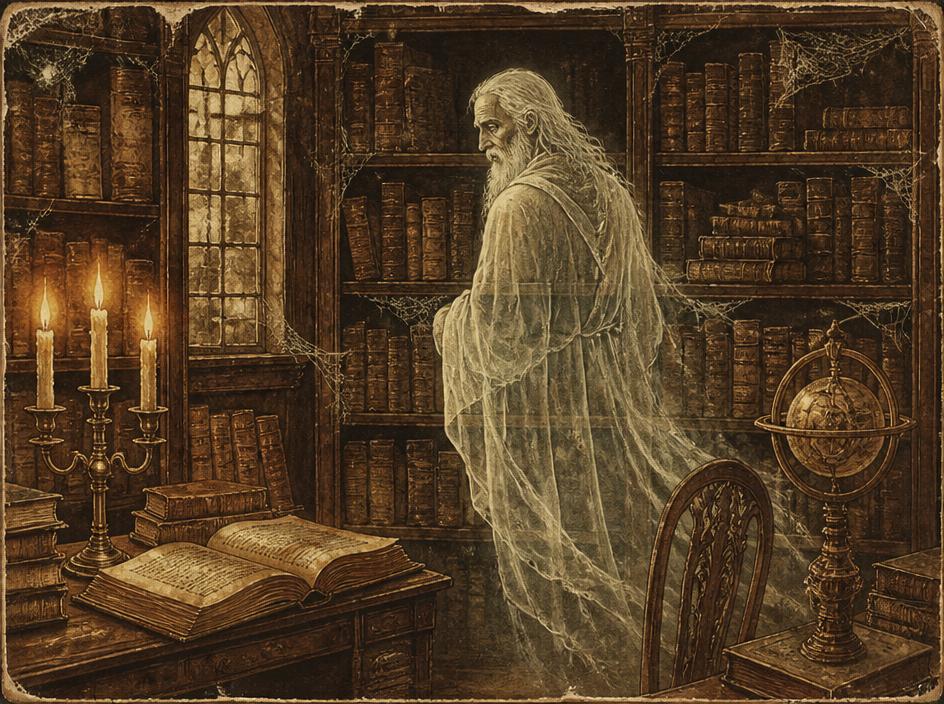
The Lantern Keeper of Hollowmere
9 min read · Original fiction — a story, not a true account
My grandfather kept the light at Hollowmere for forty-one years, and in all that time he never once told me what it was for. He told me how — how to trim a wick so it burned without smoke, how to read weather in the way gulls sat on the water, how to walk the causeway in fog by counting fence posts instead of trusting your eyes. But never why a lighthouse stood on a hill above a marsh, three miles inland, facing not the sea but a flooded valley where nothing sailed and nothing ever had.
I was eleven the first autumn I stayed with him alone. My mother had gone south to bury her sister and had left me at Hollowmere with a suitcase, a jar of pickled beets, and the instruction to be no trouble. The house crouched against the base of the tower like something sheltering from a blow. Inside it smelled of paraffin, wet wool, and the particular sourness of a kitchen where a man has cooked for himself too long.
"You'll sleep in the west room," he said. "Window faces the hill. Not the water."
I asked, reasonably enough, why it mattered which way my window faced. He looked at me for a long moment with his pale, salt-scoured eyes, and then he said, "Because you're eleven," and went out to wind the clock in the lamp room.
You must understand what Hollowmere was before you can understand what it became. There had been a village down there — a real one, with a church and a school and a lane of stone cottages that flooded every spring and dried out every summer, the way such places do. Ninety-one people, according to the census of 1927. A cheese cooperative. A brass band that was reliably terrible. Then in 1931 the county built the reservoir dam eight miles downriver, and the water came up over four years so slowly that the villagers had time to argue about it at every stage and lose at every stage.
They were relocated. That is the word in the county records: relocated. Cottages were emptied, the school bell was carted off to a chapel in Marrowby, and the graves in the churchyard were meant to be lifted and reinterred on higher ground. Meant to be. The men hired for the work were paid by the day and finished early, and there is a page in the parish ledger where the list of names moved simply stops mid-column, with a fingerprint of ink at the bottom as though someone closed the book in a hurry.
Fifty-three graves were never lifted. My grandfather knew the number the way other men know their own birthday.
The light was built in 1934, the same year the water reached the top of the church steeple. The county called it a navigation beacon, which was a lie so plain that nobody in Marrowby bothered to correct it. Nothing navigates a reservoir. It was built because in the winter of 1933 four people from three separate families walked out onto the ice at Hollowmere in the middle of the night, in their nightclothes, without lamps, and did not come back. The coroner wrote sleepwalking on all four certificates and drank steadily for the rest of his life.
So they raised a tower, and they put a keeper in it, and they told him to keep a light burning from dusk to dawn between Michaelmas and Candlemas. And every keeper since has understood, without ever being told in writing, that the light is not there to warn boats off the water. It is there to give the drowned something to look at that is not the shore.
My grandfather's rounds began at four in the afternoon in late October, when the valley filled with a fog that came up out of the water rather than down out of the sky. He would light the lamp, then take a hand lantern and walk the causeway — the old lane out of the village, which still ran a half mile into the reservoir before it sloped away under the surface. He walked to the ninth fence post and no further. At the ninth post he stood for perhaps two minutes. Then he came back.
I asked what he did out there. He said he counted.
"Counted what?"
"Lights," he said. "On the water. If there's fewer than fifty-three, that's a good night. If there's fifty-three, you come inside and you bolt the door and you don't answer it, no matter whose voice is asking."
I laughed, because I was eleven and it was four in the afternoon and laughing was the only tool I had. He did not laugh with me. He wrote something in the logbook on the kitchen table — a leather ledger fat with sixty years of other men's handwriting — and I saw, upside down, the entry for that day: 29 October. Wind SW. Fog after three. Nineteen.
I began, after that, to read the log when he slept.
It was the most patient document I have ever encountered. Weather, wind, hours burned, oil used, and then, in the last column, a number. Most nights it was blank or single figures. In November it climbed. In the weeks around Halloween it climbed steeply, and there were years — 1947, 1958, 1963 — where a keeper's hand had written forty-something and then, in the space below, nothing at all for three or four days, as though the man had needed that long to feel like writing again.
And twice — 1938 and 1971 — the number was fifty-three. Both entries were followed by the same six words, in different handwriting: Someone knocked. Did not open the door.
I stopped reading the log after that and started watching the window instead. My window faced the hill, as instructed. But the west room had a second, smaller window on the return of the stair, and the stair window faced the water, and my grandfather could not be in two places at once.
The first night I looked, I saw nothing but fog lit orange from above by the turning lamp. The second night, the same. The third night was the thirty-first of October, and the fog was thin and lay flat on the water like a sheet pulled over furniture, and I saw the lights.
They were not lights exactly. They were the idea of lights — small, low, warm, the colour of a candle behind a hand — and they sat on the surface of the reservoir in a loose crowd, out where the village had been. Some drifted. Most did not. Two were close together and moved as one, and I understood without being told that they were holding hands, and that one of them was small.
I counted forty-one, lost my place, counted again, got forty-four, and gave up shaking.
Down on the causeway my grandfather stood at the ninth post with his lantern held out at the end of his arm, as far from his body as he could hold it. He was not moving. The lights nearest to him had turned — I cannot describe how a light turns, but they had turned — and were facing him, and the water between them was flat as glass.
Then he lowered the lantern, and walked back, and I heard him bolt the kitchen door, and the sound of that bolt is the only part of the night I still hear when I am falling asleep.
He knew I had watched. He put the kettle on without looking at me and said, "How many did you make it?"
"Forty-four."
"Forty-six," he said. "You missed the two by the steeple. They stay low." He poured the tea. His hands were entirely steady, which frightened me more than trembling would have. "They're not hunting anybody. Get that out of your head first, because it's the thing that ruins men out here. They're only looking for the shore. They went into the ground before the water came, and the water came anyway, and now they don't know which way is up out of it. So somebody keeps a light where the shore is, high enough to be seen from underneath. That's the whole of the job."
"Then why fifty-three?" I asked. "Why bolt the door?"
He drank his tea. Outside, the lamp swept the fog, and swept it again.
"Because on a night when all fifty-three are up," he said, "they've stopped looking for the shore. They've found it. And what comes to the door then isn't asking for directions."
I stayed at Hollowmere eleven more days. Nothing else happened, in the way that nothing else happens when you have already been shown the thing. My mother came back sunburnt and short-tempered and took me home, and I did not return until I was thirty-four and he was dying.
He died in the February, out of season, with the lamp cold. The county had automated the light in 1979 — a timer, a sealed bulb, a man from the water board once a month with a clipboard — and they had let my grandfather stay on in the keeper's house because it was cheaper than repairing it for anyone else. He had gone on walking the causeway anyway. He had gone on writing in the log. Nobody had asked him to for fourteen years.
The last entry is in a hand I barely recognised, all long loops and no pressure. 2 February. Still. No fog. Thirty-one. Then, underneath: They are patient. Be patient back. The light does not have to be brave. It only has to be lit.
I have the log now. It sits on the shelf above my desk between the tide tables and a jar of his shirt buttons, and every October I take it down and read a year at random, and every October I tell myself I am not going to go back out there.
But I do go. I drive up the reservoir road on the last evening of the month and park where the causeway starts, and I walk to the ninth fence post — the posts have been replaced twice but they kept the count, whoever they are — and I stand there for two minutes with a torch held out at the end of my arm.
The automated light turns above me on its timer, indifferent as a clock. Out on the water the small warm lights gather and drift and do not come closer. Last year I counted thirty-eight. The year before, forty-two. I write the number on the back of a receipt in the car with the heater roaring, and I keep every one of them in the glovebox, which is, I am aware, a logbook by another name.
If you ever find yourself at Hollowmere in late October — and people do, walkers mostly, who read about the drowned church and want a photograph of the steeple at low water — I will tell you what my grandfather never quite told me, because I have decided that it is better to be eleven and warned than eleven and clever.
Stand on the causeway if you must. Count if you must; you will, whether you mean to or not. But if you reach fifty-three, do not finish the count out loud. Walk back. Bolt whatever door you have. And when the knock comes — patient, unhurried, at the height of a hand that has to reach up rather than out — remember that the light was never a warning to you.
You were only ever the thing standing between it and the ones who are looking.
"The light is not there to warn the living away. It is there so the dead can find the shore."