The Lock-Keeper of Shipley Flight
10 min read · Original fiction — a story, not a true account
I want to start with how a lock works, because nothing in this account makes any sense unless you can see it, and because almost nobody under sixty has stood in front of a working one.
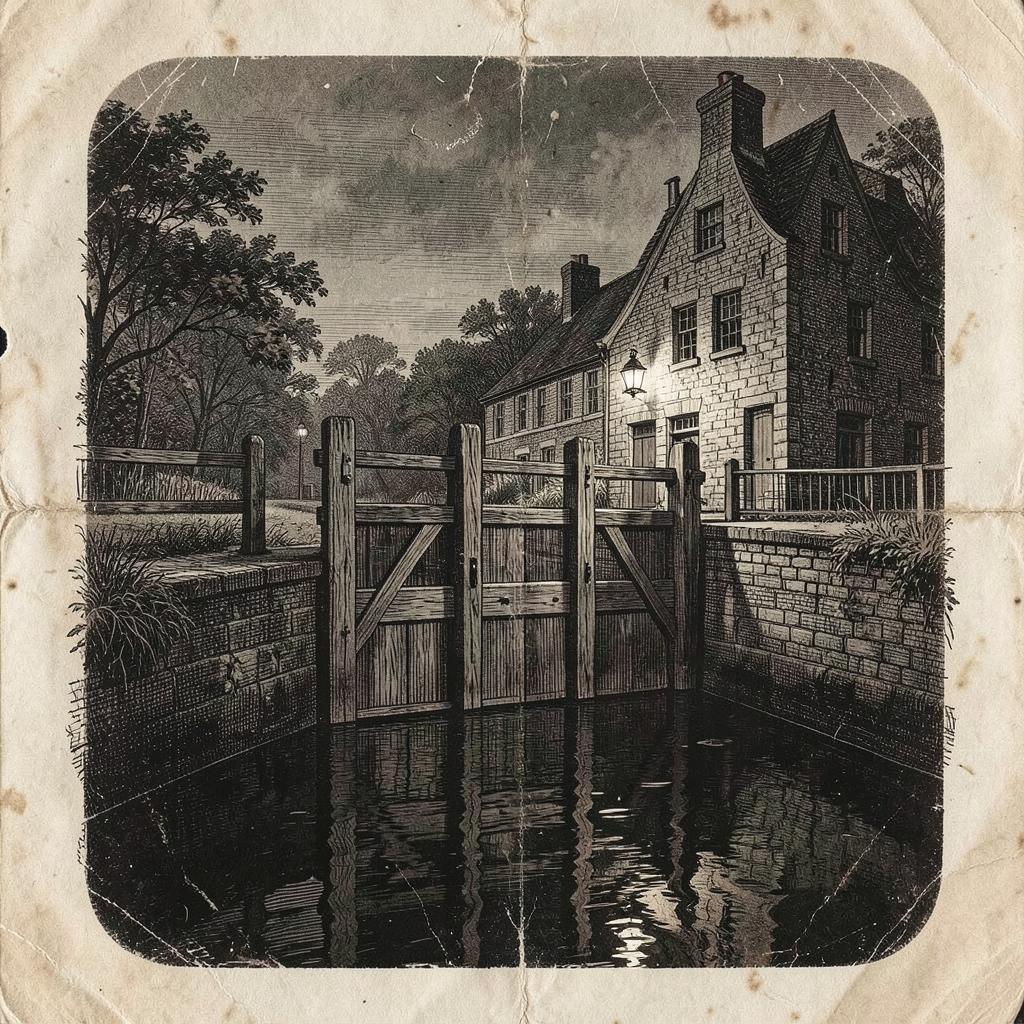
A canal does not run downhill. A canal is flat water, and where the ground drops you build a lock: a stone room, ninety feet long and fifteen wide, with a pair of wooden gates at each end. A boat comes in the top gates, the top gates close, you open the paddles in the bottom gates, and the room empties. The boat goes down with the water like a coin in a glass. Then you open the bottom gates and it goes on its way.
There is no machinery. There is a beam on each gate — a great oak arm the length of a man's outstretched body and twice his weight — and you put your back against it and you walk it round. That is the whole of the technology, and it has not changed since the seventeenth century, and it works in the dark, in ice, and in flood, which is more than can be said for most of what has replaced it.
The Shipley Flight was nine locks in three-quarters of a mile on a branch canal that carried coal, lime, and bricks for sixty-two years and lost every load of it to the railway between 1871 and 1889.
The branch was formally abandoned in 1889. The water was let out of the summit in 1893. The nine chambers have stood dry — a stone staircase full of nettles and elder and beer cans — for a hundred and thirty-three years.
Lock five, the middle of the flight, still has its bottom gates. I do not know why. Every other pair on that flight was taken for firewood or rotted into the mud by 1920, and the bottom gates of number five are there, black, waterlogged, wrong, with both beams intact, in a chamber with no water in it and nothing on either side but a footpath and a dry bed full of hawthorn.
I have measured them. They are eleven feet high and they meet at a mitre and they are as sound as the day they were hung, in oak that has been dead for a century and a half and has never been allowed to dry out.
My grandmother was born in the lock cottage at number five in 1901, twelve years after the canal closed, because her father was employed by the canal company — which still existed on paper, as these companies did, for decades after they carried anything — as a length-man, to keep the towpath walkable and the bridges from falling on anyone.
She lived in that cottage until she was nineteen and she left it in 1920 and she would not go back, and when I was a boy she told me exactly one thing about it and told me the same words every time, in the same order, the way you recite something you have decided not to think about again.
She said: At four in the morning the lock fills, and he walks the beam, and you do not go out and you do not look and you certainly do not help him.
Here is what is documented, and I am a dull man by trade — I spent thirty-one years in the county records office — so the documentation is the part I can be trusted with.
The lock-keeper at number five from 1854 to 1889 was a man named Fenwick Ord. Thirty-five years on one lock. He was appointed at twenty-six and he was there at sixty-one, when the branch closed, and the company's minute book records that on the abandonment of the branch Ord declined the offered position at another lock on the main line and asked to be permitted to remain in the cottage at number five as a length-man at reduced wages, and that this was granted.
He remained. From 1889 to 1897 there was no water in that flight and no traffic on it and Fenwick Ord lived in the cottage beside a dry lock and walked the towpath and cut back the hawthorn, and every account of him from those eight years — and there are four, in two parish magazines and a newspaper piece about the melancholy of abandoned waterways — says the same thing, which is that he kept the gates.
He greased the collars. He kept the mitre clear. He replaced a cracked heel post in 1893 with timber he paid for himself, which I know because there is a receipt for it in a bundle of the company's correspondence that nobody had untied since 1901 and which I untied in 1979 in a cold room in the basement of a records office, wearing gloves, at the age of thirty-two.
In the winter of 1897 he was found in the chamber of lock five, at the bottom, in about eighteen inches of standing rainwater, having fallen or been struck by a beam, aged sixty-nine. The inquest returned accidental death and noted that the deceased had been engaged, at night, in work upon the lower gates.
In February. Alone. In a dry lock on an abandoned canal, at night, at sixty-nine, working on a pair of gates that had not held water in eight years and never would again.
The four-o'clock filling is the part I cannot do anything with, and I have had forty-six years and a records office and an obsessive temperament and I cannot do anything with it.
I have heard it eleven times. Nine of those in the summer of 1980, when I was thirty-three and had just found the receipt for the heel post and was not, I think, entirely well, and slept in a tent on the towpath above number five for eleven nights.
It does not sound like water in a chamber. That is the first thing everyone gets wrong. There is no splashing, no pouring, no rush. What you hear, starting at some point between ten past four and half past, and building over perhaps four minutes, is the sound of a very large, very heavy volume of water being still — which is a real sound, a sort of low held pressure in the ear, the sound you get standing at the edge of a full canal at night, and which is entirely different from the sound of a dry stone hole in the ground.
The nettles do not move. The chamber is empty. You can shine a torch down it and see the mud and the bricks and a bicycle frame that has been down there since 1994. And your ears will tell you, with total confidence, that you are standing beside ninety feet by fifteen of black still water, and that it is high, and that it is right up under the coping at your feet.
Then the beam.
Wood under load. Not a creak — a groan with grit in it, and the specific double note of an oak beam swinging on a greased collar, and a man's boots going round on stone in short shuffling steps, eleven or twelve of them, which is how many steps it takes to walk a bottom gate open.
Then the same again on the other side, because there are two gates and one man, and he has to come back across the chamber on the plank and do the second one on his own, which is why it takes him about ninety seconds and why the two halves are never quite symmetrical.
And then the water goes. Not a draining sound. The held pressure simply lifts out of your ears, over about twenty seconds, the way the sound of a fridge leaves a kitchen.
I have taken a sound recordist and equipment worth more than my car down that towpath at half past three in the morning in 1988 and again in 2004, and I have thirteen hours of magnetic tape and eleven of digital audio, and there is nothing on any of it but a tent zip, an owl, a lorry on the bypass, and in 2004 my own breathing going wrong for about ninety seconds in the middle.
So I hold both of these at once, and have for a long time now: it is not on the tape, and I have heard it eleven times, and my grandmother heard it as a child in a cottage forty feet away and was so certain of what it was that she gave her grandson an instruction about it seventy years later.
You do not go out. You do not look. And you certainly do not help him.
It is the third clause that took me thirty years to understand, and I understood it in the end not by thinking but by nearly doing it.
August 2004, ten past four, the recordist asleep in the other tent, the pressure in my ears, the beam going round on the far side, and the sound of a man of sixty-nine on wet stone taking the load of a two-hundred-and-fifty-pound oak arm on his shoulder in the dark on his own.
And I was standing on the coping with my hands out. Not deciding to. Standing there with my palms open at about the height of a beam and my weight already forward, the way you stand when you are about to take one end of something heavy off somebody who has been carrying it too long.
And I stopped, because I heard my grandmother's voice say the words in the order she always said them, and because a thought arrived in one piece which I have never been able to improve on since.
There is no water in that lock. There is no boat. There is nothing above the gates to hold back and nothing below them to let down. The work is not work. It has not been work since 1889. It is a habit that outlived its purpose by eight years while the man was alive and by another hundred and twenty-nine since, and it costs him something to do it, every morning, at ten past four.
And if I put my hands on that beam, I do not think I would be helping. I think I would be signing on.
I have been back perhaps a dozen times since, in daylight, like a sensible man, with sandwiches.
The Canal and River Trust has the flight now as a heritage footpath. There is an interpretation board at the top with a nice drawing of a narrowboat and a paragraph about the coal trade, and a bench, and a bin. Lock five has a low rail round it and a sign that says DEEP DROP - KEEP CHILDREN CLOSE, which is the most useful sentence anybody has written about that place in a hundred and thirty years.
In 2019 a volunteer group cleared the elder out of the chamber and greased the collars on the bottom gates, because that is what canal volunteers do to any moving iron they find, and the gates are now, for the first time since 1897, properly maintained.
I heard about it afterwards. I went down and looked at the fresh grease in the collars and I sat on the bench for a long time, and I could not decide, and cannot decide now at seventy-nine, whether we have done that man a kindness or made it easier for him to keep going.
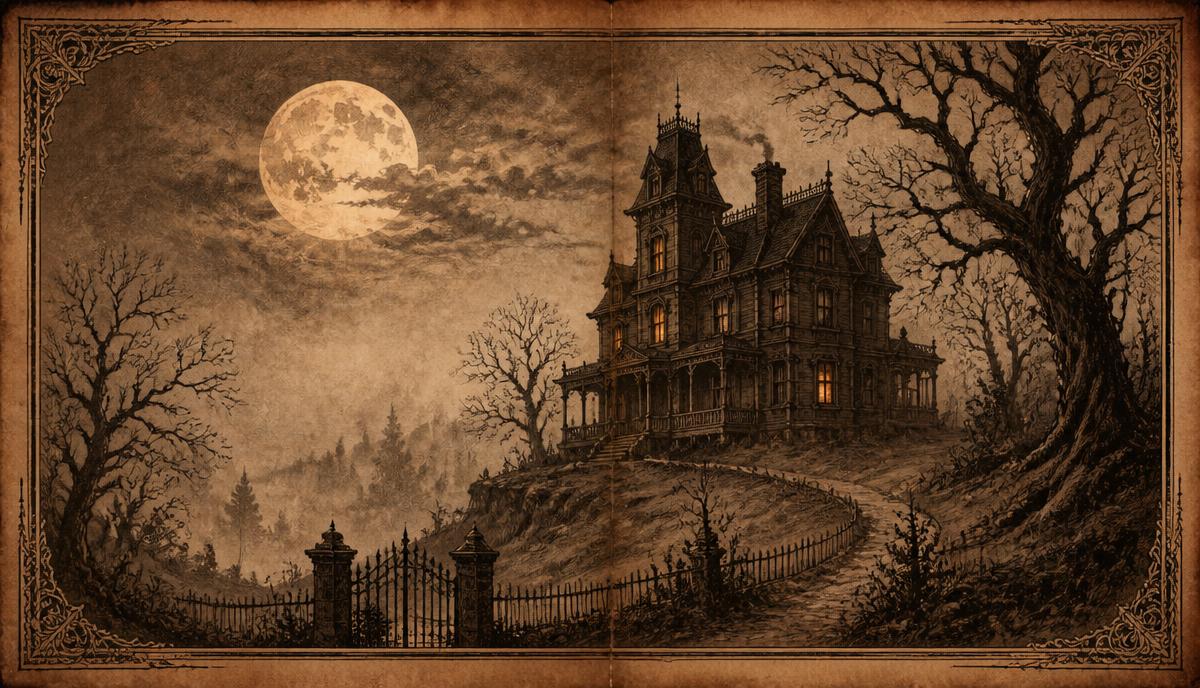
The cottage is a holiday let. It sleeps four, it has a wood-burner and a hot tub, and the listing mentions the peaceful canalside setting and the abundant birdlife, and it is booked most of the summer.
I have thought about leaving a note in the drawer of that kitchen — nothing dramatic, just my grandmother's three clauses, in her order, in my handwriting, for whoever wakes at ten past four with their ears full of a canal that has not existed since 1893.
I have not done it. But I have written it out, and it is in my desk, and it says: At four in the morning the lock fills, and he walks the beam. Do not go out. Do not look. And whatever you are, whatever your hands want to do, do not help him — he has only ever had the one job, and he is not finished with it, and there is no one to relieve him.
"A lock is a room you build in a river to lift a boat by hand. Nobody told him the river had gone."