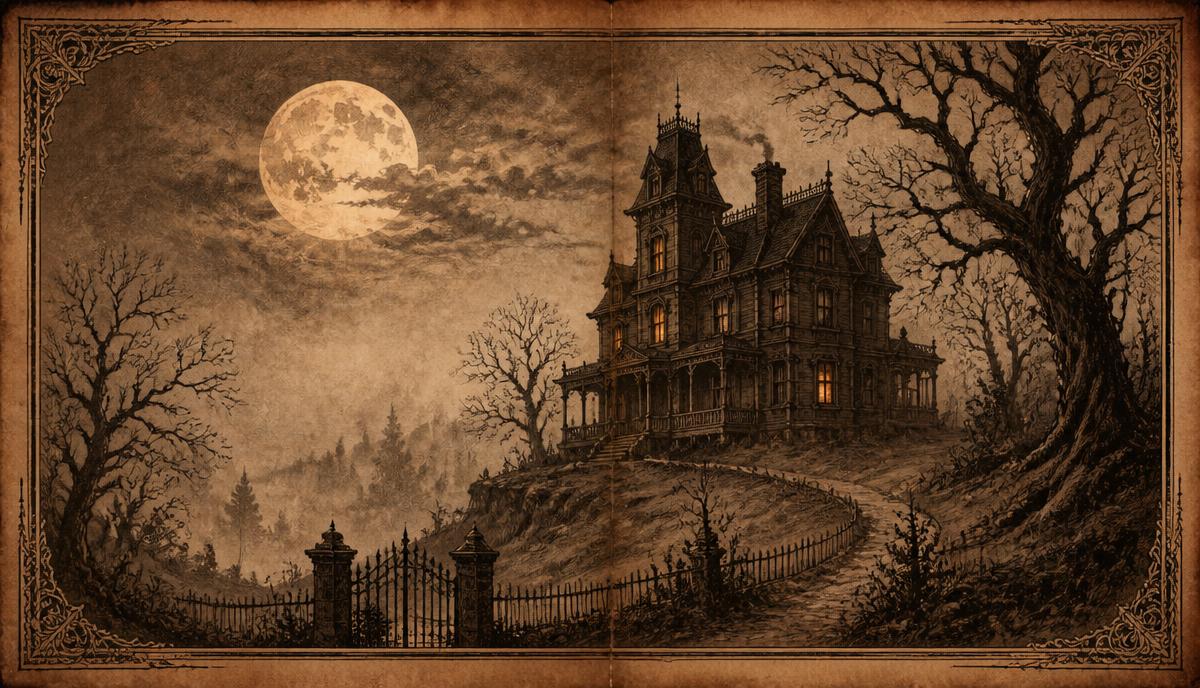
The Orchard That Counted
7 min read · Original fiction — a story, not a true account
The Ballard orchard sits on the south face of Hark Mountain in a county I will not name, and it has produced one hundred and nine bushels of apples every autumn since 1867. Not approximately. Not on average. One hundred and nine, in wet years and drought years, in the year the late frost took every other orchard on the ridge, in the year the blight came through and left the Ballard trees standing untouched in the middle of a dead valley like something the disease had been warned about.
I know this because I spent an autumn there in my twenties, hired as picking labor and kept on as something closer to a witness, and because Ada Ballard, who was eighty-one and ran the place from a kitchen chair on the porch, showed me the tally books. Ten of them. Every year in a different hand as the job passed down. One hundred and nine, one hundred and nine, one hundred and nine, in ink that went from iron gall to fountain pen to ballpoint without the number changing once.
"You'll want to know how," she said. "Everybody wants to know how. The how is easy. It's the why you'll lose sleep over."
The how, as she explained it, was this: they picked one hundred and eight bushels, and they left the hundred and ninth on the trees.
Not scattered windfalls. Not gleanings for the birds. A deliberate, counted, carefully distributed bushel's worth of good fruit, left hanging in the branches through the first freeze and the second, until it went soft and brown and dropped of its own accord into the grass. Every Ballard child learned the count before they learned long division. Every hired hand was told, on their first morning, in the same flat voice: you may eat what you like, you may take a peck home, but you do not touch a marked tree, and if you cannot tell a marked tree from an unmarked one, you ask.
The marks were small notches, waist-high, cut fresh each August. There were never many. Nine trees, usually, out of four hundred.
I asked what happened if someone picked a marked tree.
Ada looked out at the rows for a while. It was late September and the light on Hark Mountain in late September is the color of weak tea, and the fog was already coming up out of the hollow the way it does an hour before you expect it.
"In 1911," she said, "my father's cousin Wendell picked the marked trees. He was nineteen and he thought the whole thing was hill superstition and he wanted the extra money the extra bushel would bring, which was one dollar and forty cents." She folded her hands. "That's the whole of it. One dollar and forty cents."
"And?"
"And we had a hundred and nine bushels that year, same as always," Ada said. "Because Wendell went into the orchard on the third of November to see about a noise, and we never found him, and the orchard took its own hundred and ninth."
She said it without drama, in the voice of a woman reporting a hailstorm. That was the thing about Ada. She had lived her entire life inside an arrangement she did not understand and had made her peace with the not understanding, which I have come to think is a kind of courage that gets very little credit.
Here is what the family knows about the beginning, assembled from three tally books, a Bible flyleaf, and a deposition given to a county clerk in 1894 by a woman who could not write her own name.
The land was cleared in 1859 by Absalom Ballard, who bought it cheap because the previous owner had walked off it. There was already an orchard on the south face — old trees, older than the deed, planted in a pattern that made no sense for harvesting and perfect sense for something else, nine rows of nine with a gap at the center where nothing would grow and where the soil, when you dug it, came up the wrong color.
Absalom did not clear the center. This is the single decision on which four generations of his descendants have staked their lives, and there is no record of why he made it. He grafted, he pruned, he added rows to the east, and he left the center gap alone, and he fenced it with chestnut rails so that a cow would not wander in.
In 1866 the orchard failed. Every tree, the old ones and the new. Not a single apple set. And that winter Absalom's youngest daughter, Cassie, who was six, went out at dusk to the fence around the center gap and stood there for most of an hour talking to nobody, and came back and told her mother that a woman in the gap had said the trees were hungry and had been promised better.
Absalom went out at first light with an axe, intending — the deposition is clear on this — to cut the whole orchard down and burn it. He came back at noon without the axe, sat down at the table, and said, "We'll leave a share."
That was 1866. In 1867 they picked one hundred and eight bushels and left a bushel hanging. They have not missed a year since.
I want to be careful here, because I am not going to tell you that I saw a woman in the gap. I did not. I want to tell you what I actually saw, which was worse in a way I still cannot articulate.
It was the second week of October, and I had been sent up the top rows at dusk to bring down the last of the ladders. The fog had come. Hark Mountain fog does not drift; it arrives in the spaces between things, so that the row you are standing in is clear and the row beside you is gone. I had a lantern because Ada did not allow flashlights in the orchard after dark and would not say why.
I came out at the center gap, which I had never seen up close, because there was no reason to go there and every reason not to. The chestnut rails had been replaced sometime in the fifties with locust posts. Inside them was a circle of bare earth about thirty feet across, and the earth was clean — not fallow, not weedy, clean, as though it were swept, and I remember standing there doing the arithmetic of how much labor it would take to keep thirty feet of mountain soil swept and coming up with an answer that made no sense.
And in the middle of the swept circle, arranged in a low careful pile, were apples.
Good ones. The bushel that had been left hanging in the branches on nine trees scattered over a hundred acres — the fruit that was meant to soften and drop where it hung — was stacked in the center of the gap, stem-up, in a cone, the way you would build a cairn.
I counted, because I am the kind of person who counts. There were more than a bushel. I stopped at two hundred and something because my lantern was guttering and because I had begun to understand that whatever tidied that circle had been tidying it for a hundred and thirty years, and that the pile was not an offering being received. It was an offering being kept. Stored. Counted, by something that also counted, and that had apparently never once been shorted except in 1911, and had made up the difference itself.
I walked back down. I did not run, because it seemed important not to run, and I have never been able to explain that instinct either.
I told Ada. She nodded and poured me coffee and said, "Nobody's supposed to see the pile. It's not forbidden. It's just not for us." And then, after a while: "Wendell's in there somewhere, I expect. Under it. Counted and put away."
I left at the end of the season. Ada died in 2004. Her grandson runs the orchard now, and he sells at three farmers' markets and has a website with a nice photograph of the rows in blossom, and the website says the orchard has been in the family since 1859 and that they practice traditional low-intervention methods, which is true in a way that would be very difficult to elaborate on.
He still cuts nine notches in August. I know because I asked, on the telephone, in a roundabout way, and there was a pause on the line of exactly the right length, and then he said, "We do things the way they were done," in the flat voice, the same one, four generations down.
I think about the arrangement often. Everyone who hears the story wants to know what is in the gap, and I understand the appetite, but I have come to think it is the wrong question — the same wrong question Wendell asked with an axe and a ledger and one dollar and forty cents in mind.
The right question is simpler and much less comfortable. An orchard is a bargain. Somebody made it, and somebody has been paying it ever since, and it has been paid so faithfully for so long that nobody now alive has any idea what happens if it stops.
Every autumn, on the south face of Hark Mountain, one hundred and eight bushels go to market and one goes somewhere else. And every autumn, in a swept circle of bare earth in the middle of nine rows of nine, the pile gets a little higher, and something keeps count, and is satisfied.
For now.
"An orchard is a bargain. Somebody made it, and somebody has been paying it ever since."