The Roll Call at Miller's Ford School
11 min read · Original fiction — a story, not a true account
Miller's Ford School stood two miles east of the river on a rise of ground that the county road never quite managed to reach, and it held classes for fifty-one years — from the autumn of 1887 to the spring of 1938 — after which it held nothing at all except weather, wasps, and one persistent habit.
I taught in that building for two years, 1936 and 1937, as a girl of twenty-two with a normal-school certificate and no sense whatsoever, and I am writing this down because I am eighty-nine and because there is nobody left who was in that room who can be embarrassed by it.
Let me give you the building first, plainly, the way you would give a stranger directions.
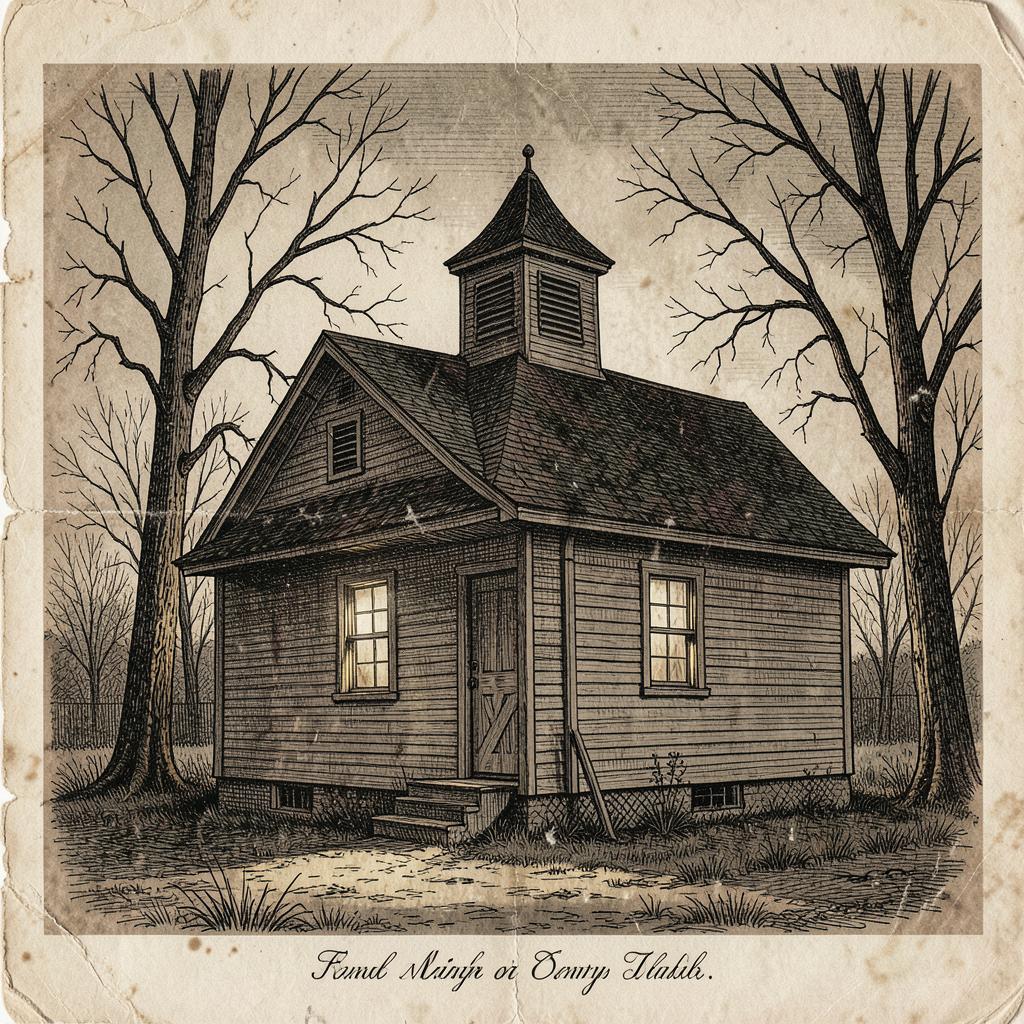
One room, thirty-two feet by twenty-four. Clapboard, white once, gray by my time. A bell cupola with a bell in it that had a flat, unmusical voice, more like a dropped pan than a chime. Two windows on the south wall and two on the north, tall and narrow and glazed with the wavy glass of the eighties, so that on a bright afternoon the whole room swam a little.
Inside: a stove in the center on a zinc plate, twenty-eight desks in four rows, a recitation bench at the front, a slate board, a water bucket with a dipper on a nail, and a teacher's desk with a drawer that did not open because the building had settled and taken the drawer with it.
And on the wall behind the desk, a framed roll — a big sheet of ruled paper under glass, on which every teacher since 1887 had written the names of her scholars in her own hand, year by year, down the columns. Fifty-one years of children in eleven kinds of penmanship. I added mine at the bottom of the sheet in September of 1936 and thought I was being sentimental. I was not being anything of the kind. I was joining something.
The habit is this, and I will say it plainly and then spend the rest of these pages telling you what I actually know about it, which is less than you would like.
On certain evenings in October, in a building that has had no floor worth walking on since the war, somebody calls the roll. Out loud. Twenty-eight names, in the same order, with a pause after each one.
I have heard it four times. Once as a young woman, once as a woman of forty, once at sixty-three, and once eleven years ago, when I was seventy-eight and had to be helped up the rise by a great-nephew who did not hear a thing and who has been very patient about it ever since.
The order is the order in the ledger. Not alphabetical — alphabetical came in later with the county forms. Miss Arletta Boyd, who taught the school from 1901 to 1919, kept her roll by the order the families had settled the district, oldest place first, and every teacher who followed her copied the order down without asking why, the way you inherit a way of stacking wood.
So the roll begins with Kinnard, because the Kinnards had the ground by the ford before there was a school on it, and it ends with Vessey, because the Vesseys came out from Ohio in 1911 and were still, twenty-seven years later, the newest people in a district that had stopped getting new people.
I want to be careful here about what I am claiming. I am not claiming that a voice speaks in an empty building. I am claiming that I have stood on the road below that building on four October evenings across fifty-six years and heard a woman's voice going steadily through twenty-eight names, and that I knew the voice on the last three occasions, and that the first time I heard it I did not know it at all, and that this is the whole of the horror of the thing and I did not understand it until I was sixty.
In 1936 the school had eleven scholars, not twenty-eight. The district was emptying. Two families had gone to Toledo, one to a farm near Fostoria, one had simply gone, leaving a stove and a hen and a note that said Tell Ruth we could not stay.
Eleven children and one teacher in a room built for thirty. We burned a great deal of wood that winter because a nearly empty room is a cold one, and I let the little ones sit in the front two rows so that we could all be near the stove together, and the back of the room went unused and got a look about it that I did not like.
It is a particular look. If you have ever taught in a shrinking place you know it. Desks with nothing on them but the initials of the dead. A row of coat hooks with four coats on twenty-eight hooks. It is not frightening. It is worse than frightening. It is a room being slowly told that it is finished.
The first time I heard the roll was the eighteenth of October, 1936, and I heard it from outside, which is important, because I was outside for a foolish reason.
I had stayed late to cut stencils and I had let the fire go out, and rather than build it again for one person I decided to walk the two miles to the Ohnsteads', where I boarded. I locked the door — the key was four inches long and lived under the step, which every child in the district knew — and got perhaps forty yards down the rise, and behind me a woman's voice said, "Kinnard, Alma."
I turned around. There was no light in the building. The windows were black and a little bit blue, the way glass is at that hour.
"Kinnard, Thomas," the voice said. "Kinnard, Robert."
It was not loud. It was pitched exactly the way you pitch your voice to be heard at the back of a room of that size, which is a thing you learn in your first month of teaching and never lose, and which is not at all the same as shouting. And there was a pause after each name — a real pause, of exactly the length that a pause takes when you are waiting for a child to say Present.
I stood on that road in the cold with my stencils under my arm and listened to twenty-eight names, and then the voice stopped, and I went to the Ohnsteads' and said nothing to anybody about it for eleven years.
Here is what I did instead, that same week, because I was twenty-two and frightened and the only tool I had was my own competence: I got out the district ledgers from the cupboard under the roll and I found which year had twenty-eight scholars in it.
There were three such years. 1904, 1905, and 1917. In 1917 the roll had twenty-eight names, and I sat at my desk with a lamp and copied them out and compared them to what I had heard, and they matched, and I put my head down on the desk for a while.
1917. Miss Arletta Boyd's sixteenth year. And the reason I could be certain it was 1917 and not 1904 was a name I had heard clearly and had never seen in the district before: Vessey, Lorna. The Vesseys came in 1911. Lorna was in that room in 1917 and she was eight years old.
Now. Everybody in that county knows what happened at Miller's Ford in the winter of 1918, and I am going to tell it badly and briefly because I have never been able to tell it any other way.
It was influenza, and it came up the river road in the second week of November, and it took a third of the district in five weeks. Fourteen of Miss Boyd's twenty-eight scholars died between the eleventh of November and the eighteenth of December, 1918. Fourteen. I have the numbers because I have had the numbers in front of me at various points across a long life and I have never been able to make them into anything but fourteen.
The school was closed by order of the county from the ninth of November until the following March. Miss Boyd, who was fifty-one and unmarried and who boarded with the Kinnards, spent that winter carrying broth. She did not take it herself. That is not the tragedy. People want it to be the tragedy and it is not.
What she did, in the spring, when the school reopened with fourteen scholars in a room with twenty-eight desks, was call the whole roll.
All twenty-eight names, every morning, in the order the families had settled the district. She called the dead along with the living and she left a pause after each name, and when there was no answer she made a mark in the ledger and went on to the next one. She did this every school morning for the whole of the spring term of 1919, and in June the county school board asked her to resign, and she did, and she lived another nineteen years in a room over a shop in the county seat and died in the spring of 1938, which is the same spring the school closed.
I have read the board's minutes. Somebody moved that Miss Boyd be relieved of her position on the grounds that her practice of daily roll call was distressing to the scholars and to their parents. The motion carried, four to one. The dissenting vote was cast by a man named Vessey.
And here is the sentence in the minutes that I have thought about for sixty years. Miss Boyd, invited to address the board, said that she had been engaged in 1901 to keep a school and to account for the children in it, that she had never been told by any authority that she might stop accounting for some of them, and that she would be glad to be instructed in writing as to which names she was to leave out.
Nobody ever wrote it down for her. They just took the school away.
So that is the voice. I did not know it in 1936 because I had never met her; she was a woman in a ledger and a hand on a framed roll. I knew it in 1962 because by then I had spent an afternoon in 1947 in a room over a shop with a very old photograph and a woman named Ruby Ohnstead who could do an imitation of Miss Boyd's flat, patient, upward-tilting way of saying a surname, and once you have heard the imitation you cannot un-hear the original.
The building came down in stages. The roof went in a wind in 1952. The stove was taken for scrap. The desks went to a church, then a barn, then nowhere. Somebody stole the bell in 1961 and returned it, anonymously, to the county historical society in 1988, wrapped in a quilt, with no note.
The framed roll is in the historical society too, on the wall by the door, fifty-one years of children in eleven hands. Miss Boyd's column is the longest, and if you look closely at the bottom of it you will see something the docents do not point out, which is that after 1919 there are fourteen names with a small pencil mark beside each one, made much later, in a different and older and shakier version of the same handwriting.
She went back at some point in those nineteen years, alone, and finished her ledger. That is not a ghost story. That is just a woman with a key that lived under a step.
I have been up the rise four times to hear the roll and I will tell you the one thing that has changed across fifty-six years, and it is the only part of this account that frightens me now.
In 1936 the pause after each name was short. Two seconds, perhaps. The pause of a teacher who expects an answer and has a great deal to get through before the arithmetic.
In 1962 the pauses were longer. In 1985 they were longer still, and the whole roll took better than nine minutes, and I remember standing in the wet grass with my coat over my arm thinking that she was tiring.
Eleven years ago, at seventy-eight, with my great-nephew's hand under my elbow, I heard eleven names in twenty minutes. The pauses had gone to well over a minute. And in the middle of one of them — after Ohnstead, Ruby, which is a name I loved, which belonged to a woman who taught me to make an imitation of a dead teacher's voice — I did something I had not done in any of the four visits.
I answered. I said, "Present."
The pause ended. The next name came. And I want to be exact about what I felt, because it was not fear and it was not comfort; it was the specific, particular shame of a woman of seventy-eight who understands, sixty-nine years too late, that the only assistance anybody ever needed to offer that building was to stand in it and say a word.
I have not been back. I am not able to walk the rise. My great-nephew has offered to drive me as far as the gate and I have not said yes, for a reason that I am going to put down here and then stop.
If I go up and answer to Ohnstead, Ruby, I will also have to sit in the grass through Kinnard and Marchant and Deel and Vessey, and I will have to hear the pauses that nobody has ever answered, and at the end of it there will still be fourteen names hanging in the dark over a foundation and a lilac bush.
But somebody ought to go. That is the whole of what I have to say. It does not require belief and it does not require courage; it requires an evening in the third week of October, a coat, and the willingness to stand on a rise of ground and say one word twenty-eight times to a woman who was never told that she could stop.
"A teacher's last habit is to count her children. Nobody told her she could stop."