The Covered Bridge at Hare Mill
9 min read · Original fiction — a story, not a true account
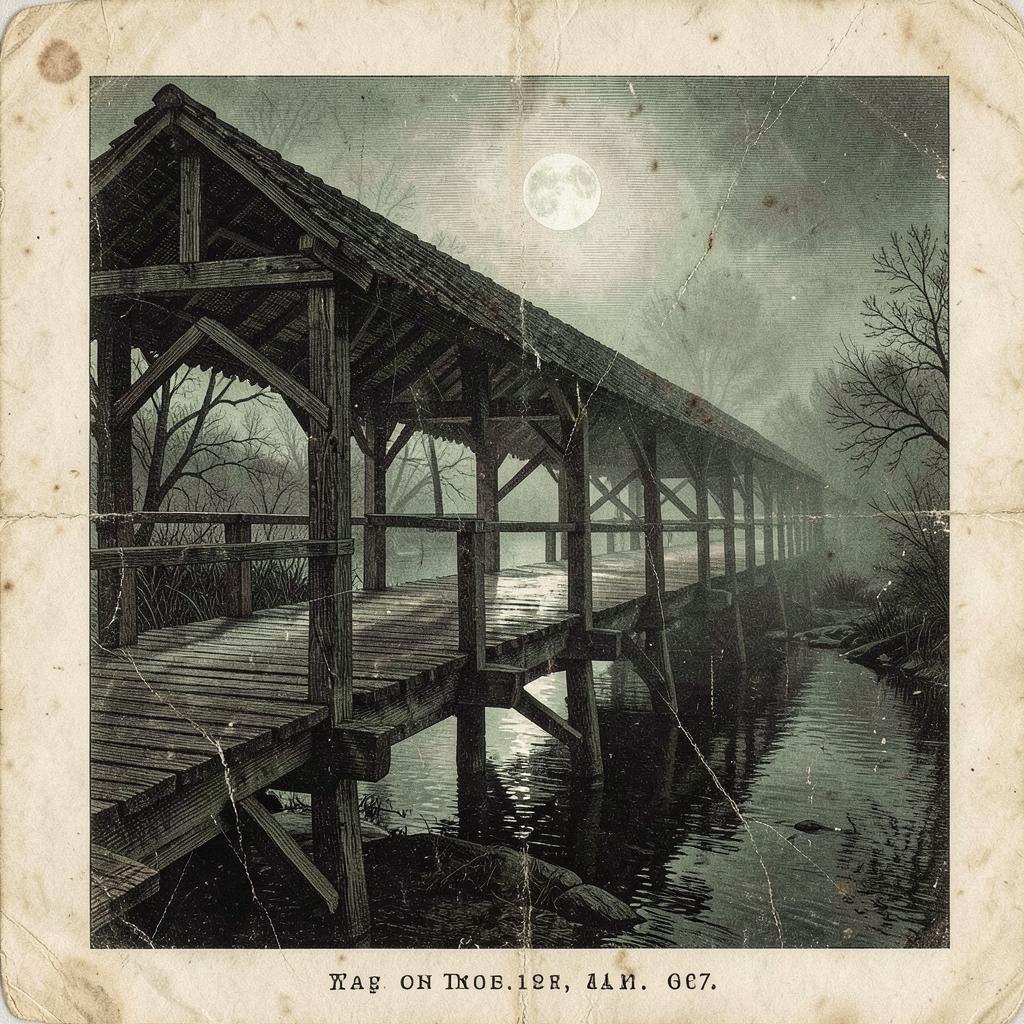
The bridge at Hare Mill was a Burr arch truss, a hundred and forty-one feet in a single span, built in 1868 by a carpenter named Absalom Deel and standing, at the time I write this, one hundred and fifty-eight years later, in the same place, over the same slow brown river, with the same smell inside it.
It is a particular smell and if you grew up near one of these bridges you have it in you for good: old dry oak, pigeon, iron, dust, and the cold breath coming up off the water through the floor planks. In summer the inside of a covered bridge is fifteen degrees cooler than the road at either end. In February it is the coldest place in the township.
There were once ten thousand of these bridges in the eastern states and there are now perhaps six hundred, and the standard explanation for the roof is the correct one and I will get it out of the way: the roof is there to keep the weather off the timbers, because an uncovered wooden truss rots in fifteen years and a covered one lasts a century and a half.
But there is a second explanation that every teamster's grandson in this county was raised on, and it is also true, and it is the one this story runs on. They roofed the bridges so the horses could not see the water.
A horse will not willingly walk out over moving water on a rattling deck. Box the sides in, put a roof on it, and you have made a dark barn a hundred and forty feet long, and a horse will walk into a barn. That is why the approaches were dark and why the old bridges have no windows and why every one of them, from the outside, at night, looks exactly like a mouth.
I taught school in this township for thirty-one years and I have collected the Hare Mill accounts the way other men collect duck decoys, and I have eighty-some of them, and they sort into two piles that do not overlap.
The first pile is ordinary and I mention it only for honesty's sake: courting couples, whiskey, a boy who broke his ankle in 1953, four separate people who heard footsteps that were pigeons, and the usual crop of teenagers who have discovered that if you stop a car in the middle of a covered bridge at night and turn the engine off, the bridge will make a noise, because a hundred-and-forty-foot wooden structure is always making a noise.
The second pile has nine accounts in it, spread across ninety-one years, and every one of them is about somebody who was wet.
The first is from 1911 and it is in the county paper, in the column of township notes, four sentences long, and it is the reason I started collecting at all.
A farmer named Elias Pruitt, driving a wagon home from the mill on the ninth of November, reported that he had passed a woman walking north through the bridge, carrying a child, both of them soaked to the skin, and that he had stopped and offered them the wagon, and that she had said, without stopping, We are nearly there.
He drove on out of the bridge, and then thought better of it, and turned the wagon in the road — which takes a minute and a half with two horses and a wagon in a narrow road, and Elias Pruitt was a careful man who noted in the paper that it had taken him a minute and a half — and went back in.
The bridge was empty. The floor planks, he said, were dry the whole length. And he sat in his wagon in the middle of that bridge and shouted until his voice gave out, because he had a wife and a daughter of his own.
The next four accounts, from 1919, 1934, 1948, and 1955, are the same account. I do not mean that they are similar; I mean that when I laid them out on my kitchen table in 1977 and read them one after another, I had to get up and walk around the yard.
In each one: a person driving or walking north through the bridge, in the dark, in the late autumn. A woman on foot, walking north, carrying a child. Both drenched, hair flat, clothing heavy with it. An offer of help. The same five words: We are nearly there. And then nothing, and dry planks.
The 1948 account is the fullest because the man who gave it to me, a mail carrier named Hollis Vessey, was seventy-four when we talked and had thought about it every year of his life. He said the thing he could not get past was the sound.
He said she was walking on wet feet in wet shoes on dry oak planks and that it made exactly the sound it ought to make, which is a small tacky sound, like somebody eating an apple in another room, and that he heard it going away behind him after he had already stopped and turned in his seat, and that it stopped in the middle of the bridge, not at either end.
He also said — and none of the others say this, and he was not a fanciful man — that the child was looking at him over her shoulder, and that the child was not frightened, and that the child raised one hand about as high as its ear, the way a child does from a car window at somebody it has decided it likes.
Now here is the record, and it took me nine years to find it, and it is not in this county.
There was no drowning at Hare Mill. I combed the township for a decade looking for one and there is not one; the river there is nine feet deep in the channel and slow and it has taken two men in a hundred and fifty years and both of them were fishing and both of them were found.
The drowning is fourteen miles downstream and forty-three years earlier, at a fording place below a town that does not exist anymore, in the spring flood of 1868, and it is in a different county's paper, and it took eleven people crossing on a flat ferry that swamped in high water.
Nine bodies were recovered in the week following. Two were not: a woman of twenty-six named Sarah Deel and her son, aged four.
Deel. Absalom Deel, the carpenter who built the Hare Mill bridge in the autumn of that same year, was her husband's brother. I have his account book, which is in the historical society in a glass case, forty-one pages of lumber orders and day wages in a small tight hand, and on the last page, under the final tally for the bridge, out of nowhere, in the same hand, is written: Roofed and boarded 9 Nov. Dry the whole length now. Come up out of it, Sarah, it is dry here.
The ninth of November. The date on Elias Pruitt's four sentences in 1911. The date in three of the other eight accounts, and within a week of the rest.
So I will give you what I think, and then the last of it, which I got in 2002 and which changed the shape of the whole thing for me.
I do not think that bridge is haunted by a drowning. The drowning happened fourteen miles away in a different county in a spring flood, and nothing about that river bend at Hare Mill has any business remembering it.
I think a man whose sister-in-law and nephew were somewhere in the mud of that river spent the summer and autumn of 1868 building a hundred and forty-one feet of dry, dark, roofed, boarded road over the water — and that when he finished it, he wrote an invitation in the back of his account book and left it open.
And I think somebody accepted, and has been walking north up the middle of it in the second week of November ever since, carrying a child, out of the water and toward the dry, and getting almost there.
The last account is from the ninth of November, 2002, and it belongs to a young woman named Corinne, who was nineteen and a nursing student and who had heard exactly none of this, because she had moved into the township in August.
She was walking home from a friend's at eleven at night with a flashlight because the road has no shoulder, and in the bridge she came up behind a woman carrying a child, both soaked, walking north.
And Corinne, who was nineteen, and who had been taught by two years of nursing school and one very good grandmother that a wet person in November is an emergency and not a mystery, did the thing that nobody in ninety-one years had done.
She did not offer the wagon. She did not shout. She took off her coat, and she stepped up alongside, and she put it around the woman's shoulders, and she said: You're nearly there. Come on. I'll walk you.
She told me she walked the last sixty feet of that bridge beside a woman she could feel the cold coming off of, and that at the north portal, where the roof ends and the road starts and there is a gravel turnout with a historical marker in it, she was walking beside nobody, and her coat was on the ground in the gravel, folded, sleeve over sleeve, the way you fold a coat you are giving back.
It was wet. She kept it. She showed it to me in 2003, in a plastic bag, and I did not touch it and she did not ask me to.
There has not been an account since. Twenty-four years, and I have asked every November, and there is nothing but pigeons and teenagers and the ordinary noise a hundred-and-fifty-eight-year-old truss makes when it lets go of the heat of the day.
The county has repaired that bridge twice in my lifetime, sistered the arch, replaced forty feet of floor, put a steel-plate weight limit sign at each end and a fresh coat of the correct dull red on the portals. There is a marker in the turnout with a paragraph on it about Absalom Deel and the Burr arch truss, and it does not mention his brother's wife, and I have never once suggested that it should.
What I have done, every year on the ninth of November for the last twenty-three years, is walk out to the middle of that bridge in the evening with a lantern I do not need, and stand there a while on the dry planks, and go home.
Not because I expect anything. Because a man built a covered road over a bad river for somebody who never got to use it, and somebody finally did, and it seems to me that a thing like that ought to have a witness now and again, even a late one.
"They roofed the bridges so the horses could not see the water. Nobody ever asked what else a roof keeps out of sight."