The Eleventh Tent at Crowder Brothers
9 min read · Original fiction — a story, not a true account
Crowder Brothers Amusements was a ten-tent carnival out of southern Indiana that worked the county fair circuit from 1924 until the spring of 1966, and I spent nine summers with it as a boy because my mother's brother ran the ring toss and my mother needed the house quiet.
Ten tents. I want that number in front of you before anything else, because it is the whole of the story and because it is a matter of record: the route book, the state license applications, the insurance schedule, and the lot plan drawn in pencil on the back of every contract all say ten.
Ten tents, four rides, one generator wagon, a cookhouse, and eighteen people.
Here is the lot plan, and I could draw it in my sleep at eighty-one years old.
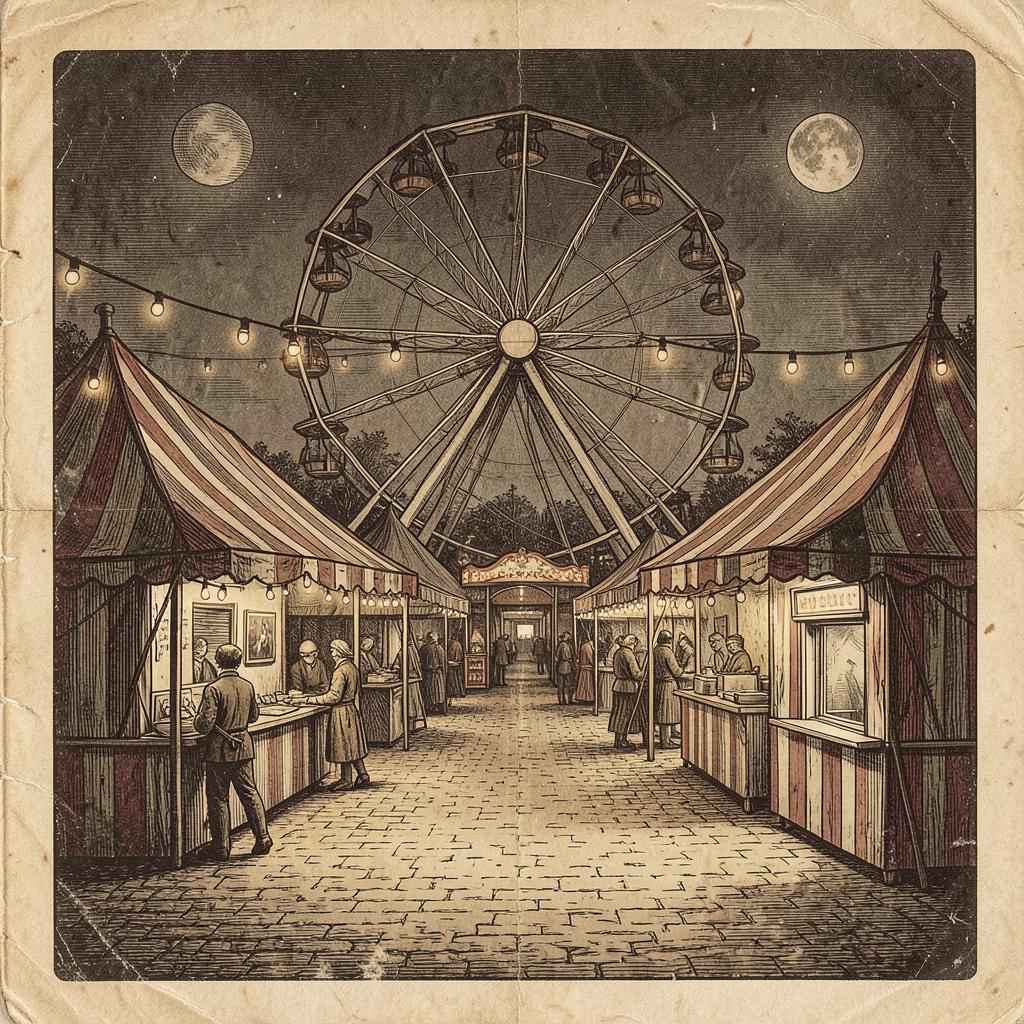
You come in off the road past the ticket wagon. The midway runs straight away from you for about two hundred feet, tents on both sides. On the left: ring toss, milk bottles, the duck pond, the cane rack, and the photo gallery. On the right: the cookhouse, the shooting gallery, Madame Sosostris, the snake show, and the ten-in-one.
At the end of the midway, crosswise, the rides: the Ferris wheel in the middle, the carousel to the left of it, the tilt to the right, and the kiddie swing tucked in behind where the mothers could sit on the grass and see it.
That is a Crowder Brothers lot. It was that lot in Vincennes and in Bedford and in Salem and in every one of the forty-odd fairgrounds that carnival worked, because the whole art of a small carnival is to build the identical town in a different field twice a week for six months.
And in every one of those towns, there is somebody alive today who will tell you about a tent at the far end past the kiddie swing, on the dark side of the Ferris wheel, that nobody remembers paying to get into.
I am going to be very careful now, because I was there, and because I have spent sixty years being careful about this and it has not gotten me anywhere.
I never saw the eleventh tent from the outside. I want that on the record. I worked those lots as a boy of nine through seventeen; I helped set up and I helped tear down; I have carried more stake iron than any man in this county; and I never once, in nine summers, saw a tent on that lot that I had not helped somebody put up.
What I have is other people's accounts, thirty-one of them collected over forty years, and one experience of my own that is not about a tent at all and that I have never been able to put down anywhere and am going to put down here at the end because I am old enough now that it does not matter.
The accounts agree on the following, and the agreement is what has ruined my peace of mind.
One: it is always at the end of the midway, past the last ride, in the dark, where the lot plan shows nothing but the trucks and the tie-down lines and a gap in the fence.
Two: it is not lit. Every account describes it as dark canvas with a lamp somewhere behind it, so that you see the shape of it and a little of the color, and the color, in twenty-nine of thirty-one accounts, is green — a dark bottle green with a lighter green scallop along the top edge, which is not a color Crowder Brothers ever owned. Our canvas was khaki and our trim was red.
Three: there is no talker outside it. No banner line, no bally, no ticket box, and nobody taking money. Every other tent on a carnival lot exists in order to relieve you of coins, and it will tell you so at volume. This one is silent.
Four: everybody goes in. This is the part I find hardest to explain and the part that I believe. Thirty-one people, most of them children at the time, all of whom had been told a hundred times to stay on the lit part of the midway, walked into an unlit tent with nobody outside it, and not one of them describes deciding to.
Five: what is inside is a show, and it is running, and the seats are full.
The accounts of the inside diverge and I have come to think the divergence is honest rather than the reverse. I will give you three.
Delia Marchand, who was eleven in 1937 at the Lawrence County fair, told me in 1974 that inside the tent there were four rows of plank benches full of people in good clothes, all facing a small stage with a curtain, and on the stage a woman was singing, and the singing had no sound. She said she stood at the back for what felt like two songs, and that nobody turned around, and that she went out because her feet were cold.
Harold Speer, who was nine in 1948 at Vincennes, told me in 1981 that inside there were benches and people and a stage with a man on it doing a knife-throwing act at a board with nobody on it, and that the knives made no noise going in. He said that a woman on the end of the second bench moved over to make room for him and that he sat down. He was in there, he thinks, four or five minutes. He said the woman's coat was wet.
And a man I will call only Mr. E., who was fourteen in 1961 and who is the only one of the thirty-one who has ever asked me not to use his name, told me that when he went in there was no show at all. Benches, people, a stage, a closed curtain, and everybody waiting, quietly, the way a full house waits when the show is running late. He said he stood at the back for a long while and that at some point he understood — his word, understood, not decided — that the show was not going to start while he was standing there, and he left.
All three of them, and twenty-six of the other twenty-eight, describe the same thing on the way out, and this is the detail that made me start writing the accounts down in the first place in 1969.
On the way out, the flap is not where you came in. You come out of that tent onto the lit midway, up by the front of the lot, near the ticket wagon — two hundred feet from where you went in — and when you turn around there is no tent behind you. There is the duck pond, or the cane rack, or whatever ought to be there, doing its ordinary business under the string lights.
Now let me tell you the three things I have found in forty years of digging that keep me from calling the whole business a shared story that children in a five-county area passed around like a cold.
The first is the green canvas. In 1971 I went to see a very old woman named Ada Crowder, the widow of the younger of the two brothers, in a nursing home in Terre Haute, and I asked her whether the carnival had ever owned green canvas, and she said no, and then she said: Marcus bought a green top in 1923.
The Crowder brothers, before they were a carnival, worked for a much older and much smaller outfit — a two-tent gilly show that traveled by rail baggage car and that folded in 1922 when its owner died. In 1923 Marcus Crowder bought the remains of it at a sheriff's sale in Terre Haute: some rigging, a stage, a lot of folding benches, and a green top with a lighter green scallop.
It burned in a windstorm at Bloomfield in the summer of 1924, the carnival's first season, before it was ever pitched for a paying crowd. Ada was clear about that. She said Marcus stood in the field and watched it go and would not talk for two days, and that the carnival ran khaki canvas from that day to the day it closed.
The second thing is the benches. In every account I have, the seating inside the eleventh tent is plank benches with folding iron ends. Crowder Brothers never seated anybody in its life. It had no seated show. The ten-in-one was a walk-through, the snake show was a walk-through, Sosostris had two chairs in a booth, and there was not a single bench on that lot for forty-two years.
There were benches in 1923, in the sheriff's sale inventory, which I have seen, which lists among other things sixty-one folding benches, condition poor.
The third thing is the name, and I have had it for eleven years and have never known what to do with it. The gilly show that Marcus Crowder bought the wreckage of was called Vanhorn's Green Pavilion, and it went out of business in September of 1922 in Sullivan County when its owner and its principal performer, a woman billed as Mademoiselle Vanhorn, drowned along with two others in the Wabash in a ferry accident on the way to a date they never played.
Three people who never got to the fairground. Sixty-one benches, condition poor. A green top with a lighter scallop that burned in a field before a paying crowd ever sat under it.
That is all I have and it is not an explanation, it is a coincidence with good documentation, and I know the difference. But I will tell you the shape my mind has settled into, at eighty-one, with no ambition left to be believed.
A show that never got to open does not know that. It has an audience and a stage and a curtain and it is waiting, and it has been waiting since September of 1922, and for forty-two years it pitched itself at the dark end of the only lot it could find — behind the wheel, past the trucks, on the ground the lot plan leaves empty — because the Crowder boys were carrying its canvas and its benches and its bad luck from field to field, twice a week, for six months a year.
And here, finally, is my own account, which is not about a tent.
In August of 1955 I was fifteen and it was teardown at Salem, two in the morning, and I was walking the far end of the lot picking up stake iron with a lantern because that is what you give a boy to do so he does not get near the wheel.
Past the kiddie swing, on the dark ground where the plan shows nothing, my lantern went across a row of holes in the grass. Stake holes. Fresh ones, with the sod still curled up out of them, in a rectangle about forty feet by twenty-five, which is the footprint of a small round-end top.
I put the lantern down and I walked the whole rectangle and counted them. Forty-four holes at the sidewall and two big center-pole plates at the middle, and the grass inside the rectangle pressed flat in rows.
I went and got my uncle. He was a hard, unsentimental man who ran a crooked ring toss and had no patience for anything, and he came out with me and stood in that grass with his hands in his pockets for a minute and a half, and then he said, All right. Get the truck loaded.
And on the way back up the midway he said the only other thing he ever said to me about it, which I have carried for seventy years, and which is the reason I have written all of this down.
He said: If it ever asks you to sit down, don't. That show's been sold out since before I was born, and there's only ever the one seat left.
"A midway is a machine for taking your money. The eleventh tent never took a cent from anybody, which is how I knew it was not part of the show."