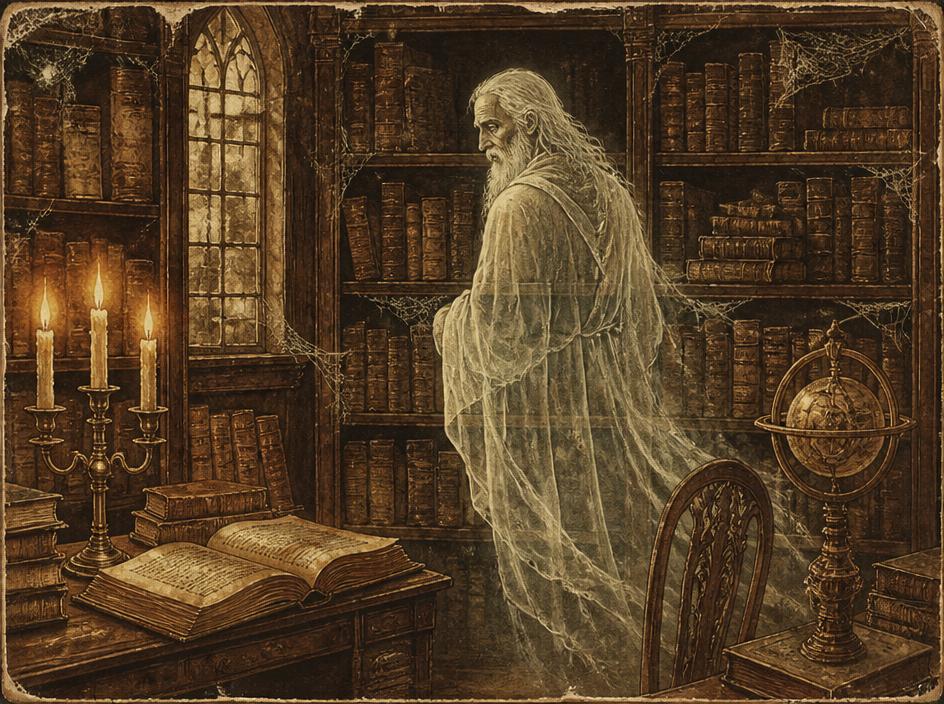
The Fourth Floor of the Marrowbone
9 min read · Original fiction — a story, not a true account
The Marrowbone Hotel closed to guests on the fifteenth of October and reopened on the twentieth of May, and in between it kept one caretaker, because the boilers needed a human being and the insurance company needed a name on a form. In the winter of 1974 that name was mine.
I was twenty-six, recently and comprehensively divorced, and in possession of a philosophy degree that had proved to be exactly as useful as everyone had promised. The job paid room and board and a small salary and required me to walk the building twice a day, bleed the radiators, log the temperatures, shovel the north entrance, and telephone the manager in town on Mondays to say that nothing had burned down.
The Marrowbone had two hundred and eleven rooms, four floors, a ballroom with a sprung maple floor, and a view down a gorge that was on the cover of the state tourism brochure for eleven consecutive years. It had been built in 1889 by a railroad and had passed through the hands of a sanatorium, a fraternal order, and a briefly notorious resort company before settling into its long dignified decline.
It also had a peculiarity, which the manager mentioned in the car on the way up, in the tone men use for things they have decided are charming.
"The elevator won't stop at four," he said. "Never has. Button's there, doesn't do anything. Stairs work fine. Guests love it — we tell them it's the ghost floor and they all go up the stairs to look and there's nothing up there but rooms."
"Has anyone ever fixed it?"
"Three times," he said. "Otis came up in '52, and again in '61, and a fellow from Pittsburgh in '68. All three said the same thing. Nothing wrong with the mechanism." He turned off the highway. "You'll have the whole place to yourself. Well. Nearly."
I asked what nearly meant. He said the owner's aunt had a life tenancy on a suite on the second floor, that she was ninety and wintered in the building because she had wintered in the building every year since 1901, and that she would be no trouble whatsoever.
Her name was Mrs. Orsini and she was, in fact, no trouble whatsoever. She was small and precise and had been a concert pianist of the second rank, and she took her dinner at six and played the ballroom piano from seven until eight and read until eleven. Within a month we had the easy unromantic intimacy of two people who are the only two people. She corrected my French. I carried her coal.
On the eleventh of December I asked her about the fourth floor, and the ease went out of the room like heat out of an opened door.
"You've walked it," she said.
"Twice a day. It's rooms."
"Of course it's rooms." She closed her book. "Young man, I am going to tell you the single most important thing anyone will tell you this winter, and then I am going to ask you not to make me explain it, because I am ninety and I would like to enjoy my evenings." She waited until I nodded. "You may walk the fourth floor as often as your duties require. You may knock on any door. But do not ever go up to the fourth floor because you were invited."
I said that seemed like a distinction without a difference.
"It is entirely a distinction with a difference," she said, "and it is the only one that has ever mattered in this building."
December was uneventful. The gorge froze. I read Middlemarch and most of Gibbon and learned to bleed a radiator without scalding myself. I logged temperatures in a green ledger that had entries in it going back to 1923, in a long parade of caretakers' hands, and I noticed — because there is nothing else to notice in a green ledger — that a great many of those hands stopped mid-winter and were replaced.
January was different. January is when a large empty building stops being a building you are working in and becomes a building you are inside of.
It began with the elevator. Not the fourth floor — the elevator itself, running at night. The Marrowbone's car was an old brass cage with a mechanical clatter you could hear on any floor, and beginning around the sixth of January it went up and down three or four times a night. I checked it every time for a week. The car was always at rest, always on the ground floor, always with the doors open and the light on and nobody in it.
Then the sounds on four. Not footsteps, which I had braced for. Doors. The very specific and unmistakable sound of a hotel corridor at eleven in the evening in high season: doors closing, one after another, at intervals, some quickly and some with the drawn-out care of a person who does not wish to wake a neighbor. I stood at the bottom of the stairwell on the night of the fourteenth and listened to eleven doors close on a floor with no guests, and I did not go up, and I told myself this was because my rounds were finished.
On the nineteenth I found the register.
It was in the manager's office, in a cabinet I had no reason to open except that I had run out of Gibbon. Guest registers, bound in green board, one per season, going back to the railroad. And in the front of each was a floor plan with room assignments pencilled in, and on every floor plan, in every register, from 1889 to 1974, the fourth floor was full.
Every room. Every season. Names in the fourth-floor column in a hand that did not match the desk clerk's hand anywhere else on the page. Eighty-five years of a full floor in a hotel that had, by its own accounting, never once let a room on four.
I copied out a dozen of the names. Three of them I recognized: they were on the memorial plaque in the ballroom, the one commemorating the eleven guests and four staff who died in the influenza outbreak of 1918, when the Marrowbone was quarantined and the fourth floor was used as the isolation ward.
I took the register to Mrs. Orsini. She looked at it for a long moment and then said the thing that I have repeated to perhaps six people in my life, always badly.
"The hotel is not haunted," she said. "The hotel is occupied. There is a difference, and the difference is hospitality. They are guests, and they were made guests properly, and they have been kept as guests properly ever since — the floor is warm, the register is filled, the piano is played at seven. That is not superstition, young man. That is housekeeping."
"And the invitation?"
"A guest who has been well kept for eighty-five years," she said, "eventually wishes to return the courtesy. And the moment you accept, you are no longer staff. You are on the register." She handed the book back. "There were four caretakers between the wars who went up when they were asked. They are on the fourth floor plan for the following season, in that same hand, in ink. You may look it up. I would rather you didn't in front of me."
I looked it up. She was right. I will not give the names.
The invitation came on the ninth of February, at twenty past two in the morning, and it was so ordinary that I nearly answered it out of pure reflex.
The telephone in my room rang. The house line — a brass box with a crank, connected only to the front desk and the suites. And when I picked it up a young woman's voice, pleasant and hurried and entirely alive, said: "Mr. Vane? So sorry to disturb you. We've a bit of a problem with the radiators in four-eleven and the gentleman is quite cold. Could you come up? We'll leave the door open for you."
Everything in me stood up to go. That is the part nobody understands when I tell it. There was no dread. There was a cold guest and a stuck radiator and a young woman on the desk being polite about it, and I had a wrench, and I was twenty-six and useful for once, and the whole apparatus of my ordinary decency was already halfway to the stairs.
What stopped me was a detail so small I am embarrassed by it. She said we'll leave the door open for you. And I thought: nobody leaves a door open in February in a building where the boiler is the caretaker's problem.
I said, "I'll send someone up."
There was a pause of about three seconds. Then the voice said, in exactly the same pleasant register, "Of course. We'll be here," and the line went dead, and the elevator in the middle of the building ran up four floors and stopped and did not come back down for the rest of the night.
I sat in my room until dawn with the wrench in my lap like a man holding a cat.
I finished the winter. I bled the radiators on four twice a day, and I said good morning to the corridor because it seemed rude not to, and on the fifteenth of April I wrote the last temperature in the green ledger and did not stop mid-winter, which put me in the minority.
Mrs. Orsini died in 1981, in her suite, in April, which the family considered a mercy because it meant she was in the building. I went to the service. There were seven of us.
The Marrowbone was sold in 1988, renovated in 1991, and the elevator was replaced entirely — a new car, new machinery, computerized controls, a button for four that lights up like any other button. I read about it in a trade magazine and thought that was that, and felt a complicated relief, as though a debt I had not incurred had been settled by someone else.
Then in 1994 a friend who consults on historic properties mentioned, over dinner and without any idea of what he was telling me, that the Marrowbone had an odd little maintenance quirk: the new elevator ran fine, but the software logged phantom calls to four every night between one and three, and the manufacturer had rewritten the controller twice, and there was nothing wrong with the mechanism.
I asked whether they still kept a caretaker in the off-season.
"Two," he said. "They found one alone doesn't stick."
If you go — and it is a beautiful hotel, genuinely, the gorge in October is worth the drive — you will be told about the ghost floor at check-in, because it is good business and because it is easier to sell a story than to explain a practice. Take the stairs. Look at the corridor. There is nothing up there but rooms, which is exactly what everyone has always said, and it has always been true.
But if the telephone in your room rings very late, and a young woman apologizes for disturbing you, and mentions that a door has been left open on your account: be sorry, be polite, and send someone else.
"The hotel is not haunted. The hotel is occupied. There is a difference, and the difference is hospitality."