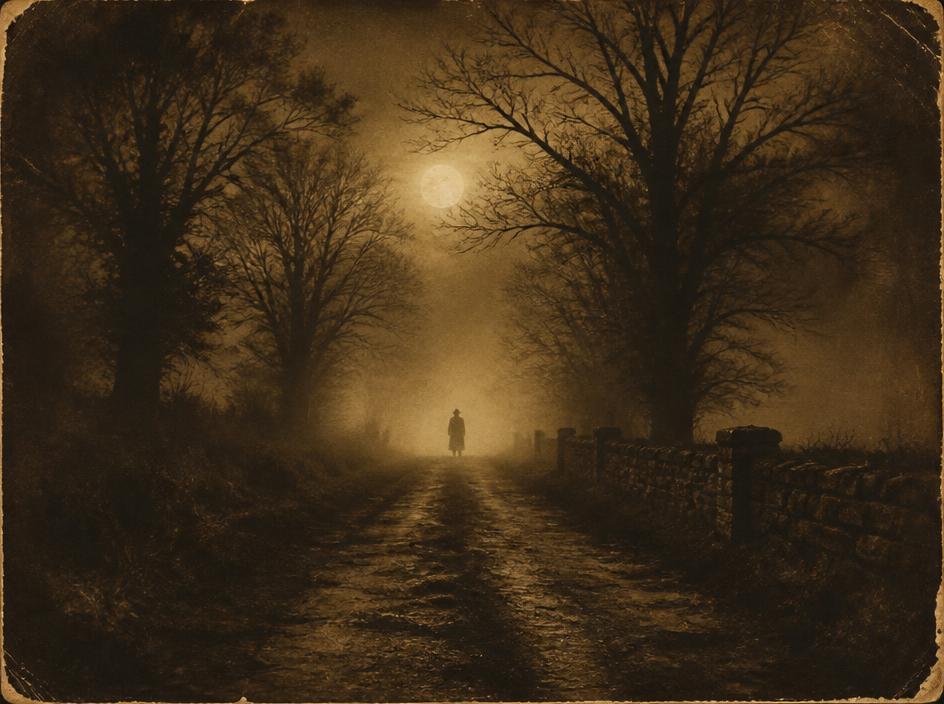
The Second Feature at the Alcazar
10 min read · Original fiction — a story, not a true account
The Alcazar was the second-run picture house on Delaney Street, and it burned on the night of the fourth of March, 1961, during the second feature. Four hundred and eleven people got out. One did not: the projectionist, a man of fifty-six named Emmett Pike, who was in the booth when the nitrate went up and who — according to the fire marshal's report, according to the newspaper, according to every version of the story anyone in that town has ever told — kept the machine running.
That is the part that matters. Not the fire. The town has had fires. What the town has is a booth on the second floor of a burned building where a man chose, in the last ninety seconds of his life, not to run.
The film in the gate was a western called Ride the High Pass, a nothing picture, a B-feature that played on the bottom of double bills for two years and is now considered lost — no print in any archive, no negative, nothing but a poster in a collector's book and eleven minutes of trailer footage in a university collection in Wisconsin.
I have seen forty minutes of it. So have perhaps two hundred people in that town, and none of us can prove a thing, and all of us agree on the same three scenes.
Let me lay out the plain facts first, because they are checkable and because the checkable parts are what kept me digging for eleven years.
The Alcazar was built in 1927, twelve hundred seats, a Wurlitzer, plaster grapes on the proscenium. It was a palace for about nine years and a serviceable neighborhood house for twenty-five more. By 1961 it ran double bills on the weekends and matinees for children on Saturday, and its owner had already been to the bank twice about the roof.
The fire started in the booth, in a rewind bin, in a stack of nitrate reels that should not have been in the building at all — nitrate stock had been out of general distribution for a decade, but Ride the High Pass was an old print of an old cheap picture and it had gone around the circuit a dozen times and nobody had pulled it.
The evacuation was, by every account, superb. Emmett Pike had a bell in the booth wired to the manager's office and to the stage, and he rang it, and the house lights came up, and the manager and four ushers cleared twelve hundred seats' worth of Saturday-night audience through five exits in something under four minutes with no serious injuries.
And the picture kept playing on the screen the whole time. That is in the fire marshal's report, in the depositions of eleven witnesses, and in the interview the manager gave the paper the following Tuesday, which I have on microfilm and have read perhaps a hundred times.
"Emmett kept it running," the manager said. "I don't know why. I've thought about it every hour since. The only thing I can figure is he knew that if the screen went dark and the lights came up on a room full of people who could smell smoke, we'd have had a stampede in the aisles and I'd be burying children this week. So he stood up there in the fire and he kept a cowboy picture going until the last one of them was out the door."
The booth was gone by then. The reels in the bin went in seconds; there was no exit from that booth that was not through the fire. Emmett Pike was fifty-six years old, a widower, a Legion man, and the last thing he did on this earth was change over from reel four to reel five while the room around him burned, so that nobody in the seats below would look up and be frightened.
That is a true story and it is checkable and I want you to hold onto it, because everything else I am going to say is the town's, not the record's, and the town's version has been wearing itself smooth for sixty-five years.
The Alcazar was never rebuilt and never quite demolished. The insurance was disputed, then the owner died, then the estate went into a decades-long argument between heirs, and by the time anybody wanted the lot the facade had been declared architecturally significant by a preservation board with more enthusiasm than money. So it stands: brick shell, marquee with no letters, doors chained, roof mostly open, plaster grapes still on the fragment of proscenium that faces the sky.
Every teenager in that town for three generations has gone in through the loading door on the alley side. It is not difficult. There is a step down into what used to be the orchestra pit and then the long slope of the auditorium floor with the seat bolts still in it, and the screen wall at the far end, which is only a wall — the screen itself burned in 1961 with everything else.
You go in at night on a dare, and you stand in the dark on a floor full of pigeon bones, and if you go in during the first week of March, sometimes there is a picture on the wall.
I went in on the fourth of March, 1979, when I was sixteen, with three friends and a borrowed flashlight, and I have spent the rest of my life failing to explain what I saw to anyone who was not standing in the room.
It was not a projection. This is the first thing everyone gets wrong when I tell it, and it is the thing I am most certain of. There was no beam. There was no cone of light in the air, no dust swimming in it, no bright rectangle with edges. There was a section of scorched brick wall about twenty feet across, and there was a picture happening on it, black and white and grainy and full of the scratches and cigarette burns of a print that has been around the circuit a dozen times, and it was as flat and matter-of-fact as a window.
And there was sound. Bad sound, the boxy compressed sound of a cheap optical track through a house horn, and it came from behind the wall, which is where the horns would have been.
The three scenes are always the same three scenes, in the same order, and this is the part that has kept me at it for four decades, because two hundred people who mostly do not know one another describe them identically.
First: a man on a horse coming down through a pass, shot from below, with a hard sky behind him. It runs perhaps four minutes and nothing happens in it. It is very badly composed. Everyone who sees it says the same thing afterward, which is that it went on too long, and I have come to think that this detail is the most persuasive evidence in the entire business, because nobody inventing a ghost story invents a boring scene.
Second: a woman in a kitchen with a lamp, saying a line that half the people in that town can quote and that I have heard from a man of eighty and a girl of fifteen in the same identical cadence. She looks off camera and she says, "You'll want to be gone before my brother's up, and you'll want to take the road, not the field."
Third: a fistfight in a livery stable that ends with a lamp knocked into straw, and a cut to fire, and then — and this is where the forty minutes always end — the picture goes white. Not black. White, edge to edge, the way a frame goes when a print stops in the gate and the lamp burns through it, and the sound drops out, and there is a sound over the top of it that is not on any soundtrack, which is a bell. A small hard electric bell, ringing and ringing.
Then the wall is a wall.
The bell is the detail I could not get past. It is not in the film. It cannot be in the film. It was Emmett Pike's bell, wired from the booth to the manager's office and to the stage, and it was in a burned building in 1961 and it is in every account of every viewing since, and no teenager sneaking into a ruin on a dare in 1979 had any way of knowing that a bell existed at all. I did not know. I looked it up eleven years later in the fire marshal's report and had to put the microfilm reader on pause and go outside.
I have done what I can with the film itself. Ride the High Pass was made in 1948 by a poverty-row outfit that folded in 1953. The eleven minutes at Wisconsin are trailer material — different footage, no kitchen, no livery stable. But the trailer has the man on the horse coming down through the pass, shot from below, held too long. I sat in a screening room in Madison in 1991 and watched four hundred frames of a scene I had seen on a brick wall as a sixteen-year-old and I did not say anything to the archivist, who was very kind and thought I was crying about film preservation.
The kitchen line is not in the trailer. But there is a continuity script for Ride the High Pass in a studio collection in Los Angeles — nine pages of it, water-damaged — and on page four, in a scene marked INT. FARMHOUSE - NIGHT, a character named Ellen has the line: "You'll want to be gone before my brother's up. Take the road, not the field."
Not identical. Close. Two hundred people in one town remember an actress's delivery of a line from a lost film more accurately than the script it was written from, which is exactly what you would expect if they had watched the film and not read about it, and which I cannot account for by any mechanism I am able to describe.
So here is where I have landed, after forty-seven years, and you are welcome to do better.
I do not think the Alcazar is haunted by Emmett Pike. I have never felt watched in that building, and I have been in it perhaps thirty times, and I say that as a man who is quite susceptible to feeling watched. There is no cold spot and no figure in the booth doorway, and every version of this story that adds those things is a version somebody improved.
What I think is that a projectionist ran a machine for ninety seconds longer than any reasonable man would have, in order to hold four hundred and eleven people steady, and that the light he was making got into that room the way smoke gets into a coat. A film is just light with a shape. Nobody has ever satisfactorily explained to me why light should stop when the building does.
And I think it plays those three scenes because those were the reels in the gate — the pass, the kitchen, the stable, the changeover, the white frame, the bell. Forty minutes. It is not a story the building is telling. It is a man's last shift, running on a loop, in a room he emptied.
The preservation board finally got its grant in 2019, and the Alcazar is being stabilized: new steel, new roof over the lobby, the marquee rewired with its original bulbs. The plan is a performing arts space by 2028. There is a rendering on the fence with a family in it.
I sat on the board's public comment list for two years and made exactly one request, which was that the booth be left as it is and closed, and that a plaque with Emmett Pike's name go on the wall at the top of the stairs. I got the plaque. I did not get the booth; the booth is going to be a lighting position, which is, when I have made my peace with it, the correct use for a booth.
But I have thought a great deal about what happens the first time somebody in that building runs a show. About a full house, and a lamp on, and light going out across a room where light has been going out across a room since 1927 and has not entirely stopped since 1961.
If you are ever in the seats on the fourth of March and the picture goes white, and you hear a bell over the top of it — do not run.
That is the only thing that was ever asked of anyone in that room. He asked it once, at the cost of everything he had, and four hundred and eleven people did as they were told and walked out in good order into the cold on Delaney Street.
The least we can do, when he asks again, is stay in our seats.
"A film is just light with a shape. Nobody ever explained why light should stop when the building does."