The Folklore Almanac
Día de los Muertos: History, Meaning and the Ofrenda
Halloween night leads straight into two of the most meaningful days of the year for millions of families in Mexico and across the Americas. Día de los Muertos, the Day of the Dead, is not a Mexican Halloween. It is a time of remembrance that can be joyful, tender, solemn and mournful all at once, when families welcome the spirits of loved ones home with marigolds, candlelight, favorite foods and stories. This guide explains where the tradition comes from, what the ofrenda means and how to build one with care. It is also widely called Día de Muertos.
By Haunts Halloween Editors · Reviewed October 27, 2026
The short answer
Día de los Muertos is celebrated mainly on November 1 and 2. It blends Indigenous Mesoamerican customs for honoring the dead with the Catholic feasts of All Saints' and All Souls' Days. Families build an ofrenda, a home altar with photographs, marigolds, candles, water, food and personal objects, to welcome visiting spirits, and often clean and decorate graves. The mood is loving and often celebratory, with room for grief. UNESCO first proclaimed Mexico's Indigenous festivity dedicated to the dead in 2003 and inscribed it on its Representative List of Intangible Cultural Heritage in 2008.
Key points
- The main days are November 1, often for children, and November 2, for adults; some families begin in late October.
- It grew from centuries of exchange between Indigenous Mesoamerican remembrance and Catholic All Saints' and All Souls' Days.
- An ofrenda welcomes specific loved ones home; there is no single correct altar.
- La Catrina began as Posada's satirical La Calavera Garbancera and took her familiar gowned form in Diego Rivera's 1947 mural.
Where the Day of the Dead Comes From
Día de los Muertos grew from many centuries of remembrance, and it is still changing today.
Indigenous and Catholic Roots
Two traditions of honoring the dead met and blended after the Spanish conquest.
The main threads
- Mexica (Aztec) feasts for the little dead (Miccailhuitontli) and the adult dead (Hueymiccailhuitl)
- Mictecacíhuatl and Mictlantecuhtli, the lady and lord of Mictlán, the land of the dead
- Catholic All Saints' Day (November 1) and All Souls' Day (November 2)
- Local village and family customs
How it developed
Many Mesoamerican peoples kept close ties with their dead, offering food and remembrance rather than treating death only as an ending.
In Mexica belief, many souls made a long journey through the levels of Mictlán; some explain multi-tier altars this way, though that link is a popular reading rather than settled history.
Historians often link the season to Mexica observances associated with the dead; how closely they connect is still discussed.
Under Spanish colonial rule, Indigenous practices and Catholic observances met and mixed over centuries, unevenly and differently from place to place, rather than one simply replacing the other.
Regional practices in places such as Michoacán, Oaxaca and the Valley of Mexico developed their own forms.
A Living, Changing Tradition
Some familiar images are surprisingly modern.
Later additions
- La Catrina, from José Guadalupe Posada's prints
- Large public parades in some cities
- Celebrations in the United States and elsewhere
What to know
In the early twentieth century, José Guadalupe Posada made a satirical print, La Calavera Garbancera, mocking people who denied their Indigenous roots by dressing in European fashions. Diego Rivera gave her a full gown and boa in his 1947 mural Sueño de una tarde dominical en la Alameda Central, which popularized the name La Catrina.
Mexico City's large-scale parade was invented for the opening of the James Bond film Spectre (2015) and first held in 2016. Processions and public celebrations elsewhere are much older.
UNESCO proclaimed the Indigenous festivity dedicated to the dead in 2003 and inscribed it on the Representative List in 2008. It recognizes a living tradition, not a physical heritage site.
Mexican-American and other communities carry the tradition forward in their own ways.
The Meaning Behind the Days
At its heart, the holiday says that the dead are still part of the family.
The Days of Remembrance
Dates and customs vary, but a common pattern is widely shared.
Common calendar
- Late October in some regions: preparations and remembering those who died in particular ways (see Night by Night below)
- November 1: Día de los Angelitos or Día de los Inocentes, for children
- November 2: Día de los Difuntos, for adults
What happens
Families clean the house, gather offerings and set up the ofrenda before the spirits are expected.
Children who died are remembered first, often with toys, sweets and white flowers.
Adults are welcomed on November 2, sometimes with a favorite drink, cigarettes or music.
Many families visit cemeteries, clean and decorate graves, and spend the night sharing food and stories.
Not a Mexican Halloween
They share a season and some deep roots in remembering the dead, but their focus differs. Halloween mixes community play, costumes, folklore and the supernatural; Día de los Muertos centers on welcoming specific loved ones home.
Key differences
- Remembering particular loved ones by name
- Warmth, humor, celebration and grief side by side
- Family, home and community centered
Being a good guest
Treat skulls and skeletons as affectionate reminders of life's cycle, not horror decorations.
If you wear face paint to a public celebration, do it to honor, not as a costume joke, and follow local hosts' lead.
Never treat someone else's family ofrenda as a photo prop without asking.
Learning the history and supporting artisans is a good way to take part respectfully.
Night by Night
In some families and regions, each night before November 1 welcomes a particular group of souls. This is one widely shared pattern, not a rule everyone follows.
Oct 27
Beloved pets, in some households
A fairly recent popular custom.
Oct 28
Those who died suddenly, by accident or violence
Oct 29
Those who drowned
Oct 30–31
Forgotten souls, the unbaptized, or those with no one to remember them
Nov 1
Children: Día de los Angelitos or Día de los Inocentes
Nov 2
Adults: Día de los Fieles Difuntos
The Four Elements of the Altar
Many ofrendas are said to balance the four elements of nature.
Earth · Tierra
Pan de muerto, seasonal fruit, seeds and clay pottery stand for the harvest and the food of the land.
Wind · Viento
Papel picado moves with the lightest air; many families say its fluttering shows a visitor has arrived.
Water · Agua
A clean glass of water eases the thirst of a soul after its long journey.
Fire · Fuego
Candles and veladoras give warmth and light the way home, often one for each person remembered.
What an Ofrenda Is and Why Families Build One
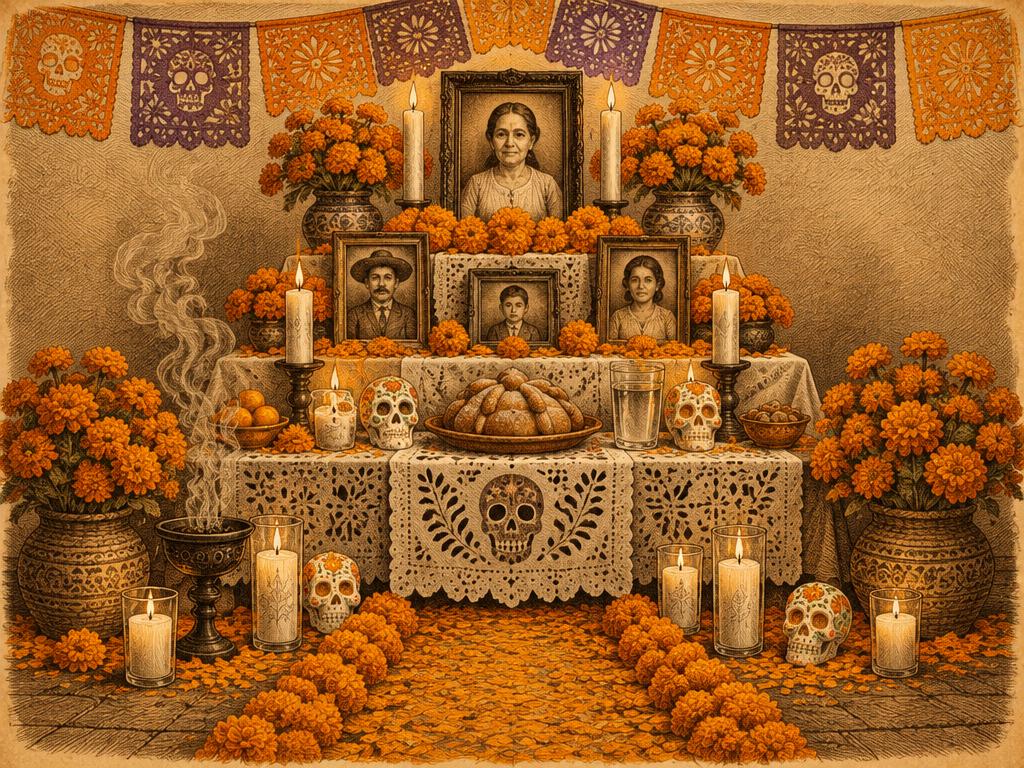
The ofrenda (offering) is an altar of welcome. It gives a returning spirit what it needs for the journey and reminds the living of who that person was.
Levels of the Altar
Some ofrendas have two, three or seven tiers; others are a single table.
Common forms
- Two levels: earth and heaven
- Three levels: often heaven, earth and the underworld, or a Catholic reading
- Seven levels: steps a soul passes on its way to rest
Common interpretations
Meanings differ between regions and families; no tier count is required.
A single shelf with love and care is a complete ofrenda.
Many families place a cross or religious image at the top and food lower down.
An Ofrenda, Labelled
One example altar. Arrangements and meanings vary from family to family.
- 1Papel picado. Cut-paper banners, linked with wind and the delicacy of life.
- 2Photographs. Show whom the altar welcomes, and remind the family whom they honour.
- 3Candles. Light the way home; often one per soul.
- 4Pan de muerto. Bread of the dead, shared with the visitor and later the family.
- 5Water. Refreshes the soul after its journey.
- 6Sugar skulls. Calaveras de azúcar, sometimes with a loved one's name, treated with affection rather than fear.
- 7Cempasúchil marigolds. Their colour and scent are said to guide spirits; petals may form a path.
- 8Copal incense. Its smoke cleanses the space and carries prayers.
- 9Petal path. Leads the visitor from the doorway to the altar.
- 10Favourite foods and fruit. What the person loved to eat or drink.
Not pictured: personal belongings such as a hat, a letter, a toy or a book. These often matter most, because they make the altar about one particular person.
Three Symbols Worth Knowing
Pan de muerto
The round loaf is often read as the circle of life and death. The knob on top is the skull, the crossed ridges are bones, and many bakers scent it with orange-blossom water.
The Xoloitzcuintli
In Mexica belief, this hairless dog, linked with the god Xolotl, helped souls cross a great river on the way to Mictlán. Small clay Xolos still appear on some altars.
Calaveritas literarias
Joking rhymed verses that imagine friends, family or public figures carried off by La Huesuda, the Bony Lady. Newspapers and schools still print them every year.
How to Set Up an Ofrenda at Home
A simple, respectful home ofrenda for remembering your own loved ones. Adapt it to your family and faith.
Building Your Ofrenda
Set it up in late October and keep it through November 2.
You will need
- A table, shelf or stacked boxes covered in cloth
- Photos of the people you are remembering
- Marigolds, fresh or paper
- Candles (battery candles are safest)
- A glass of water and a small dish of salt
- Pan de muerto or a favorite bread
- Their favorite foods, drinks or treats
- Small personal items: a hat, a letter, a toy, a book
Steps
Choose a calm spot away from curtains and where pets and children cannot knock things over.
Cover the table or tiers with a cloth, often white or brightly colored, and hang papel picado above.
Place the photographs at the top or center, one for each person.
Arrange marigolds around the altar and scatter a petal path toward it if you like.
Add water, salt, bread and their favorite foods and drinks.
Add personal objects that tell their story, and write their names on sugar skulls or cards.
Light candles while you are present, or use battery candles, and never leave real flames unattended.
Spend time there: share memories, play their favorite music, cook their recipe.
When the Days Are Over
Families often share the food and keep the memories.
Common customs
- Sharing the offered food with family and neighbors
- Saving photographs and keepsakes for next year
Practical notes
Many families say the spirits have taken the essence of the food, and the living then share it.
Discard perishable food that has been at room temperature for more than 2 hours, or 1 hour above 90°F/32°C. If you want to eat the dishes afterward, keep a separate portion safely refrigerated and leave the altar food as an offering only.
Pack photos and treasured items safely so they can return next year.
Regional Traditions
Three well-known examples. Customs differ within each region too, from town to town and family to family.
Lake Pátzcuaro and Janitzio, Michoacán
Purépecha communities are known for night vigils in island and lakeside cemeteries, with candlelit graves and, in some places, fishermen's canoes on the water.
Oaxaca
Families build large altars with sugarcane arches, mole, chocolate and local breads, and comparsas (costumed street groups) appear in some towns.
San Andrés Mixquic, Mexico City
This old town on the city's edge is known for its cemetery vigil and the ringing of church bells to call the dead home.
A Small Glossary
The holiday is called both Día de los Muertos and Día de Muertos.
- Ofrenda oh-FREN-dah
- Offering; the altar itself.
- Cempasúchil sem-pah-SOO-cheel
- Mexican marigold, from Nahuatl cempōhualxōchitl, often explained as "twenty flower".
- Papel picado pah-PEL pee-KAH-doh
- Perforated or cut tissue-paper banners.
- Pan de muerto pahn deh MWER-toh
- Bread of the dead.
- Calavera kah-lah-VEH-rah
- Skull; also a sugar skull or a satirical verse.
- Copal koh-PAHL
- Tree-resin incense used since pre-Hispanic times.
- Xoloitzcuintli sho-lo-eets-KWEENT-lee
- Hairless Mexican dog, linked in Mexica belief to guiding souls.
Remembrance Checklist
An optional personal aid, not a required ritual. Use what fits your family.
- A cloth-covered table, shelf or stacked boxes in a safe spot
- A photograph of each person you are remembering
- Marigolds, fresh or paper
- Battery candles, or real candles only while you are present
- A glass of water and a small dish of salt
- Bread and a favourite food or drink
- A personal belonging
- Write down a favourite memory of them
- Write down a recipe they made or loved
- Write down a saying, song or joke they always used
Frequently Asked Questions
- When is the Day of the Dead?
- Mainly November 1 and 2. November 1 often honors children and November 2 adults, and some regions begin preparations or observances from late October.
- Is Día de los Muertos the same as Halloween?
- No. They share a season, but Día de los Muertos is a celebration of remembrance for specific loved ones, rooted in Indigenous and Catholic traditions, while Halloween mixes costumes, community play, folklore and the supernatural.
- What is an ofrenda?
- A home or graveside altar of offerings that welcomes the spirits of the dead with photographs, marigolds, candles, water, food and personal belongings.
- Why are marigolds used?
- Their bright color and strong scent are traditionally said to guide spirits home, often along a path of petals.
- Can I make an ofrenda if I am not Mexican?
- Many people do, to honor their own loved ones. Learn the meaning of each element, approach it with respect, and keep it about remembrance rather than decoration.
Sources and Further Learning
Start with these institutions for deeper reading. Wording on this page is our own summary.
- Indigenous festivity dedicated to the dead · UNESCO Intangible Cultural Heritage
- Day of the Dead learning resources · Smithsonian National Museum of the American Indian
- Día de Muertos · Smithsonian's National Museum of the American Latino
- Día de Muertos · Secretaría de Cultura, Gobierno de México
- Instituto Nacional de Antropología e Historia · INAH
- Leftovers and food safety (the 2-hour rule) · USDA Food Safety and Inspection Service