Victorian Winter Tales
The Long Nights
Halloween opens the haunted season; the Victorians closed it at Christmas. Families gathered on the longest nights of the year to tell ghost stories by the fire, and magazines printed special winter numbers filled with them. The Long Nights continues that tradition with three original tales of snow, frost and unwelcome guests.
The short answer
The Long Nights is a Haunts Halloween collection of original winter ghost stories written in the Victorian fireside tradition. Each tale takes about five minutes to read aloud and is set between the first frost and Twelfth Night. They are fiction, not true accounts.
Key points
- Telling ghost stories at Christmas was a well-established Victorian custom.
- Christmas magazine numbers, including Dickens's, popularized the seasonal ghost tale.
- Winter settings isolate the characters: snow closes roads and long dark evenings fill the house.
- These three tales are original fiction written for Haunts Halloween.
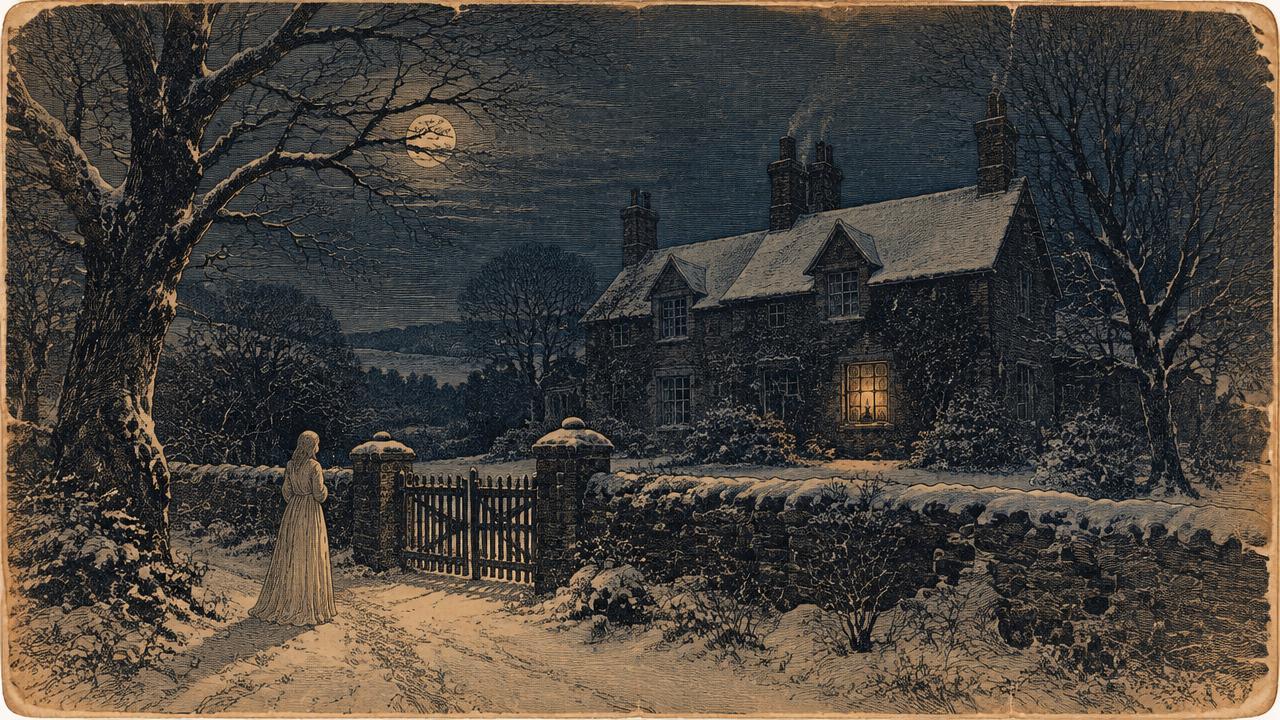
Northumberland, 1868 · 5 min read
The Guest on Twelfth Night
Snow has closed every road, yet someone keeps knocking at the door of Larkhall to be let in.
The snow came on the fourth day of Christmas and did not stop, and by the eve of Twelfth Night Larkhall was as cut off as a ship at sea. We were eleven in the house: my aunt, her guests, and the servants who had not gone home before the drifts closed the lane.
At a quarter to midnight there came a knock at the front door: three slow strokes of the iron ring. My uncle's man went to answer it and found the step bare, the snow beyond it smooth and unbroken to the gate. He shut the door and laughed about the wind. The knock came again before he had reached the hall fire.
My aunt said, without looking up from her cards, that we must not open it a third time. She said it so mildly that the younger guests took it for a parlour game and pressed her to explain. 'He has been asking since my grandmother's day,' she said. 'He only wants to be counted. If we let him in, we shall be twelve, and in the morning one of us will be gone to make it eleven again.'
No one laughed after that. We sat until the clocks struck midnight and the knocking stopped. In the morning the snow lay pristine to the gate, but on the inside of the front door, at about the height of a tall man's hand, the frost had formed three round marks, as if knuckles had pressed it from within.
Birmingham canals, 1881 · 5 min read
The Skater on the Cut
During a hard frost, a lock-keeper's daughter watches a skater who never leaves a mark on the ice.
The winter of 1881 froze the Cut so hard that the boats lay locked in it for a month and the boatmen's children skated where the horses usually walked. My father kept the third lock, and from our kitchen window I could see the whole straight reach to the bridge.
It was there, in the blue hour after the lamps were lit, that I first saw the skater: a young man in an old-fashioned coat, gliding long and easy from the bridge toward our lock gates and turning, always, just before them. He came every night of the frost. The other children never mentioned him, and when I pointed him out they looked and saw only the ice.
On the last evening, before the thaw, I went down to the bank with a lantern. The ice where he skated was clean as a plate, and I understood that his blades had never cut it. He turned toward me at the gates as he always did, and I saw that his coat was dark with water to the shoulders.
My father told me afterwards that a boatman's son had gone through the ice at our lock forty winters before, trying to reach the bank. 'He's only trying to finish the length,' my father said. When the thaw came, we found a single old skate wedged in the lock gate, its strap still buckled.
Somerset, 1894 · 5 min read
The Unlit Window at Bellwether
Every Christmas Eve the villagers set a candle in each window. One house on the green is never lit, and someone inside it is always watching.
In Bellwether it is the custom on Christmas Eve to set a candle in every window facing the green, so that whatever walks the lanes that night may see the houses are kept. I came there as the new schoolmistress and thought it charming. I was told, gently, to leave the schoolhouse's end window dark.
That window looked onto nothing but the churchyard wall, and I lit it anyway, out of a mixture of tidiness and pride. Within the hour there was a figure at the glass: a girl of about ten, in a pinafore and a winter shawl, looking in at the candle with an expression of the most terrible hope.
I am not a brave woman, but I am a teacher, and a child at a window on Christmas Eve is a child at a window. I opened the casement. There was no one there, and no prints in the frost on the sill, but from the dark beyond the wall a small voice said, quite clearly, 'Is it time for lessons yet?'
The parish register, when I looked, recorded a pupil of the old schoolhouse who had died of a fever in the week before Christmas, 1849. She had been the last child to leave that room. I blew out the candle that night, and I have never lit that window since; but every Christmas Eve I leave the schoolhouse door unlocked and a primer open on the front desk, and in the morning the page has always been turned.
Frequently Asked Questions
- Why did Victorians tell ghost stories at Christmas?
- Long winter evenings and family gatherings made Christmas a natural time for fireside storytelling, and magazines published special Christmas numbers full of ghost stories. Dickens's A Christmas Carol (1843) is the best-known example.
- Are The Long Nights stories true?
- No. They are original fiction written for Haunts Halloween in the style of Victorian winter tales.