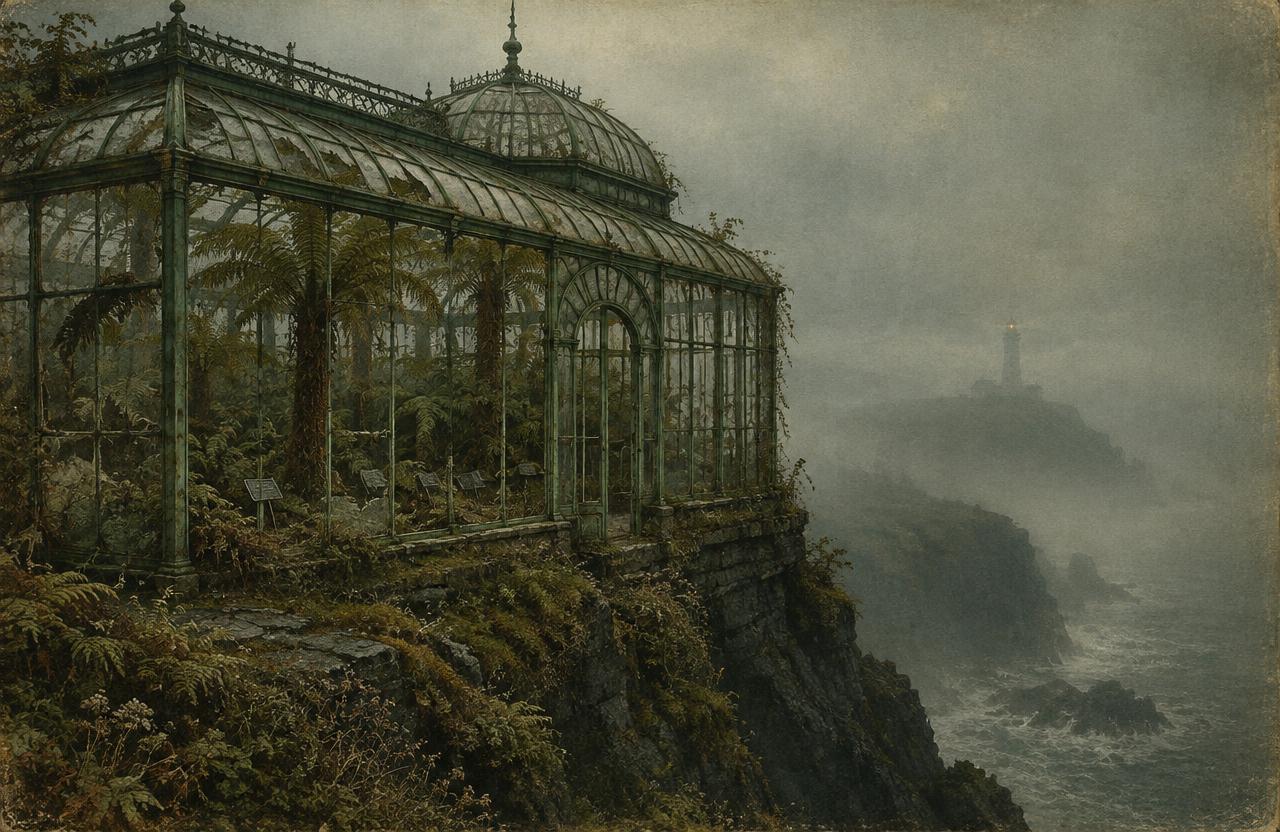
The Glass Garden of Widow’s Reach
6 min read · Original fiction — a story, not a true account
By Haunts Halloween Editors · Reviewed October 27, 2026
The conservatory at Widow’s Reach was built entirely of salvage timber and green bottle glass. It clung to the black slate bluff forty feet above the surf, where the spray salted the panes until they looked like dried grease.
Captain Elihu Vane built it in 1884 for his wife, Margaret, who could not abide the smell of fish or the sound of the foghorn. He brought her tree ferns from New Zealand, night-blooming cereus from Jamaica, and miniature black orchids from the damp limestone gorges of the Spanish Main. Two years later, his schooner, the Seven Sisters, broke her back on the reef below the headland. Margaret did not leave the glasshouse to attend the memorial. She simply locked the brass door from the inside, took the key into the fern pit, and let the boiler fire go out.
I was sent to Widow’s Reach in October of 1911 by the Royal Horticultural Society to inventory the surviving specimens before the estate was cleared for the coastal gun battery.
The house was already a shell—gulls nested in the drawing-room chimney and sheep sheltered in the pantry—but the glasshouse was whole. The salt had etched the glass so thoroughly that the sky above was only a milky blur, but inside the air was warm, sweet, and suffocatingly thick with the smell of rotting peat and crushed mint.
Every plant was dead, or so I thought.
The tree ferns were blackened skeletons whose fronds had collapsed into ropes of brown hair. But beneath them, carpeting the brick floor and climbing the rusted iron arches, was a moss I had never seen in any flora of the British Isles. It was pale silver, like the nap of a worn silk hat, and it grew in precise, geometrical squares that followed the joints of the floor tiles.
At the base of each mound of moss stood an oval plant label stamped from soft lead sheet and wired to an iron skewer.
I knelt by the first marker and scraped the verdigris with my thumb. I expected a binomial: Polypodium vulgare or Asplenium trichomanes.
The stamping read:
THOMAS COOKE Able Seaman, aged 19 Schooner 'Seven Sisters' Drowned 14 October 1886 Buried 3 fathoms off the south horn.
I dropped the label. The wire hummed against the brick.
I moved to the next:
MATTHIAS CRANE Carpenter’s Mate, aged 31 Drowned with Cooke.
There were seventy-four lead labels in the main aisle alone. Every one bore the name of a sailor lost along that three-mile shelf of ironstone between Michaelmas of 1880 and the Great Gale of 1903.
The handwriting stamped into the soft metal was not a man’s work; the steel letter-punches had been struck lightly, hesitantly, with a jeweler’s hammer, the way a woman might set pearls into a mourning brooch.
I worked until the light went yellow behind the salt glass. By four in the afternoon, the sea fog had climbed the bluff and was leaning against the panes with a soft, wet rustle like sheep crowding a pen.
I packed my notebook, closed my tin vasculum, and walked toward the western porch door.
The door was locked.
I shook the handle. The brass plate was cold and stiff with salt crust. Through the glass, the path down the bluff was already gone, swallowed by white vapor that boiled up from the breakers below.
Behind me, in the warm green gloom of the fernery, a small sound broke the silence.
Tink. Tink. Tink.
It was the clear, metallic ring of a light hammer striking lead.
I turned slowly. At the end of the central gallery, where the glasshouse bulged into a domed octagonal bay, a figure sat on an upturned wicker potting hamper.
She wore a gown of dark plum-coloured bombazine, frayed at the hem and stiff with dried greenhouse soil. Her hair was pinned with tortoiseshell combs that had clouded with age. In her lap lay a flat slab of boxwood and a small box of steel punches; in her right hand she held a watchmaker's mallet with a head no larger than an acorn.
Beside her feet, a fresh lead slip lay on the moss.
"The tide has turned," she said. Her voice was thin and dry, like dead laurel leaves scraped across flagstones. She did not raise her head from the bench. "They will be on the shingles by the hour."
"Madam," I began, and found my throat full of moss dust. "The door is caught. If you have the key—"
"There is no key," she said mildly. "Elihu swallowed it when they brought his jacket up with the grapnel. He thought I would go down to the churchyard. But they do not keep them in the churchyard. The churchyard is dry, and their hair is full of sand. They prefer the greenhouse. It is damp here, and the glass keeps the gulls away."
She lifted the mallet and struck a single blow.
Tink.
On the lead slip in her lap, a fresh letter appeared: the clean, sans-serif capital *J*.
"Who is that for?" I whispered, unable to look away from her swollen, soil-stained knuckles.
She paused, the hammer suspended an inch above the metal.
"A boy from the collier brig," she said, looking straight into the white glass wall. "He took the towline around his wrist twenty minutes ago off the south horn. He has not stopped shouting yet. But he will when he reaches the warmth."
Through the floorboards beneath my boots came a long, shuddering thump—the impact of a green roller bursting against the sea cave under the glasshouse foundations. And with that thump came a breath of air that smelled of kelp, iodine, and cold iron.
Along the main aisle, the silver moss began to stir.
It did not sway as if blown by wind; it lifted its edges, square by square, like carpets being rolled back by invisible housemaids. From beneath each brick, a faint, milky bead of vapour rose into the warm air, coalesced into a strand of white fog, and drifted toward the glass dome, until seventy separate columns of white mist stood motionless between the iron pillars.
None of them had faces. None of them made a sound. But they turned toward the potting bench as one body, the way sunflowers follow an autumn lantern.
The woman set down her hammer.
"The names are almost finished," she told the glass. "There are only three empty slips left in the drawer. When they are stamped, the roof will come down, and we may all go back into the channel together."
She picked up the letter-punch *A*.
I did not wait for the strike. I took my brass vasculum by its leather strap, swung it against the lowest pane of the porch door, and crawled through the jagged hole into the wind and the gorse. The salt air cut my hands to ribbons, but I did not stop running until I reached the coastguard station at the beacon.
The coastguards did not laugh. When I told the station officer about the lead labels, he only took down the slate log and checked the evening report:
5:15 p.m. Sloop 'Martha Day' ashore at South Horn. Three hands lost. One boy: James Avery, aged 16.
The glasshouse still stands on Widow’s Reach, though two bays of the roof fell into the surf during the storms of 1928. If you climb the bluff when the sea fog is heavy, you can still hear the watchmaker's mallet ringing behind the salt glass:
Tink. Tink. Tink.
Counting the ones who have finally come in out of the cold.
"Counting the ones who have finally come in out of the cold."